An ozone generator concentrates a paradox: it manufactures a gas valuable enough to build plant around and hazardous enough that none of it may leave. Monitoring is what keeps those two facts compatible. This article walks the four measurement duties around an ozone installation — output, contact, destruct and room — and the dissolved measurement that proves the dose in the water itself.
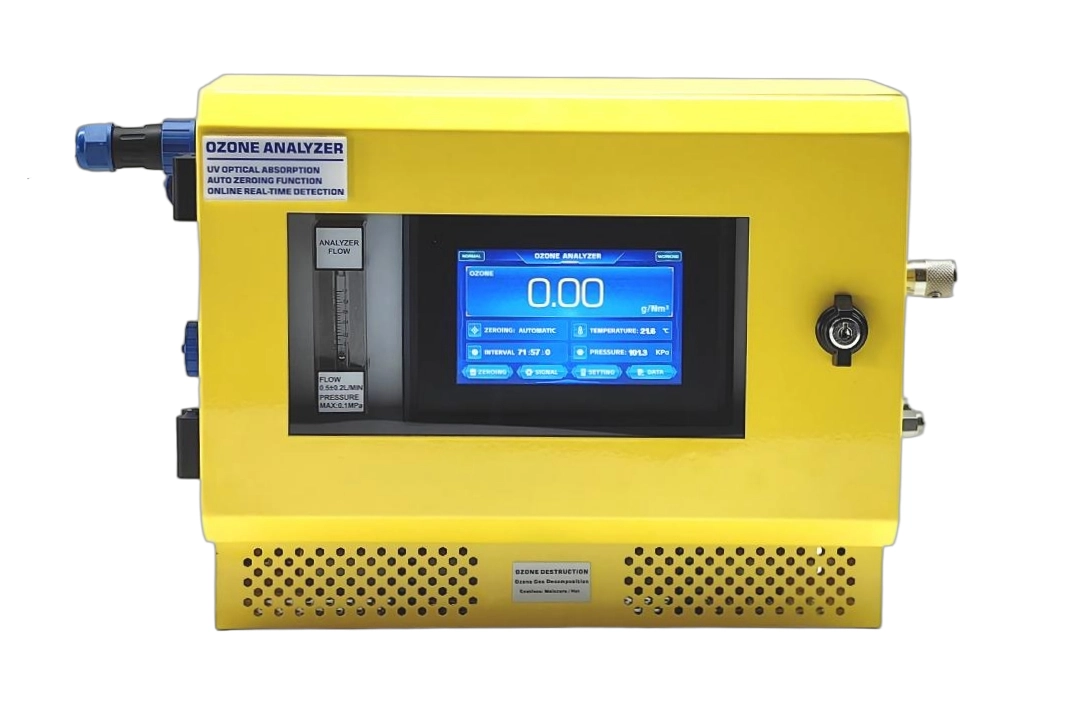
Output: proving production
At the generator outlet the gas is at working strength — grams per normal cubic metre, not ppm — and the measurement must be just as strong. Ultraviolet absorption is the reference method: ozone's UV fingerprint is intense and specific, and a dual-path photometer like the MIC500OZ holds its calibration by continuously comparing the sample path against a reference. Its published spans — up to 300 g/Nm3 at the top, with a 0–1000 ppm range at the bottom — bracket the generator's whole operating envelope.
Output concentration feeds dose control: it is the number that turns generator power into applied ozone, and its trend is the earliest indicator of generator fouling or feed-gas problems.
Exhaust and room: proving containment
After the contactor, unreacted ozone must be destroyed — thermally or catalytically — and the destruct unit's outlet is monitored to prove it. This is a ppm-span duty on the same UV physics, and it belongs on a relay: the MIC500OZ's optional relay sets exist to interlock generation against a failed destruct or a rising residual.
The room is the third containment layer: generator halls and pipe runs get low-level monitoring, by fixed points or by portable survey on the 0–1 ppm span of the portable platform. Ozone's sharp smell is not a monitor; like other treacherous gases it fatigues the nose that trusts it.
Dissolved: proving the dose
Gas-phase success is not process success: what disinfects is the ozone dissolved in the water, and dissolved measurement — the family's OZ-150W online dissolved analyzer is the listed instrument — closes the loop between what the generator made and what the water received. Residual dissolved ozone after the contact tank then verifies the safety side: enough was applied, and it is gone before discharge.
Operators who instrument all four duties can run an ozone plant on evidence; those who instrument only the generator are running the other three on hope. The ozone generator monitoring guide on this site assembles the same loop as a specification.
The generator's three atmospheres
Ozone work divides a plant into three atmospheres that must never be confused. Inside the generator and its pipework, ozone is the product, present at weight concentrations — grams per cubic metre — measured to control production and protect the equipment. In the room air, ozone is a contaminant with an eight-hour exposure limit of 0.1 ppm, measured to protect people. At the destruct unit's outlet, ozone is a residue, measured to prove the off-gas has been returned to ordinary air before discharge. Each atmosphere has its instrument class, its range and its alarm meaning, and the classic ozone incident begins with one atmosphere's number being read in another's terms — a product-strength reading mistaken for a room condition, or a room monitor asked to judge a process stream.
Ultraviolet measurement, and why it rules the product stream
Ultraviolet absorption at 254 nanometres measures ozone specifically and absolutely, referencing the sample against the same gas scrubbed of ozone, so drift cancels continuously. At generator concentrations, electrochemical cells saturate and semiconductor sensors wander; the UV bench reads on, which is why production control, efficiency accounting (kilograms of ozone per kilowatt-hour, computed from concentration and flow) and generator protection all hang off UV instruments. Their care is simple and non-negotiable: clean optics, a healthy scrubber, dry sample gas. A UV analyser fed condensate will lie beautifully and expensively.
Room monitoring: the people's instrument
Room monitors live at breathing height, near the places leaks actually start — generator doors, pipe flanges, the destruct unit, the contactor vents — and they answer to the exposure limit, not to the process. Their alarms are evacuation instructions, staged: a first level that sends staff to investigate from the doorway with a portable, a second that clears the room and starts emergency extraction. Semiconductor and electrochemical sensors serve this duty well at ppm and sub-ppm levels; their cross-sensitivities (chlorine, nitrogen oxides) should be understood and their calibration kept on schedule, because a room monitor that cries wolf teaches a workforce to ignore the one reading that matters.
The destruct outlet and the discharge argument
Catalytic and thermal destruct units earn their keep invisibly until they begin to fail — catalyst ageing, heater faults, flow excursions — and the only witness is the outlet monitor. A rising residual trend is the maintenance department's early warning, arriving weeks before a discharge exceedance. Outlet monitors therefore belong on the trend screen, not just the alarm list: their slow drift upward is information, while their alarm is an event. Sites discharging to sensitive surroundings should treat the outlet record as a compliance document, retained and reviewable like any other emission record.
Interlocks and the choreography of a trip
When room ozone crosses its high threshold or the generator's own protections fire, the sequence should be choreographed in advance: generator power cut, oxygen feed isolated, extraction running, room locked out until a measured clearance — not a timed guess — says the air is back under the limit. Instruments provide the measurements at each step of that choreography, including the clearance reading that ends it. Write the sequence down, drill it twice a year, and let the drill include the instruments' behaviour, because the first time a workforce watches the room monitor fall back through the threshold should not be with real ozone in the room.
Calibration across three orders of magnitude
One plant, three ranges, three calibration habits: UV production instruments verified against their internal references and periodic cross-checks; room monitors spanned with ppm-level ozone or a sanctioned surrogate on the sensor maker's schedule; outlet monitors zeroed and checked at the low end where their decisions live. Ozone's reactivity makes cylinder standards impractical — it is generated at the point of calibration — which is exactly why the routines must be written and owned rather than improvised. The plants that monitor ozone well share a visible trait: the calibration log is boring, regular and complete.
Ozone in water treatment: the contactor's atmosphere
Water plants meet ozone at the contactor — where the gas is dissolved into the stream — and the contactor hall concentrates the plant's ozone geography: generator feeds arriving, off-gas leaving for destruction, seals and sight glasses ageing in an oxidising neighbourhood. Room monitoring in the hall follows the refrigeration playbook: sentinels at breathing height near the credible leak points, staged alarms, extraction that answers them. The dissolved side has its own measurement — residual ozone in the treated water, the number the disinfection credit is computed from — and the two measurements, air and water, belong in one operating picture, because a falling water residual with a rising room reading is a leak telling its story in stereo.
Semiconductor and food: ozone's other workplaces
Beyond water, ozone works quietly in semiconductor wet processes, in food-plant sanitation where it disinfects rooms and rinse water, in pharmaceutical water loops, in odour control. Each setting repeats the three-atmosphere pattern at its own scale: a generation point where concentrations are process numbers, a workplace where they are exposure numbers, an exhaust where they are discharge numbers. The settings share one more trait — the workforce often did not grow up with ozone, so the monitoring carries an educational duty: alarms whose meanings are posted, drills that include the gas's behaviour, and readings displayed where staff actually pass. An unfamiliar hazard with a familiar monitoring grammar is manageable; an unfamiliar hazard with improvised monitoring is how small industries generate their first serious incident.
Maintenance in an oxidising neighbourhood
Ozone service ages everything it touches, including its own instruments: seals perish, sample lines embrittle, sensor baselines wander in the oxidising air. Maintenance intervals in ozone plants are therefore set by the environment's aggression, not by the calendar's symmetry — inspections of wetted materials on a short cycle, scrubber and catalyst checks in the UV instruments, cell replacements in the room sentinels before their drift becomes the story. Spares philosophy follows: ozone plants stock the oxidisable parts the way ships stock rope. The plants that internalise this run boring monitoring for decades; the gas rewards the respect and punishes its absence with unusual consistency.
The drill: rehearsing the room alarm
An ozone room alarm asks people to do an unnatural thing calmly: leave a room that looks identical to safety, by a route that does not pass the generator, and stay out until a measurement — not a manager — clears it. That behaviour is built by drills, and drills should exercise the instruments as well as the people: simulate the reading, watch the staging (first alarm's investigation-from-the-doorway rule, second alarm's full clearance), time the muster, and debrief against the logged trace. The drill's discoveries are reliably mundane — a beacon hidden by new racking, an alarm tone confused with the forklift's, a door that swells in summer — and reliably valuable, because the real event will not schedule itself after the fixes. Ozone is patient; drills are how plants borrow its patience.
Ozone's materials audit: walking the plant with a list
An ozone plant benefits from a peculiar audit: walk it listing every elastomer, hose, gasket and seal in ozone's reach, and grade each as ozone-rated, suspect or wrong. The audit reliably finds the plant's next three small leaks — the ordinary rubber hose fitted during a hurried repair, the seal kit substituted at a shutdown — before the room monitor finds them at concentration. Instruments then verify what the audit fixed. The exercise costs an afternoon and a clipboard, and it belongs in the commissioning of every new installation and the annual rhythm of every old one, because ozone's attack on the wrong materials is not a risk but a schedule.
Data: the four traces on one screen
The mature ozone plant watches its four traces together — feed dew point, product concentration, room concentration, destruct residual — on one screen with one clock, because their correlations are the diagnosis: product falling as dew point rises is a dryer; residual rising as product holds is a destruct catalyst; room rising as both hold is a leak's signature. Operators taught to read the quartet catch in hours what single-trace watching catches in weeks. Specifying the data integration that puts the quartet on one screen is therefore not an IT nicety but the monitoring system's central design decision, and it belongs in the purchase documents beside ranges and accuracies.
Retirement and replacement: knowing when a monitor becomes a liar
Ozone instruments announce their retirements characteristically: UV benches by scrubber exhaustion showing as zero wander, room cells by baselines that climb and will not calibrate down, semiconductor sentinels by a general loss of nerve — alarming at shadows, missing drills' test gas. The programme that tracks calibration adjustments per instrument reads these announcements as schedules; the programme that does not meets them as incidents, usually during the event the instrument existed for. Replacement budgeting in ozone service is thus a monitoring output, and the plants that treat it so are never surprised by their own instruments — the final form of the respect this gas demands from everyone who works with it.
Ozone by the numbers: three worked readings
Three readings, interpreted. The product analyser falls from 95 to 80 grams per cubic metre over a month while feed flow holds: the trend is the generator or its feed ageing — check dew point first, dielectrics second, and the energy bill will confirm the story in kilowatt-hours per kilogram. The room sentinel peaks at 0.14 ppm every afternoon and clears by evening: a pattern with a schedule is a process, not a leak — look for the operation that vents, the door that props, the destruct fan that rests at lunch. The destruct residual doubles over a quarter while the product holds: the catalyst is spending itself, and the maintenance window should be booked before the discharge limit books it for you. In each case the number alone was inert; the trend, the pattern and the comparison made it speak — the entire craft of ozone monitoring in three small stories.
Specifying the trio as one purchase
Buyers equipping a generator hall should write the three instruments as one schedule with shared terms: one data spine and clock, one calibration philosophy per principle with named owners, alarm stages that reference each other (the room's second stage assumes the product instruments are believed, and says so), and commissioning that rehearses the trio together — a simulated leak watched on all three traces at once. Vendors quoted against the schedule will price the integration the plant actually needs, and the commissioning rehearsal will find the crossed wire and the mislabelled range while they are still anecdotes. Ozone rewards the plants that buy systems and punishes, politely but persistently, the ones that buy boxes.
Ozone's paperwork: the log that ties the trio
The generator hall's three instruments produce one story, and the story deserves one log: product trends with their efficiency arithmetic, room events with their dispositions, destruct residuals with their maintenance sequels, calibrations across all three in a single calendar view. Kept so, the log answers the questions ozone plants are actually asked — by insurers after a scare, by regulators after a complaint, by their own engineers after a yield sag — in the order they are asked, from evidence rather than from memory. The log's format matters less than its unity; a paper book honestly kept outperforms three software silos, and either outperforms the commonest arrangement of all, which is three instruments and no story.
The quiet hall as the goal
End where the work aims: a generator hall that is boring to walk through. The product trace steady in its band, the room sentinel silent for the right reasons and proven weekly not to be merely asleep, the destruct residual a flat line with a maintenance date approaching on schedule. Boredom of that quality is not the absence of the hazard — the tonnes of oxidant are still being made behind the panels — but the presence of a system that has the hazard's measure. Every article in this series has pursued the same destination under different gases: measurement honest enough, maintained well enough, and read closely enough that the extraordinary day finds a programme already awake.
The hall's first month, narrated
A new generator hall's first month of monitoring has a plot worth scripting in advance. Week one belongs to baselines: the product trace's normal face at each load, the room's silence defined, the destruct residual's flat signature recorded. Week two belongs to the drills — the staged alarm walked through with the crew that will meet it at night. Week three belongs to the first honest anomaly, whatever it is, investigated to its cause and entered in the log as the archive's founding story. Week four belongs to the review that converts the month into the operating rhythm: calibration calendar confirmed, trend screens arranged as the quartet, the log's format settled. Script the month and the hall starts its life awake; leave it to chance and the hall's habits form around whatever happened first, which is rarely the best teacher.
The trio's joint commissioning, scripted
Script the joint commissioning as a single ceremony with three acts. Act one: the product instrument proves itself against its scrubber's zero and a span challenge, and the efficiency arithmetic is demonstrated live from concentration, flow and meter. Act two: a controlled ozone release at the room sentinel's face walks the staged alarms from first light to full evacuation order, with the muster timed and the clearance reading — not the clock — ending the exercise. Act three: the destruct outlet is challenged and its trend watched arriving on the same screen as the other two traces, one clock over all. A hall whose trio has performed together once, in rehearsal, will perform together on the day; a hall whose instruments were commissioned in separate weeks by separate contractors owns three soloists and no orchestra.
Ozone's ledger: what the hall owes the future
Close the hall's account with what it owes forward. To the next operators: an archive whose traces explain the plant they inherit, baselines drawn while the equipment was young, the log's narrative of every excursion and its cause. To the neighbours: a destruct record that can be produced without embarrassment on the day anyone asks. To the energy ledger: an efficiency trend that either vindicates the plant's operation or indicted it early enough to matter. Three debts, all payable only in the currency of monitoring done daily and kept honestly — which is to say, payable in advance, in instalments, by exactly the routines this article has described. Ozone charges interest on every other kind of debt; on this one, it pays it.
A last calibration of the reader
The reader who has followed the trio this far owns the article's whole argument: that three instruments measuring one gas at three scales are not a shopping list but a single act of attention, divided by physics into product, people and discharge, and reunited by the discipline of reading them together. Keep the trio's traces on one screen, their calibrations on one calendar, their stories in one log. The gas will do the rest of the teaching, at its own pace, in its own sharp dialect — and a monitored hall is simply a hall that has agreed to listen.
The trio, remembered as people
Operators give instruments personalities, and the trio earns good ones when it is kept honest: the product analyser as the hall's accountant, exact and unbribable; the room sentinel as its nightwatchman, unglamorous and awake; the outlet monitor as its character witness, testifying to the neighbours about what left the fence. Anthropomorphism is usually a training vice, but here it is a mnemonic with a payload — crews maintain characters they respect and ignore boxes they do not. Name the trio well, introduce it to every new operator by its roles, and let the log's narrative voice match: the hall that speaks of its instruments as colleagues keeps them calibrated like colleagues.
Colophon: attention, instrumented
Ozone is attention made visible as a molecule — too useful to refuse, too fierce to ignore — and its monitoring is attention made durable as a system. The hall that sustains the trio's discipline has, in effect, decided to pay attention permanently, at three scales, with instruments for hands. That decision, repeated across every gas and every industry in this series, is the whole of the art; the hardware is merely where the decision happens to be stored. Keep the trio reading, and the hall will keep its side of the bargain: product made, people safe, and the air beyond the fence returned to being merely air.