At workplace level, ozone escapes from generator rooms, water treatment halls, corona and UV equipment and welding areas. It attacks airways at low ppm, and its smell — sharp, electric — fatigues like hydrogen sulfide's does. Instruments, not noses, hold the line.
Portable and ambient spans
The MS400 platform table reads ozone at 0–1 ppm with 0.001 ppm resolution — the residual and room-air span, suited to leak checks around generator pipework and surveys of treatment halls. The MS800A-10 ambient station includes ozone among its gases for environmental monitoring, where ground-level ozone is a pollutant in its own right.
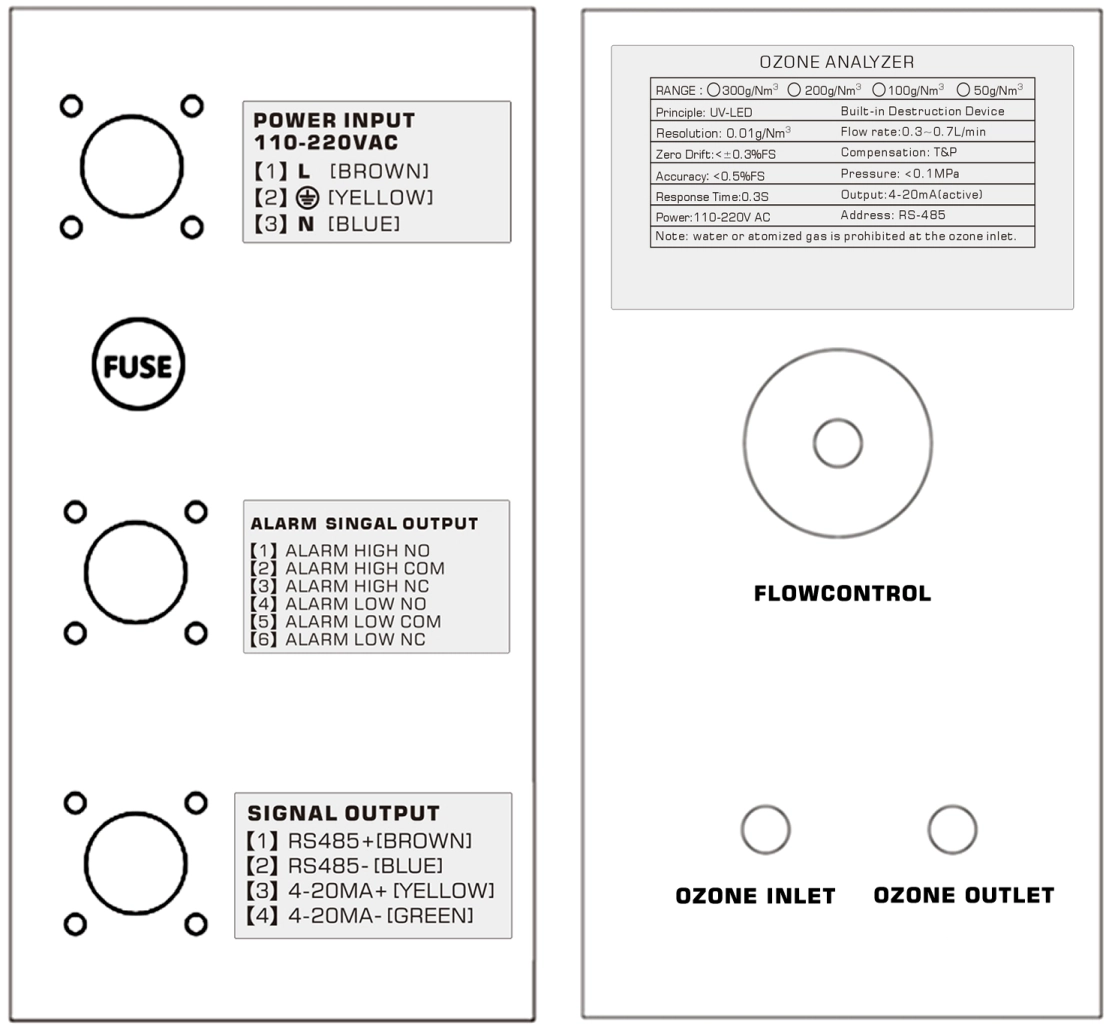
UV absorption is the measurement principle at both ends of the concentration world: the same physics that quantifies generator output in the MIC500OZ serves sensitive low-level photometers, because ozone's ultraviolet fingerprint is strong and specific.
The two-sided programme
A complete ozone programme measures production and protection together: output concentration for process control, exhaust residual to prove destruction, room air to protect staff. The generator monitoring guide lays out the control loop; this guide's portable span is the verification layer that walks the plant and proves the fixed layers honest.
Ozone's two concentration worlds
No gas in this catalogue spans a wider working range: generator output at grams per cubic metre, workplace limits at a tenth of a part per million — a factor of a hundred thousand between the product and the permissible breath. Every ozone specification must therefore begin by naming its world. Product instruments are ultraviolet benches built for weight concentrations and process conditions; workplace instruments are ppm and sub-ppm sentinels built for stability at the bottom of the scale, where drift of a few hundredths of a ppm is the difference between a quiet room and a false evacuation. A single instrument family may cover both, but each installation is specified, ranged and alarmed for one.
Workplace ozone: sources beyond the generator hall
Ozone escapes its industrial home in photocopiers' ancestors, water treatment, food processing sanitation, semiconductor wet benches and any place corona discharge or ultraviolet lamps work in air. Workplaces discover ozone incidentally — a smell described as electric, irritation complaints near equipment — and the detection answer is the standard one: a fixed sentinel at breathing height near the source, alarmed in stages against the exposure limit, with a portable for the investigation. The gas's own reactivity helps: it decays on surfaces and in air, so a cleared room re-enters quickly once the source stops — verified by measurement, not by the clock.
Materials and the ozone environment
Ozone attacks elastomers, cracking ordinary rubber and degrading seals, which shapes both plant design and instrument care: ozone-service instruments and sampling lines use resistant materials — PTFE, stainless steel, ozone-rated polymers — and nearby equipment is specified the same way. A sampling line of the wrong polymer is not merely short-lived; it consumes the analyte on its way to the sensor and reports the room's air as cleaner than the product stream it was meant to measure. Material compatibility belongs on the ozone specification checklist beside range and accuracy.
Ozone specification checklist
Ozone's checklist begins with the declaration of world — product, workplace or discharge — and its concentration band, from grams per cubic metre down through ppm to the sub-ppm floor of room monitoring. The principle follows the declaration: ultraviolet absorption for product and reference work, electrochemical and semiconductor sensing for workplace sentinels, each with its maintenance signature (scrubbers and optics above; cells and cross-sensitivities below). Materials compatibility runs through every line — sample path, seals, nearby equipment — because ozone edits its environment chemically. Alarm philosophy splits by world as well: product excursions are process events routed to operators, workplace excursions are evacuations routed to everyone, discharge excursions are compliance events routed to the record. An inquiry that keeps the three routings distinct will be quoted three honest instruments; one that blurs them invites a single instrument performing three impersonations, which this catalogue exists to prevent.
Ozone terms
Corona discharge — the electrical method of ozone generation, whose hiss is the gas's birthplace sound. Ultraviolet generation — the lamp-based production used at small scales and in some analysers' references. Scrubber reference — the ozone-free stream against which UV analysers ratio their sample, cancelling drift. Destruct catalyst — the manganese and precious-metal surfaces that return ozone to oxygen, ageing in service and trended by outlet monitors. Residual ozone — the disinfection credit's quantity in water, measured in the liquid, distinct from every air number on the site. Ct value — concentration multiplied by contact time, the disinfection dose that residual monitoring serves.
Off-gas — the contactor's undissolved exhaust, routed to destruction with its ozone content as the routing's reason. Elastomer attack — ozone's cracking of ordinary rubbers, which specifies the plant's seals and the instruments' wetted parts. Exposure limit — the tenth-of-a-ppm order of the workplace line, against which room sentinels are staged. Generator efficiency — kilograms per kilowatt-hour, computed from the product analyser, the flow and the meter. Feed dew point — the dryness of the oxygen or air supply, governing both yield and the generator's internal corrosion. Smell threshold — ozone's sharp odour, noticeable below the limit yet never a measurement, as all odours are not.
Ozone's incident grammar
Ozone incidents speak a consistent grammar: a seal or a scrubber ages past its duty, a concentration that belongs inside equipment takes a room as its new address, and the people present learn of it from symptoms or from an instrument — the order of those two being the whole history of the site's monitoring in one detail. The grammar's lesson is that ozone safety is mostly maintenance foresight: the materials audit, the scrubber's calendar, the outlet trend read as a slope. Detection's role is to make the foresight verifiable — to give the maintenance programme eyes at the three addresses where the gas legitimately lives and the one where it must never arrive unannounced.
Ozone's measurement frontier: the personal badge
Workplace ozone practice is acquiring the personal layer this catalogue knows from other gases: wearable sentinels that log a worker's actual exposure across a shift of generator rooms, contactor halls and destruct maintenance. The personal data disciplines the area scheme — showing which tasks, not which rooms, carry the dose — and it usually argues for engineering at the task (a local extraction here, a resequenced job there) rather than for more sentinels on walls. Instruments shrink; the doctrine does not change: measure where the decision lives, and for exposure decisions the decision lives on the person.
One gas, three professions
Ozone's worlds are staffed by three professions that rarely meet: the process engineer who makes it, the hygienist who limits it, the environmental officer who discharges it. The instruments translate between them — the product analyser's grams becoming the hygienist's fractions of a ppm only through the room, the destruct residual closing the officer's file — and a site that puts the three professions in one room once a year, with the year's traces on the table, discovers that most of its ozone questions were translation problems. The meeting is cheap; the mistranslations it prevents have historically been priced in evacuations and exceedances.
| Instrument | O3 measurement | Role |
|---|---|---|
| MS400 platform | 0–1 ppm, 0.001 ppm resolution | Residual and room-air checks |
| MIC500OZ | g/Nm3 spans plus 0–1000 ppm | Generator output and exhaust |
| MS800A-10 | O3 in ambient panel | Environmental monitoring |
Send a target gas list, get a configuration
Quotations are built from the published parameters on this site. Tell us the gases, the ranges and the quantity — or the point schedule for a fixed project — and the reply comes back within 24 hours.
Request a quotation