Its working territory is the ozone generator itself — measuring output at the generator outlet and residual ozone in exhaust gas — where concentrations are high, the gas is aggressive and the instrument must run continuously.
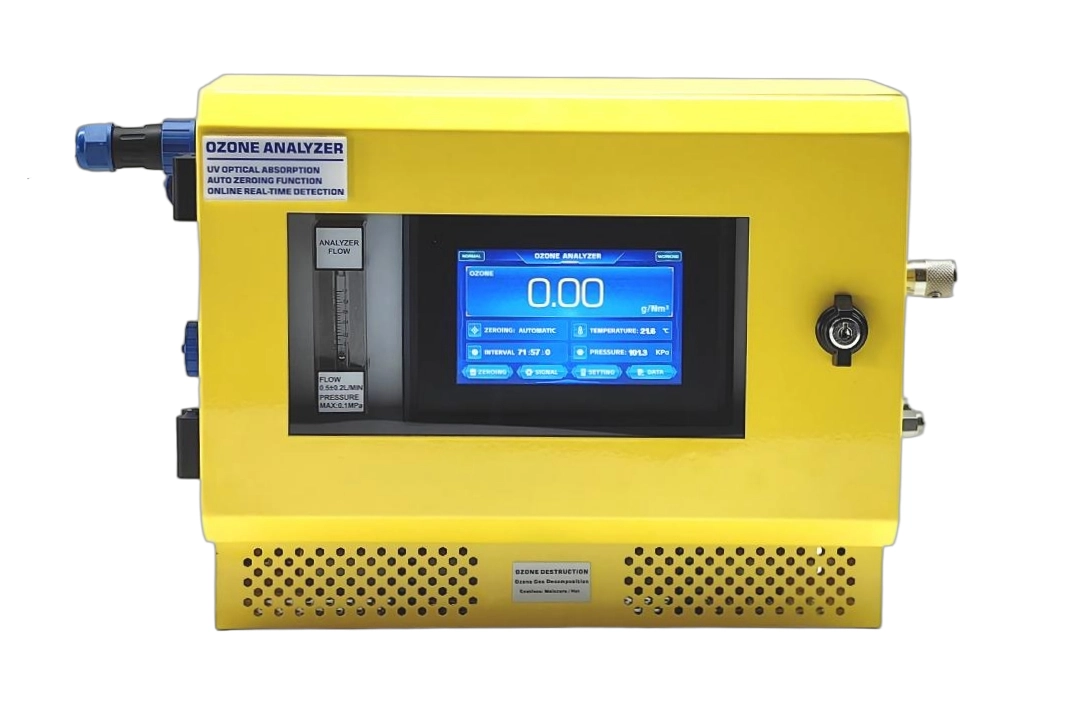
Ranges and installation
Published ranges cover generator-duty concentrations: 0–300, 0–200, 0–100 and 0–50 g/Nm3, plus a 0–1000 ppm span for lower-level monitoring. The housing is rated IP65 for outdoor installation, with waterproof aviation connectors that keep cabling sealed in washdown and weather.
The UV source is an imported UV LED — LED sources switch instantly, run cool and avoid the warm-up and disposal issues of mercury lamps.
Zero management
Ozone instruments drift mainly at zero, so the MIC500OZ builds zero management in: automatic zero adjustment plus a built-in timed zero-calibration device (a company invention-patent design) that re-zeros on schedule without an operator visit. One or two relay output sets are available for alarm and interlock duty — for example shutting a generator down on high exhaust residual.
For dissolved ozone in water, the shop-listed OZ-150W online analyzer covers the liquid side; it is listed on the ozone category page rather than given a detail page here.
Ultraviolet absorption and the zero reference
The MIC500OZ measures ozone the way metrology prefers: by its ultraviolet absorption at 254 nm, against a scrubbed reference stream. The alternating measurement — sample, scrub, sample — cancels lamp drift and cell fouling continuously, which is why UV instruments hold calibration in continuous duty where electrochemical cells wander. The practical disciplines are few but firm: keep the scrubber healthy, keep the sample free of condensate, and let the automatic zero do the job it was designed for instead of forcing manual zeros on a schedule.
Range selection is the specification art for ozone. Generator output points work at weight concentrations — grams per normal cubic metre — while destruct-outlet and room points sit orders of magnitude lower. A single model family spanning to 300 g/Nm3 with selectable ranges lets one maintenance regime cover the plant, but each point's range must be chosen for its own duty: resolution wasted at the top of an oversized span is accuracy lost where the decision lives.
Ozone plant monitoring as a system
A generator hall wants three conversations at once: production (how much ozone the generator is making), containment (whether any of it is escaping into the room), and destruction (whether the off-gas leaving the destruct unit is clean). Output analysers, room monitors and outlet points answer respectively, and their alarms mean different things — a production excursion is a process event, a room excursion is an evacuation. Specifying them as one package, with alarm meanings written down, is what turns instruments into a monitoring system.
Output per kilowatt: putting the MIC500OZ in the efficiency loop
Generator economics are concentration times flow divided by power, and the concentration term belongs to instruments like this one. Read continuously and recorded against flow and electrical metering, the MIC500OZ's number becomes the plant's efficiency trend — the trace that shows a generator's dielectrics ageing, a dryer tiring, feed oxygen purity drifting, weeks before the output shortfall forces the conversation. Efficiency loops justify analyser-grade measurement at the product point in a way that alarm-only thinking never does: the analyser is not guarding against an event, it is pricing every hour of production.
That role sets the specification's centre of gravity: range chosen around the operating concentration with resolution where the control decisions live, outputs integrated into the plant's control and historian systems, and a maintenance regime — scrubber, optics, sample dryness — owned by name. An efficiency instrument that is down is a plant flying without its fuel gauge; redundancy arguments that sound excessive for an alarm become ordinary for a gauge.
Ozone and materials, once more with feeling
The sampling path of an ozone analyser is itself in ozone service: wetted materials must be the resistant set — PTFE, stainless steel, ozone-rated elastomers — because a reactive line consumes the analyte and reports the generator as weaker than it is, a lie with an energy bill attached. Every fitting is a small decision in the same direction, and the commissioning checklist should walk the path from sample tap to exhaust asking one question: would ozone survive this journey unchanged? The destruct-side sample path asks the mirror question at the other end of the plant, where the expected answer is near zero and any material that manufactures a false zero is a compliance risk wearing a ferrule.
Glossary for ozone analysis
Ultraviolet absorption — ozone's measurement by its 254 nm attenuation, referenced against the same gas scrubbed clean. Scrubber — the catalyst stage that destroys ozone in the reference stream, whose health is the zero's health. Weight concentration — grams per normal cubic metre, the product world's unit, tied to defined temperature and pressure. Normal conditions — the reference state that makes weight concentrations comparable between plants and days. Destruct unit — the catalytic or thermal stage that returns off-gas ozone to oxygen before discharge. Residual — the ozone remaining after a process or a destruct stage, the discharge world's quantity of interest.
Feed gas — the oxygen or dried air from which ozone is generated, whose dew point governs yield and generator life. Dielectric — the barrier in the discharge gap across which ozone is born, whose ageing is the generator's slow story. Specific energy — the kilowatt-hours per kilogram of ozone, the plant's efficiency conscience. Contacting — the dissolution of ozone into water or process fluid, where the gas-phase measurement hands over to the liquid-phase one. Off-gas — the undissolved remainder leaving a contactor, routed to destruction and monitored on its way. Half-life — ozone's decay time in a given environment, the reason cleared rooms recover and stored ozone does not exist.
Specifying the product point: a worked pattern
A worked pattern may help specifiers. The duty: continuous concentration at a generator's outlet, the stream dry oxygen carrying ozone in the tens of grams per normal cubic metre, the consumer a control system that trims generator power and an archive that prices efficiency. The instrument: ultraviolet absorption, ranged around the operating band with resolution where the trim decisions live, automatic zero against its scrubber reference, outputs in the plant's protocol, sample path wholly in resistant materials, maintenance owned by a named technician with scrubber and optics on a calendar. The failures this pattern prevents: the electrochemical cell saturated into silence, the unrecorded drift that repriced a quarter's energy, the rubber ferrule quietly eating the analyte. Every line of the pattern is a scar from somebody's plant, which is what patterns are.
Two plants, one analyser philosophy
A municipal water works and a pharmaceutical plant buy the same ultraviolet principle for the same molecule and run it in opposite social worlds — one staffed around the clock by operators who know ozone the way they know chlorine, the other by a facilities team for whom the generator is one utility among thirty. The instrument serves both when its alarms, records and maintenance demands are set for the world it actually lands in: the water works integrates it into process control and trends it daily; the pharmaceutical plant leans on its automatic zero, its staged room protection and a service contract that brings the ozone competence to site. Specification is the translation between the catalogue and the social world, and this model's page, like every page here, is an argument for performing that translation in writing before the order.
- Principle
- Dual-path UV absorption
- Source
- Imported UV LED
- Ranges (high)
- 0–300 / 0–200 / 0–100 / 0–50 g/Nm3
- Range (low)
- 0–1000 ppm
- Points
- Generator outlet and exhaust gas
- Housing
- IP65, outdoor installation
- Connectors
- Waterproof aviation connectors
- Duty
- 24 h continuous
- Zero
- Automatic zero adjustment; built-in timed zero-calibration device
- Relays
- 1 or 2 sets, optional
Measurement
Build
Zero and outputs
- Reference-method UV absorption with dual-path stability
- Generator-duty ranges up to 300 g/Nm3
- IP65 outdoor housing with sealed aviation connectors
- Automatic and timed zero calibration built in
- Relay outputs for alarm and generator interlock
Send a target gas list, get a configuration
Quotations are built from the published parameters on this site. Tell us the gases, the ranges and the quantity — or the point schedule for a fixed project — and the reply comes back within 24 hours.
Request a quotation