Ozone's measurement method is settled physics: ultraviolet absorption, specific to ozone and fast. The engineering questions are placement, ranges and what each reading drives.
The three measurement points
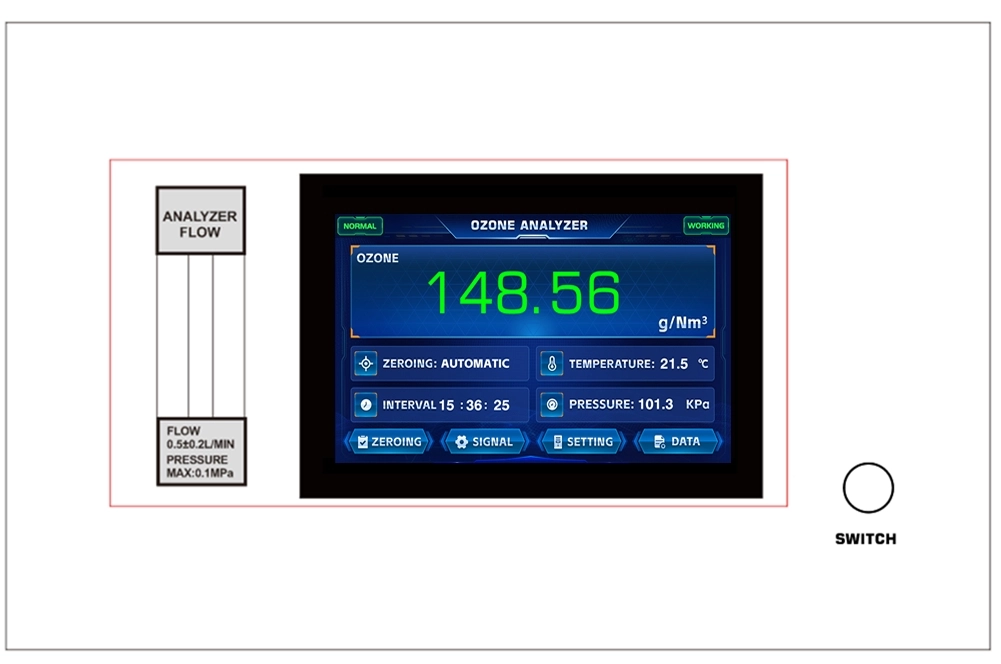
Output: high-concentration measurement at the generator outlet (the MIC500OZ's g/Nm3 spans) proves production and feeds dose control. Exhaust: residual measurement after the destruct unit proves the ozone is gone before air leaves the plant; the same analyzer family covers it on its ppm span. Room air: low-level monitoring protects staff, served by the portable ozone spans in the ozone detection guide.
Zero integrity is the quiet requirement across all three: ozone instruments live or die by their zero, which is why the MIC500OZ builds in automatic zero adjustment and a timed zero-calibration device.
Relays and interlocks
Monitoring that cannot act is decoration: the analyzer's relay sets — one or two, optional — drive alarms and interlocks, shutting generation down on high exhaust residual or ventilation failure. Specify the loop, not just the analyzer: what each threshold does is the design decision that turns measurement into protection.
Efficiency accounting: kilograms per kilowatt-hour
Ozone is manufactured from electricity and oxygen, and its true cost is the pair of them per kilogram delivered. Concentration multiplied by gas flow gives production; production divided by total power gives the efficiency the plant is actually buying. Monitoring those three quantities continuously — concentration by UV, flow by the gas metering, power by the electrical metering — turns efficiency from a nameplate claim into an operating variable, visible when feed-gas quality slips, when a generator's dielectrics age, when cooling water warms in summer. Plants that watch the ratio catch degradation as a trend; plants that watch only the output meet it as a shortfall.
Feed gas quality: dew point and oxygen
Generators are only as good as their feed: moisture in the feed gas slashes yield and breeds nitric acid that eats the generator from inside, so dew point is monitored and alarmed as a first-class variable, and oxygen concentration (for PSA and liquid-oxygen feeds) is watched for the purity the yield assumes. The monitoring plan for a generator installation therefore starts upstream of the generator — dryers, filters, feed analysers — because most 'generator problems' are feed problems wearing the generator's nameplate.
Multiple generators and load sharing
Plants with several generators gain a choreography problem: sharing load so units run in their efficient band, rotating duty to equalise wear, and proving total output against demand that swings with the water or process load. Per-unit concentration and flow monitoring makes the choreography visible and auditable; plant-level monitoring alone hides the lazy unit and the overworked one behind a satisfactory total. The same per-unit data schedules the maintenance rotation — dielectric cleaning, dryer service — by evidence rather than by the calendar's superstition.
Monitoring plan for a generator installation, assembled
Assembled on one page, a generator installation's monitoring plan reads: feed gas — dew point and oxygen purity, alarmed; generator output — concentration by UV, with flow, as the efficiency pair; room air — ozone sentinel at breathing height with staged evacuation alarms; destruct outlet — residual trend with compliance-grade retention; and the data spine that records all four with one clock. Owners named per line, calibration per line, the trip choreography rehearsed per plan. That single page, drawn at design time, is the difference between an installation that is monitored and one that merely contains monitors — a distinction this catalogue has now made in several dialects, because it is the distinction the whole discipline turns on.
Generator monitoring terms
Specific energy consumption — kilowatt-hours per kilogram of ozone, the installation's efficiency conscience. Dew point monitor — the feed-gas dryness sentinel whose alarm protects yield and dielectrics together. Dielectric barrier — the discharge's defining surface, whose ageing writes the generator's long trend. Oxygen concentrator — the PSA plant that prepares feed gas, with its own purity monitoring. Cooling water circuit — the thermal management whose summer temperatures appear in the yield data. Load sharing — the choreography of multiple generators across their efficient bands.
Duty rotation — the equalisation of running hours across a generator fleet. Destruct outlet residual — the discharge compliance trend, watched as a slope before it is an event. Room sentinel — the breathing-height ozone monitor whose staged alarms own the evacuation. Trip choreography — the rehearsed sequence of power, feed, extraction and lockout that an alarm sets in motion. Clearance reading — the measured return below threshold that, alone, ends an evacuation. Calibration generator — the bench ozone source by which workplace instruments are spanned, the gas being unfit for cylinders.
The generator hall's complete picture
Step back and the generator hall's monitoring resolves into a single picture with four dials — feed quality, product strength, room safety, discharge cleanliness — and a crew that reads them as one instrument. That picture is the guide's destination: not four purchases but one understanding, specified together, calibrated together, reviewed together. Installations that achieve it run with a characteristic quietness, their alarms rare and always meaningful, their efficiency a number the operators can recite. Installations that bought the dials separately spend years discovering the correlations the picture would have shown them in the first month. The difference is not budget; it is whether anyone drew the picture before the purchase orders were signed.
Draw it, then, for any hall you are equipping: the streams as lines, the instruments as witnesses on the lines, the alarms as sentences the witnesses may speak, and the crew's responses written beneath each sentence. That drawing, pinned in the control room and revised at every modification, is the monitoring system; the hardware is how the drawing happens to be implemented this decade.
Monitoring the monitors: a meta-routine
Generator monitoring deserves one meta-routine above its calibrations: the periodic deliberate test of the whole chain — a controlled ozone challenge at the room sentinel's face, a simulated product excursion, a destruct residual introduced at the sample point — watched end-to-end on the screens and in the responses they trigger. Chains fail at their joints (the relay nobody proved, the screen nobody watches, the alarm whose meaning changed in a software update), and only end-to-end tests find joint failures. Twice a year is a rhythm most plants can hold; the findings are reliably small, specific and worth ten times the hour they cost, which is the signature of every good proof test in this catalogue's world.
The generator's logbook, kept like a ship's
Ships keep logbooks because the sea forgets nothing and forgives less; ozone plants should borrow the habit entire. The generator's log — output and efficiency by shift, feed dew point's excursions, room events and their dispositions, destruct residuals and the maintenance they scheduled, calibrations across every instrument — becomes, over years, the installation's autobiography, from which its ageing, its seasons and its near-misses can be read by any successor. Digital historians hold the numbers; the logbook holds the narrative, and narrative is what the next engineer actually needs at 3 a.m. when the traces do something the manual did not describe.
Efficiency's moral dimension
A closing thought on why generator efficiency monitoring matters beyond its energy bill. Ozone is made from electricity at a thermodynamic discount that no engineering abolishes; wasting it is wasting the grid's marginal generation, with its emissions, on a molecule that decays in minutes. The plant that watches its kilograms per kilowatt-hour is practising a small industrial virtue — attention to a conversion the universe taxes — and the instruments that make the watching possible are the virtue's instruments. Monitoring, in this guide's last analysis, is how a plant keeps its promises to physics, to its neighbours and to its own future operators, all of whom are reading the same four traces.
Send a target gas list, get a configuration
Quotations are built from the published parameters on this site. Tell us the gases, the ranges and the quantity — or the point schedule for a fixed project — and the reply comes back within 24 hours.
Request a quotation