This comparison sets the two styles against each other on coverage, response, data and lifetime cost, using the ranges this site sells: MIC300 and MIC100 fixed points on one side; the MS400, MS600 and MS104K portables on the other.
Coverage logic
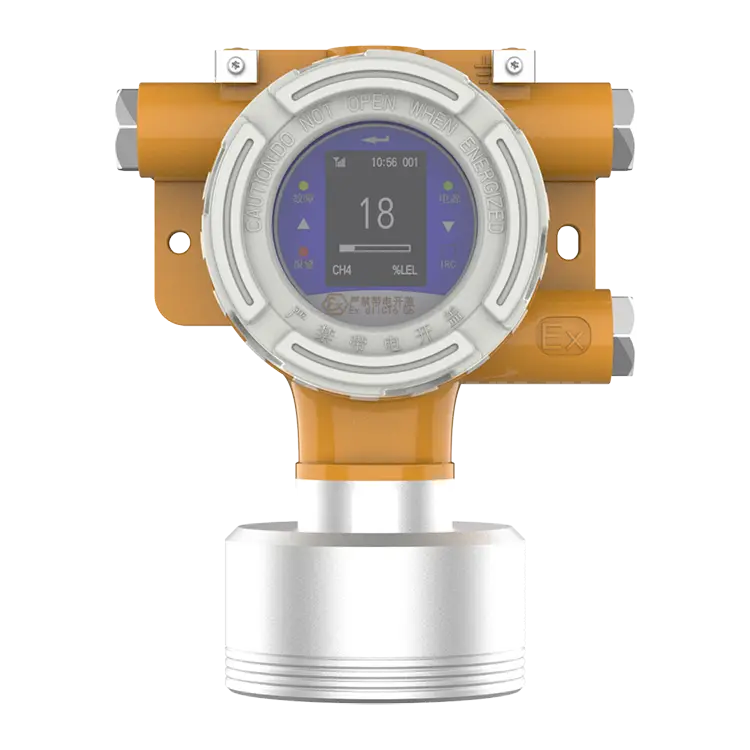
Fixed detection covers locations: leak sources, accumulation points, unmanned areas. Its readings are continuous, alarmed and recorded whether or not a person is present, and they drive building responses — ventilation, shutdowns, beacons — through controllers. The cost is installation: cabling, mounting and a calibration route to every point.
Portable detection covers people and tasks: entries, permits, inspections, leak hunts, emergencies. It goes where the work goes, including everywhere no fixed point exists. Its weakness is presence — a portable in a charger detects nothing.
Data and decisions
Fixed systems produce the compliance record: continuous logs per point, alarm histories and fault supervision. Portable fleets produce the exposure record: who was where, with what readings, downloaded from dataloggers or streamed by telemetry models.
The specification question is therefore not 'which is better' but 'which risks are positional and which are personal'. Map the positional risks first — they set the fixed point schedule — then equip the tasks that remain with portables.
Lifetime cost shape
Fixed points cost more per location and less per year of watch; portables cost less per unit and more per year of calibration, sensors and fleet management. Over a decade, a mixed system usually costs less than either pure system stretched to cover the other's work — and it is the only configuration that actually covers both risk shapes.
Failure modes, honestly compared
Each architecture fails in its own accent. Fixed systems fail silently and systemically: a fouled sampling line or a lapsed calibration contract can blind a whole area while every screen shows green normality — which is why proof-testing and calibration discipline are existential for fixed schemes, and why alarm-event reviews ask what the system did not see. Portable fleets fail individually and visibly: an unbumped unit, a flat battery, an instrument left in the van — failures of routine that supervisors can catch at the issue desk. Knowing the accent of each failure tells a site where to spend its assurance effort: fixed schemes buy testing regimes; portable fleets buy issue-desk discipline.
The economics over a decade
Fixed detection concentrates cost at installation — cable, containment, panel ways, commissioning — then amortises across decades of sensor swaps. Portable detection spreads cost evenly — instruments every few years, sensors and gas continuously, labour at the desk daily. Sites with stable layouts and long horizons usually find fixed coverage cheaper per protected point-year in the areas that qualify; sites in flux — construction, decommissioning, campaign operations — find portable flexibility cheaper than re-cabling a building that will change next year. The crossover is a property of the site, not of the technologies, and it should be computed rather than assumed.
Designing the hybrid deliberately
The deliberate hybrid assigns each layer its failure-proof role: fixed points own the unstaffed hours and the actuation; portables own the person, the entry and the investigation; the data systems merge both layers' records into one reviewable history. Hybrid by drift — a fixed scheme that silently became portable-dependent when its maintenance lapsed — is the dangerous counterfeit, and the tell is documentation: a hybrid by design can show you its layer assignments in writing. If your site cannot, the next detection project is not a purchase; it is the writing.
Response time as a system property
Brochures quote sensor response; incidents experience system response — the gas's travel to the sensor, the sensor's T90, the panel's scan, the operator's recognition, the evacuation's start. Fixed points win the travel term when they are placed at the source and lose it catastrophically when the release is across the room from the nearest point; portables invert the bet, travelling with the exposed person but sampling only where that person happens to stand. System-level thinking therefore compares geometries, not datasheets: draw the credible releases, walk the gas, and time each architecture honestly. The drawing exercise alone has redesigned more schemes than any instrument launch.
Data: two kinds of memory
Fixed systems remember continuously and impersonally — the area's history whether anyone was watching or not. Portables remember personally — tied to a wearer, a task, a dock record. Incident investigation wants the first; exposure assessment and programme management want the second; occupational hygiene, increasingly, wants both joined by time and place. When specifying either layer, order the data interfaces for the join — common timestamps, exports the safety system can ingest — because the investigation that needs it will not send advance notice, and the value of the archive is decided on that day.
Terms the comparison depends on
Coverage geometry — the map of what each layer can actually sense, drawn from release points and air movement rather than from floor plans. Unstaffed hours — the portion of a facility's life with nobody present to hear a local alarm, the fixed layer's reason to exist. Actuation — a detection system's power to change the plant: fans, valves, beacons, trips. Vigil — the continuous personal watch a worn instrument keeps over one breathing zone. Proof test — the scheduled end-to-end exercise that fixed systems owe because their failures are silent. Issue desk — the portable layer's equivalent institution, where its readiness is manufactured daily.
Point-year — the unit of fixed coverage economics: one point protecting for one year, calibration included. Instrument-year — the portable counterpart, cells, gas and dock labour included. Alarm event review — the periodic reading of a fixed system's history for the points that alarm often and the points that never do, both being findings. Personal exposure record — the portable layer's archival product, tying atmosphere to person and task. Layer assignment — the written decision of which hazards belong to which architecture, the hybrid scheme's founding document. Common-cause failure — the shared weakness (one calibration contract, one dock) that can blind a layer entire, hunted deliberately in good designs.
The comparison in one drawing
Draw the facility. Mark where people are, hour by hour, and where gas could credibly appear, scenario by scenario. The overlap of the two maps is where portables are irreplaceable; the gas map where it extends beyond the people map — the unstaffed room, the sealed vessel farm, the 3 a.m. pipe rack — is where fixed points earn their cable. Most real facilities produce a drawing with both territories clearly visible, which is why most real answers are hybrids, and why the comparison's correct output is not a winner but a map with two legends. Sites that have never drawn it are choosing blind, whatever they buy.
The comparison applied to one corridor
Take one corridor of a chemical plant at shift change: crowded, transient, with a compressor house at its end and a loading bay opening off it. The people map says portables — every worker in the corridor is a moving breathing zone. The scenario map says the compressor house earns fixed points with actuation, because its worst hour is the empty one. The bay says both: fixed LEL at the arms, personal instruments on the crew. One corridor, three verdicts, no contradiction — the comparison's whole teaching is that 'which is better' dissolves, on contact with an actual map, into 'which, where, and what does each owe the other'. Sites that perform the dissolution on paper before procurement stop having the argument in the abstract, where it cannot be won.
| Point | Portable detectors | Fixed detectors |
|---|---|---|
| Watches | People and tasks | Locations and plant areas |
| Presence needed | Yes — carried and worn | No — continuous 24 h watch |
| Typical instruments here | MS400S, MS600, MS104K family | MIC300 series, MIC100 |
| Response drives | Wearer's escape and alarm | Controllers, ventilation, shutdowns, beacons |
| Record produced | Exposure and event logs | Continuous point logs and alarm history |
| Pre-entry checks | Yes — the standard tool | No |
| Unmanned-area cover | No | Yes |
| Main lifetime cost | Calibration, sensors, fleet admin | Installation, point calibration access |
- Fixed points for positional risks; portables for personal risks
- Pre-entry testing is always portable work
- Controllers turn fixed readings into building responses
- Budget both styles as one system, not two purchases
Send a target gas list, get a configuration
Quotations are built from the published parameters on this site. Tell us the gases, the ranges and the quantity — or the point schedule for a fixed project — and the reply comes back within 24 hours.
Request a quotation