This guide covers the four measurement styles used on methane — catalytic and infrared point sensing in portables and fixed points, ppm instruments for trace work, and laser remote detection for networks — and the instruments on this site that carry each.
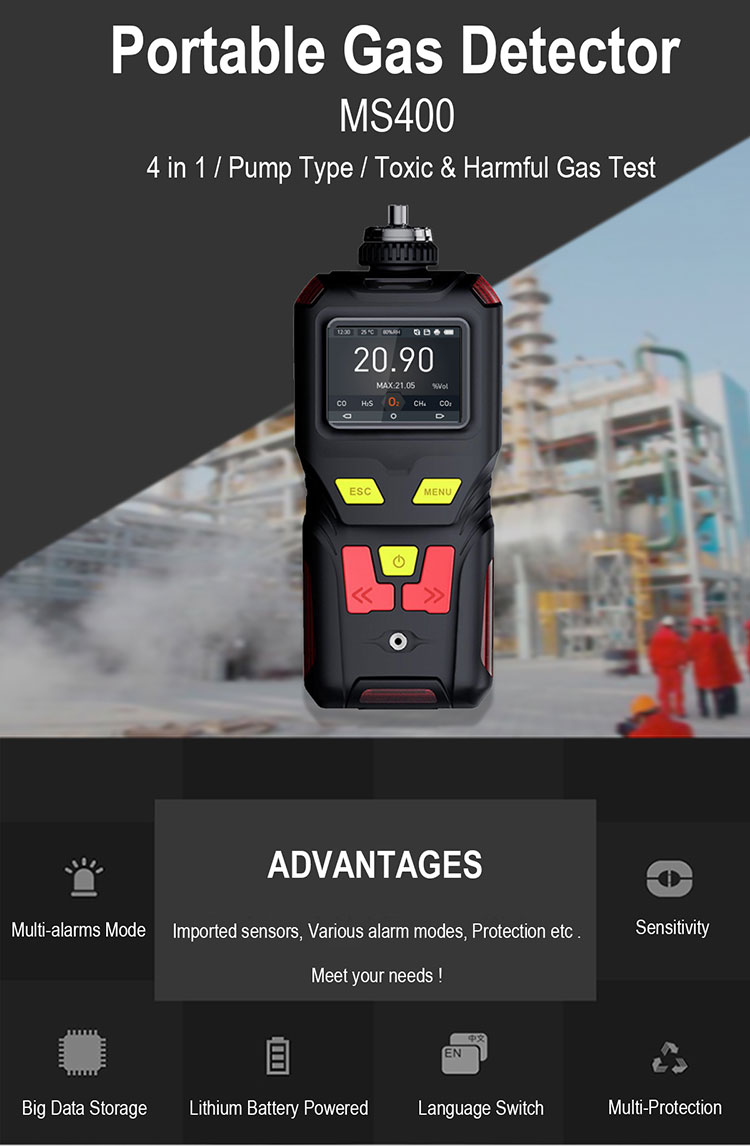
Point measurement: the %LEL world
The MS400 platform table reads methane at 0–100 %LEL with 0.1 %LEL resolution and a T90 inside 10 seconds — the response profile of pre-entry checks and leak hunts, where the operator sweeps fittings, flanges and ground bars and watches the number climb toward the source. Fixed points (MIC300 series spans, MIC100 channels) hold the same watch permanently over compressor houses and storage yards.
Catalytic sensors need oxygen to burn the gas and can be poisoned by silicones and sulfur compounds; infrared sensors need neither and resist poisoning, which is why both principles persist in the portable range. Sensor choice for a methane fleet should follow the atmosphere the sensor will actually live in.
Analysis and trace contexts
Above the safety layer, methane is also an analyte: the MIC300-F08 infrared analyzer measures CH4 among its six gases for biogas, syngas and process streams, where the question is composition rather than alarm. Biogas plants read methane as their product's energy content; the biogas analyzer category covers that duty.
Remote and network-scale detection
For distribution networks, contact measurement is too slow: laser methane detectors read the gas from metres away, and the U8 vehicle system surveys whole streets, using its ethane channel to separate pipeline gas from background methane. The laser methane category and the methane workflow — screen remotely, pinpoint by contact — are the professional pattern this site equips end to end.
The behaviour of methane in real buildings
Methane's lightness shapes every detection decision. Released indoors, it rises and layers against ceilings, roof decks and the tops of enclosures, so a detector at breathing height can stand in clean air beneath a flammable layer. Ventilation complicates the picture helpfully and dangerously: helpfully, because exhaust at high level removes the layer; dangerously, because a sensor placed in the exhaust stream reads the room's average rather than its worst pocket, and one placed in a dead corner reads the pocket but not the room. Competent schemes sample both the accumulation zones and the occupied zone, and treat disagreement between them as information about the ventilation, not as an instrument fault.
Outdoors the rules invert: wind disperses methane so fast that fixed points guard only the immediate vicinity of sources, and the measurement art moves to surveys — vehicle and foot — that hunt plumes rather than guard volumes. Temperature inversions and still nights are the surveyor's friends, concentrating what midday turbulence would shred.
Setting methane alarm thresholds
Thresholds translate the physics into decisions. In percent-LEL terms, common practice investigates at 10% LEL and evacuates or trips at 20–25% LEL, leaving a fat margin below the flammable boundary for sensor error, stratification and rising leaks. In process instruments measuring percent volume, thresholds are process limits — engine protection, product specification, flare consent — set by the process engineer rather than the safety case. The discipline is to know which conversation a given instrument belongs to and to label its alarms accordingly; a methane number without its threshold philosophy is a number waiting to be misread at 3 a.m.
For laser and survey instruments the threshold concept changes again: readings are path-integrated or plume samples, judged as patterns — a sharp localised rise against background — rather than absolute limits. Survey procedures should encode that judgement in advance: what rise, sustained over what distance, marks a point for ground investigation.
Methane in the energy transition
Methane measurement has acquired a second master: emissions accounting. The same molecule that safety teams keep below explosive limits, climate programmes now count in tonnes, and the instruments increasingly serve both — fixed points that guard a compressor hall also evidencing its fugitive losses, survey vehicles reporting to emissions inventories as well as repair lists. Buyers specifying methane detection today should ask how the data will be used in five years, because the audit trail requirements of emissions reporting are quietly becoming the specification for safety instruments too.
Methane specification checklist
A complete methane specification names: the duty (safety guarding, entry testing, process measurement, survey, emissions accounting); the scale that duty thinks in (percent LEL, ppm, percent volume, path-integrated ppm·m for laser work); the principle fitted to the atmosphere (catalytic where oxygen and cleanliness allow, infrared where poisons or inerting rule it out, TDLAS where distance or speed is the requirement, thermal conductivity or NDIR for bulk process gas); the alarm philosophy per duty; the response-time expectation including the gas's journey to the sensor; the calibration gas and its concentration, with correction factors where the sensor's calibration gas is not the site's methane-bearing mixture's only component; and the record the reading must leave behind. Inquiries written that way return quotations that can be compared line by line — which is the entire point of writing them.
The checklist's last item deserves emphasis because it is the one most often skipped: the record. Safety readings feed incident reviews; process readings feed yield accounting; survey readings feed repair programmes and emissions inventories. Each consumer wants the number with different companions — timestamps, locations, instrument identity, calibration state — and a specification that names the consumer gets an instrument whose data arrives already dressed for its job.
Methane terms
Lower explosive limit — the leanest concentration that can burn, 5% by volume for methane in air, the anchor of every percent-LEL conversion. Upper explosive limit — the richest boundary, about 15% for methane, beyond which the mixture awaits dilution to become dangerous. Stoichiometric mixture — the proportion at which fuel and air would consume each other exactly, near 9.5% for methane and the most violent point of the range. Buoyant plume — the rising body of a light gas, whose ceiling-hugging travel dictates detector height. Catalytic oxidation — the bead's surface burning by which percent-LEL methane is classically measured. TDLAS — laser absorption tuned to methane's own line, the survey and remote principle.
Gas layering — the accumulation of a light gas against a ceiling or roof void, invisible to sensors at breathing height. Ventilation short-circuit — the airflow fault in which fresh supply reaches the exhaust without sweeping the room, leaving layers intact above moving air. Fugitive emission — an unintended release, the survey world's quarry and the inventory's substance. Background methane — the atmosphere's own roughly two parts per million, the floor beneath which no field instrument need resolve. Percent LEL — the safety scale that expresses concentration as a fraction of the explosive threshold. Gas density — methane's roughly 0.55 relative density against air, the physical author of its behaviour.
Failure stories and what they teach
Methane's accident literature repeats three plots. In the first, the gas layered above the sensors: a roof void, a ceiling, a high enclosure filled while instruments at breathing height reported a safe room, and the layer found its ignition at a light fitting. In the second, the sensor was poisoned or starved: a catalytic bead in a silicone-rich atmosphere, or an inerted space where the bead had no oxygen to burn with, reporting calm in a rising cloud. In the third, the survey was believed too much: a windy afternoon's clean vehicle pass archived as a district's innocence. Each plot has its engineered answer — placement at the gas's own height, principle selection against the atmosphere's poisons and oxygen, survey honesty about weather — and the answers are all in this guide because the plots keep being re-performed by people who had not read it. Detection is a literature before it is a technology: its case law is written in incident reports.
| Instrument | Methane measurement | Role |
|---|---|---|
| MS400 platform | 0–100 %LEL, 0.1 %LEL resolution, T90 ≤10 s | Portable checks and leak hunts |
| MIC300-F08 | CH4 among six NDIR gases | Composition analysis |
| Laser family / U8 | Remote beam measurement; CH4 + C2H6 from a vehicle | Network survey |
Send a target gas list, get a configuration
Quotations are built from the published parameters on this site. Tell us the gases, the ranges and the quantity — or the point schedule for a fixed project — and the reply comes back within 24 hours.
Request a quotation