The company's own range history includes online cleanroom monitoring systems and airborne microbial samplers among its pharmaceutical solution work; this guide is the buyer's map of that territory.
The four layers
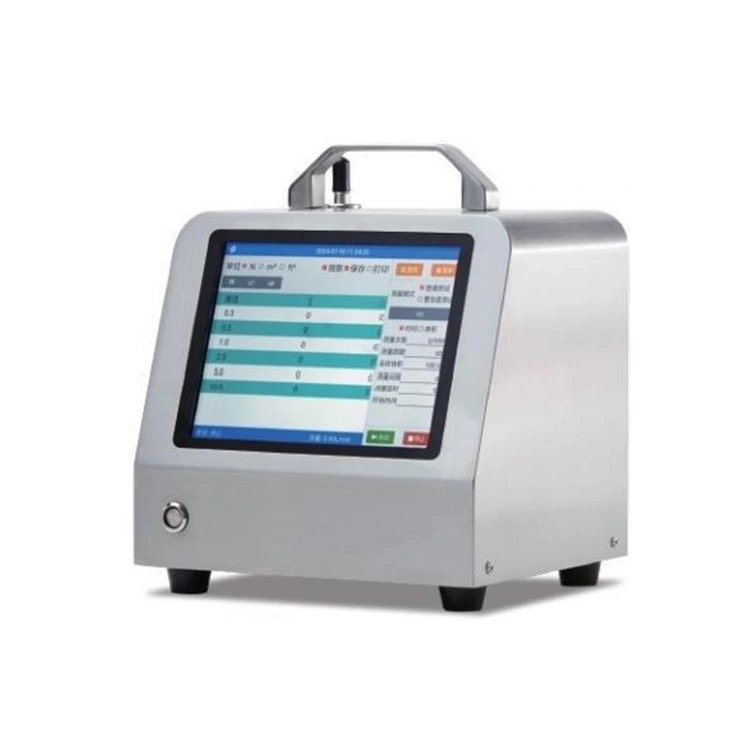
Counting: portable counters like the B1030 (0.1 µm, six channels) and B110-Pro (audit-trail records for regulated data) qualify rooms and hunt excursions; online counters watch fixed points continuously. State: differential pressure and temperature/humidity transmitters prove the cascade and climate that keep the room a cleanroom between counts.
Biology: active air samplers culture what the counter cannot judge — viability. Integrity: filter and glove testers plus the aerosol challenge toolkit prove the barriers the whole programme leans on. A programme missing a layer has a known blind spot; auditors find blind spots professionally.
Records are the product
In regulated environments the monitoring record is a quality document: who measured, where, with what instrument, calibrated when, and what the audit trail shows. That is why the B110-Pro's permissions, audit trail and million-record storage are purchasing features rather than specifications trivia, and why monitoring programmes are specified as systems — instruments plus data behaviour — rather than as boxes.
Designing the monitoring point map
Point selection is the monitoring programme's constitution. Points go where the product is exposed — beside filling and capping, at wafer staging, over open processes — plus the diagnostic points that explain excursions: supply and return air, the personnel and material locks, the gowning area. Each point earns its place by the decision it informs; a point nobody acts on is a cost wearing a sensor. Document the reasoning per point in the monitoring plan, because auditors ask 'why here' and because staff turnover erases unwritten reasoning within a year.
Alert and action levels, set honestly
Levels set at the class limit guarantee late warnings; levels set at the noise floor guarantee ignored ones. Honest levels come from the room's own baseline: alert at a multiple or percentile of the demonstrated in-control distribution, action below the class limit by a margin that buys response time. As the room's data matures, the levels should tighten — the programme's ambition ratchets with its evidence. Review them after every facility change and at least annually; a monitoring plan whose numbers never change is describing a room that no longer exists.
Excursions: the response choreography
An excursion is a small incident with a script: acknowledge, assess product impact by time-and-place against the batch record, investigate the cause family (people, process, plant), act, and document. The monitoring system's contribution is precision about time and place — when the counts rose, at which point, for how long — which is why synchronised clocks and retained raw data matter more than elegant dashboards. Sites rehearse excursions the way they rehearse alarms, with the quality and production teams reading the same trace and agreeing the disposition before the auditor asks them to.
Data review: the meeting that makes monitoring real
Monitoring programmes live or die in their review meeting — the recurring hour where operations, quality and facilities read the trends together. Its agenda is short and strict: excursions and their dispositions, points trending upward inside their limits (the early warnings that are the programme's real product), instrument health and calibration currency, and the changes coming that the point map must absorb — new equipment, moved processes, altered shifts. Programmes that hold the meeting find their monitoring data cited in decisions; programmes that file the data find it cited in audit findings. The instruments are the same in both facilities; the meeting is the difference, and it costs an hour a month.
The review should also own the programme's memory: baseline studies after construction or refurbishment, the seasonal patterns (humidity seasons change particle behaviour), the correlation library between excursions and causes. A monitoring archive with that memory attached is an engineering asset that appreciates; without it, the same archive is a warehouse of unexplained numbers awaiting a stranger's interpretation.
Cleanroom monitoring terms
Monitoring plan — the governed document that fixes points, frequencies, levels and responses. Baseline — the room's demonstrated in-control behaviour, from which alert levels are honestly derived. Alert level — the early line whose crossing starts investigation while product is still safe. Action level — the line whose crossing starts intervention and disposition. Excursion — any departure beyond a level, with its scripted response. Point map — the drawing that binds each monitoring location to its rationale. In-operation state — the room as it actually produces, people and process present, the state monitoring chiefly serves.
Trending — the periodic reading of histories against baselines, the programme's prophetic faculty. Deviation — the quality system's formal handling of an excursion with product implications. Gowning — the dressing discipline that is the room's largest particle variable, coached by live counting. Air changes and recovery — the ventilation performance that returns a room to class after disturbance, verified by test. Viable monitoring — the microbiological sampling that complements particle counts as verdict to their warning. Data review meeting — the recurring hour in which the programme's records become decisions.
Monitoring through change: construction next door
Cleanrooms live beside entropy: the refurbishment in the next suite, the new tool arriving through the wall, the corridor works that share the air handling for a weekend. Each is a monitoring event before it is a project milestone — baselines re-established, points temporarily multiplied, alert levels watched with the project's dust in mind. Programmes that treat facility change as a monitoring input, with a standing seat in the change-control meeting, catch the excursion as a trend on Tuesday rather than as a classification failure in the audit month. The guide's whole teaching compresses here: monitoring is not the observation of a static room but the biography of a changing one, written continuously enough that no chapter surprises its author.
Monitoring's seat at the design table
The cheapest monitoring point is the one designed into the room: power and data where the point belongs, sampling access that does not breach the envelope, a location argued while the walls are still lines. Programmes should claim their seat at the design table for every new suite and refurbishment, arriving with the point rationale method in hand — product exposure first, diagnostics second, baselines always — because retrofitting points into a finished cleanroom costs multiples and compromises locations. The design-stage conversation also fixes the data architecture before the room has habits: one clock, one archive, levels derived from the commissioning baseline by a written method. Rooms born monitored stay monitored; rooms adopted later bear the marks of the adoption.
The monitoring plan's first page
A monitoring plan's first page should say, in plain sentences, what the programme is for: the products and patients it protects, the decisions its data feeds, the levels at which humans act, and the meeting at which its trends are read. Everything after that page is machinery. Plans that begin with machinery produce machinery-shaped programmes — points without purposes, archives without readers — while plans that begin with purpose survive their own revisions, because every later argument about a point or a level can be settled against the first page's sentences. Write that page as if an auditor, a new manager and a sceptical operator will each read it once — because each of them will.
The plan's second reader
Write every monitoring plan for its second reader: the engineer who inherits it in year three, without the founding meetings in their memory, deciding whether a point may move or a level may change. That reader needs the rationales the founders carried in their heads — why this point, why this level, what the baseline was and how it was earned — set down while the founders still remember them. Plans that pass the second-reader test survive staff turnover with their logic intact; plans that fail it decay into rituals whose original purposes, once lost, cannot be reconstructed from the data alone, because the data was collected by the logic that has been forgotten.
Send a target gas list, get a configuration
Quotations are built from the published parameters on this site. Tell us the gases, the ranges and the quantity — or the point schedule for a fixed project — and the reply comes back within 24 hours.
Request a quotation