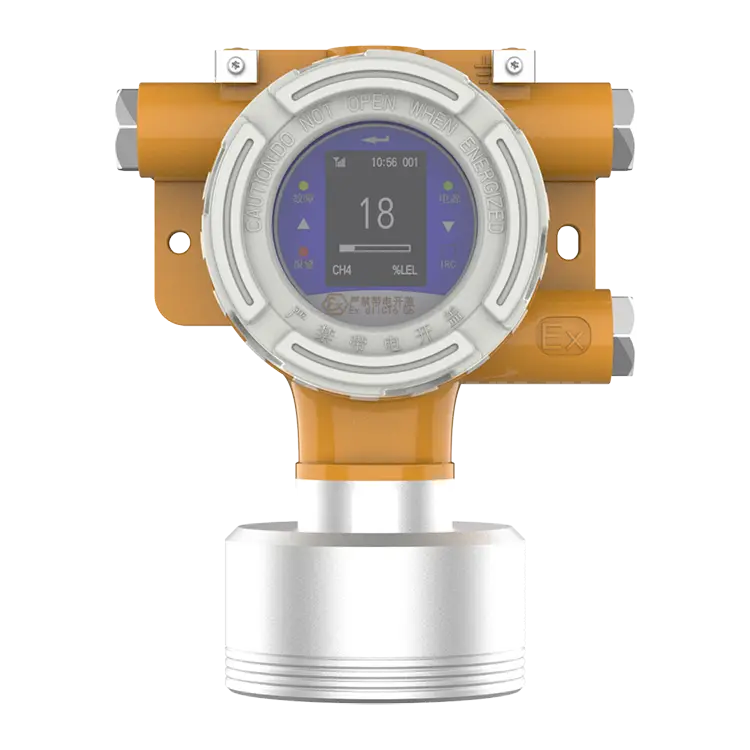
Around those transmitters sit the supporting categories: gas transmitters as the signal layer, alarm controllers for beacons and sounders, and UV flame detectors for open-area fire-and-gas schemes.
Browse by type
Models and resources in this range
Designing a fixed scheme
Start from the gas map: which gases, released where, drifting which way. Detector placement follows density and airflow — hydrogen high, solvent vapours low, toxics at breathing height near the source. The transmitter choice then follows the span needed at each point.
Outputs decide the integration effort: 4–20 mA loops land on almost any panel; RS485 digital points suit networked architectures. The portable-versus-fixed comparison on this site walks through where each detection style earns its money.
Maintenance reality
Fixed points drift and age like any sensor; a fixed scheme includes calibration access in its design — points mounted where a technician with a gas bottle can actually reach them. Modular sensors (MIC100) and standard spans (MIC300) keep that lifetime work predictable.
Send a target gas list, get a configuration
Quotations are built from the published parameters on this site. Tell us the gases, the ranges and the quantity — or the point schedule for a fixed project — and the reply comes back within 24 hours.
Request a quotation