Sensors are modular and intelligent, across catalytic combustion, electrochemical, NDIR and PID technologies, matched per channel to the target gas.
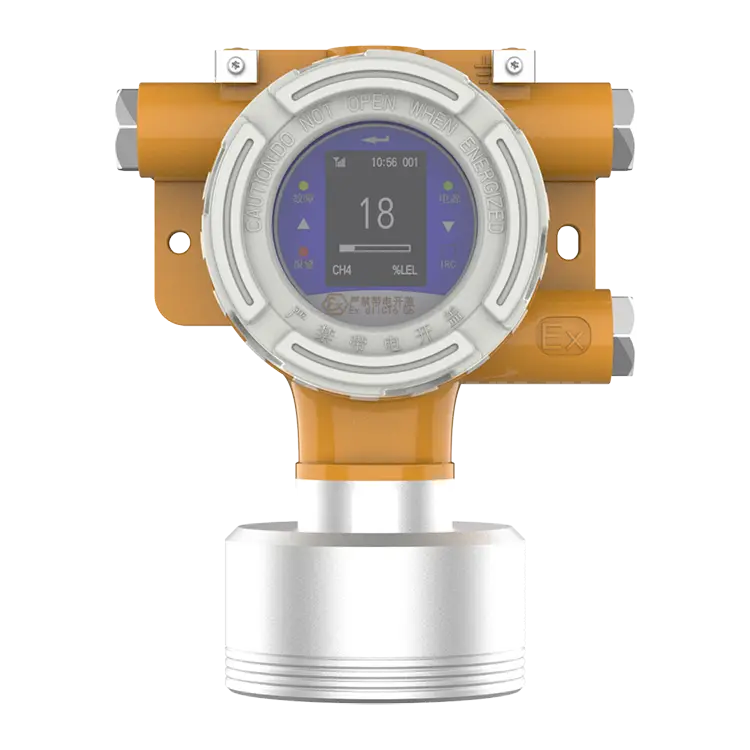
Local interface and calibration
An OLED display shows readings at the point of installation, so a technician on rounds can verify the atmosphere without returning to the control room. Infrared remote control allows configuration through the housing, and multi-point calibration with built-in temperature compensation keeps accuracy across seasonal swings.
Modular sensors simplify spares: a channel that reaches end of life is exchanged as a module rather than returning the whole transmitter.
Outputs and system fit
Two output standards are fitted: 4–20 mA for analogue loops and RS485 for digital networks, so the MIC100 drops into both legacy panels and modern Modbus-style architectures. Pair it with alarm controllers for beacon and sounder control, or feed it straight into a DCS or SCADA system.
Where a single gas per point is enough and the span ladder matters most, the MIC300 series is the alternative; the two families share the fixed-detection pages of this site so project engineers can compare approaches.
Compact points and the retrofit problem
Most fixed detection is not designed into new plants; it is retrofitted into buildings that were never given cable routes, panel space or spare ways in the marshalling cabinet. That is the MIC100's home ground: a compact loop-powered point that mounts where the gas is, draws its power from the signal pair, and reports on the same 4–20 mA convention the site already maintains. Boiler houses gain carbon monoxide points without a panel upgrade; refrigeration plant rooms gain ammonia coverage on the existing loop; car parks and battery rooms stop being unmonitored exceptions.
The four published variants divide by span and output rather than by badge: two with relay outputs for local action, two without where the loop alone reports to a panel. Choosing between them is a question about what should happen at 3 a.m. — if the point must start a fan or sound a local alarm by itself, the relay variant; if a staffed panel owns the response, the plain loop variant keeps the installation simpler.
Placement notes for small points
Compact does not mean casual. The placement rules are the same physics as any fixed point: methane high, propane and solvent vapours low, carbon monoxide at breathing height where people work, hydrogen straight to the ceiling. What compactness buys is the ability to obey those rules in awkward rooms — the point can go on the wall nearest the credible source rather than the wall the cable tray happens to pass. Keep points out of direct wash-down jets and away from fresh-air inlets that dilute the sample before it is measured.
Loop-powered design and what it forbids
Two-wire loop power is a budget: the transmitter must sense, compute and signal on the current the loop allows, which disciplines the design toward efficient electrochemical and infrared sensing and away from hungry heaters and pumps. The MIC100's architecture is that discipline made product — no local power supply to install, no separate signal pair, intrinsic simplicity at the panel. The budget also explains the variant logic: relay-equipped versions ask the loop for actuation energy as well, and the specification should confirm the loop and panel can feed the chosen variant at the end of the longest cable run, in the cold, at alarm current. Electrical honesty at design time is cheaper than voltage-drop mysteries at commissioning.
Commissioning a compact point is correspondingly simple and should still be done by the book: loop current verified at zero and span, alarm thresholds proven at the panel (not merely at the device), the point's identity — tag, location, gas — recorded in the site's detection register. Small points accumulate invisibly over years of retrofits; the register is what prevents a plant from discovering, during an incident review, that nobody knows how many points it owns or where the oldest ones are.
Where compact points should not go
Honesty about limits is this catalogue's habit: a compact loop-powered point is not a sampling system for hostile streams, not a multi-gas answer, and not the right tool where response must survive wash-down jets, direct process leaks at pressure, or temperatures beyond its rating. Those duties belong to the sample-draw and heavy-duty end of the fixed range. The MIC100's excellence is the ordinary room, the ordinary leak, the ordinary loop — covered properly, maintained simply, and present in the many places that would otherwise wait for a bigger project's budget.
Glossary for compact loop-powered points
Loop-powered — a transmitter fed by its own signal circuit, needing no separate power wiring. Two-wire — the installation economy that results: one pair carries energy and information together. Live zero — the 4 mA floor of the standard loop, whose presence distinguishes a healthy zero reading from a broken wire's silence. Alarm current — the loop value a point asserts at threshold, arranged with the panel so the state cannot be confused with a measurement. Voltage drop — the resistance tax along long cable runs, budgeted at design so the furthest point still feeds at alarm current on the coldest day. Marshalling — the panel-side gathering of field loops into the control system.
Retrofit — the addition of protection to a building that predates it, the compact point's native project. Point register — the record that keeps small retrofitted points from becoming anonymous over the years. Span potentiometer — the adjustment by which a simple point's response is set against calibration gas. Capillary and gauze — the diffusion path's guardians against dust and splash at a point's face. Local beacon — the relay-driven light that lets a compact point announce itself in its own room. Panel mimic — the diagram on which the site's points report, whose accuracy is a maintenance output, not a drawing-office hope.
The register, the rounds and the decade view
Compact points reward a particular management style: a register that knows every point's address, gas and birthday; a calibration round that walks the register rather than memory; and a replacement rhythm that treats the fleet as a population with an age profile rather than as individuals who fail by surprise. Managed so, a hundred compact points behave like one instrument with a hundred faces — known health, known cost, known coverage. Managed by anecdote, the same hundred points become a hundred small unknowns distributed through buildings people trust. The instrument cannot choose between those futures; the register can, and it is made of nothing but attention.
A note on panels and people
The compact point's last metre is human: somebody must read its alarm and know what it commands. Small installations should therefore spend their sophistication budget on annunciation — the right beacon in the right corridor, the panel label that names the room in the words the night staff use, the instruction card that says what the first alarm means and what the second demands. Detection that ends in a number nobody interprets is an unfinished sentence, and finishing it is cheaper than any hardware in this catalogue.
Small points, long memories
The compact point's biography is written by its register entry: fitted on a date, by a project, for a room's named risk; calibrated on a rhythm; adjusted by amounts that trend; retired on evidence. Ten years of such entries across a building become a history of the building's own changing risk — the room that gained a battery bank, the store that became a workshop — readable by whoever inherits the estate. That is a great deal of institutional value to arise from the catalogue's simplest instruments, and it arises entirely from the register's upkeep, which is why this page keeps returning to it: the MIC100's real specification is the attention system around it.
- Gas capacity
- Up to 4 gases simultaneously
- Targets
- Combustible gases, toxic gases, VOCs
- Sensor technologies
- Catalytic combustion, electrochemical, NDIR, PID
- Sensors
- Modular intelligent sensors
- Display
- OLED
- Control
- Infrared remote control
- Calibration
- Multi-point calibration with temperature compensation
- Analogue
- 4–20 mA
- Digital
- RS485
Measurement
Interface
Outputs
- Up to four gases at one fixed point
- Four sensor technologies available per channel
- OLED display and infrared remote configuration
- Temperature-compensated multi-point calibration
- 4–20 mA and RS485 outputs fitted together
Send a target gas list, get a configuration
Quotations are built from the published parameters on this site. Tell us the gases, the ranges and the quantity — or the point schedule for a fixed project — and the reply comes back within 24 hours.
Request a quotation