The platform addresses more than 500 gas types across its sensor range, so the same transmitter family covers combustible, toxic and oxygen targets throughout a site standard.
Ranges and resolution
Range options are published in a wide ladder: 0–1, 0–10, 0–100, 0–1000, 0–5000, 0–50,000 and 0–100,000 ppm for concentration targets; 0–200 mg/L; 0–100 %LEL for combustibles; and 0–20, 0–50 and 0–100 %Vol for percent-level gases, with further ranges customisable. Resolution follows the range: 0.001–0.01 ppm on the lowest spans, 0.01 ppm up to 100 ppm, 0.1 ppm up to 1000 ppm, 1 ppm at 10,000 ppm and above, 0.1 %LEL and 0.01 %Vol.
Specifying a fixed detector starts from the target gas and the alarm philosophy: the span should bracket the alarm thresholds with resolution to spare, which the ladder above is designed to allow.
Integration
The analogue output is 4–20 mA, the long-standing plant standard, and the detector integrates with DCS systems so readings, alarms and faults appear where operators already work. Continuous online monitoring replaces periodic manual checks in areas that are hard to staff.
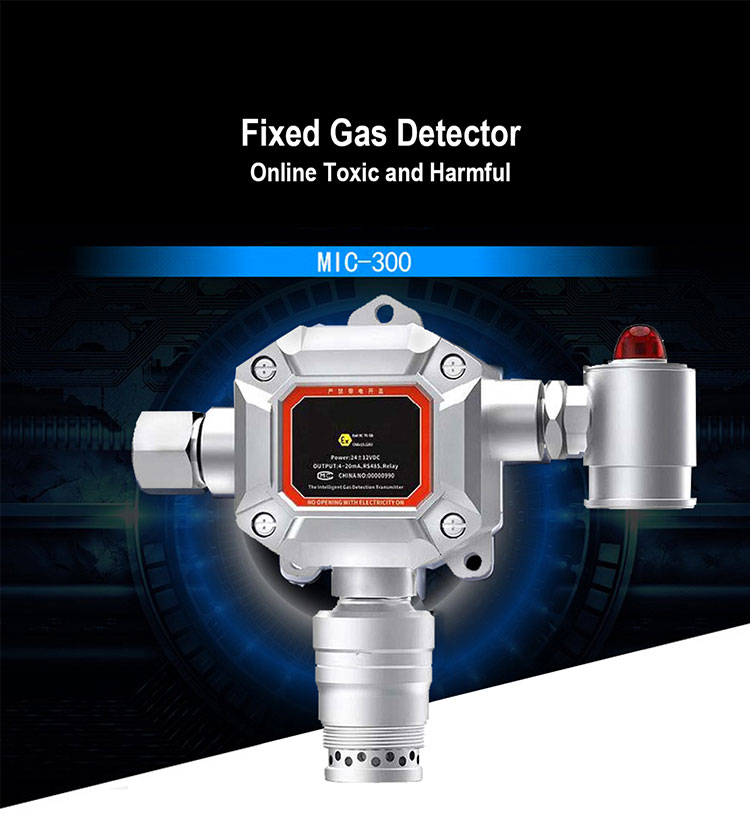
For multi-point projects, pair MIC300 points with the MIC100 where up to four gases share one location, and route both into the site alarm philosophy alongside the controller options in the fixed range.
Designing a point schedule around the MIC300
A fixed-point schedule starts from release scenarios, not from a grid. For each credible leak — a flange, a compressor seal, a loading arm, a sample point — the designer asks where the gas goes: buoyant gases climb to roof steel and high-level vents; heavy vapours slump to pits, trenches and bunded floors; mid-weight gases ride the ventilation. MIC300 points go where the gas will be, at the height it will be there, close enough to catch a release while it is still a leak rather than a cloud. The wide span options then match the duty: percent-LEL points for flammability protection, ppm points for toxic exposure control, percent-volume points for process and inerting duties.
Signal integration is the second half of the design. The 4–20 mA loop feeds the plant system the way every other transmitter does; the RS485 Modbus channel carries the richer diagnostic picture to a gas panel or data logger; the relay output acts locally without waiting for a control room decision — starting a fan, closing a valve, sounding the local beacon. A point that only reports is half a safety system; the relay makes it an actor.
Living with fixed points
Fixed detection fails quietly when maintenance lapses: a sensor drifting low reports safety that is not there. The MIC300's calibration routine — infrared remote or magnetic wand through the housing — exists so that calibration does not require opening enclosures in classified areas or breaking permits. Build the calibration interval into the site's planned maintenance from day one, bump-test after any event that could have poisoned or flooded a sensor, and trend the calibration adjustments: a point needing ever-larger corrections is announcing its replacement date in advance.
Alarm philosophy deserves the same forethought. First-stage alarms that start ventilation and notify, second-stage alarms that trip process and evacuate — the two relay-capable stages map to that philosophy. Voting arrangements, where several points must agree before a trip, belong to larger engineered systems; for most unit-scale duties a well-placed, well-maintained point with honest thresholds outperforms a sophisticated scheme nobody fully understands.
Voting, zoning and alarm management at scale
As point counts grow, alarm philosophy becomes a design discipline of its own. Zones group points by the response they share — one ventilation area, one process trip, one muster decision — and the cause-and-effect chart records, for every point and stage, what acts and who is told. Voting (two points must agree before a trip) suits processes where a spurious shutdown carries its own danger; single-point action suits fast toxics where delay is the danger. The MIC300's per-point relays and dual digital-analogue personality let the philosophy be implemented in hardware and software together, but the philosophy must exist on paper first — the chart, reviewed after every modification, is the system; the transmitters are its senses.
Alarm floods deserve a sentence of their own: a major release will alarm every point downwind, and the panel's job in that minute is prioritisation, not completeness. Rationalised alarm lists — first-out indication, shelving discipline for maintenance, flood suppression that never hides a rising trend — are the difference between a control room that acts and one that drowns. Detection projects that include the panel conversation deliver safety; those that stop at the field devices deliver hardware.
Calibration access and the permit economy
Every fixed-point calibration spends permits, access equipment and technician hours, so the calibration method is an economic specification. Non-intrusive calibration — infrared remote or magnetic wand through the closed housing — removes the hot-work and enclosure-opening costs from most visits, which is how quarterly regimes survive contact with real maintenance budgets. When comparing fixed instruments, price the decade of calibrations beside the purchase: the instrument that is cheaper to keep honest will be kept honest, and the one that is not will quietly stop being a safeguard while continuing to be a line on the drawing.
Glossary for fixed-point systems
Point schedule — the engineered list of detection points: location, height, gas, range, alarm stages, actuations, and the release scenario each point answers. Release scenario — the credible leak a point is placed to catch, described by source, rate and the gas's travel from it. Cause and effect chart — the matrix that records, for every alarm, what acts and who is told; the fixed system's constitution. Voting — the requirement that multiple points agree before a trip, trading a little speed for immunity to single-point falsehood. Proof test — the periodic end-to-end exercise of sensor, logic and actuation that fixed systems owe because they wait silently. Bypass — the controlled, recorded suspension of a point's action for maintenance, with an owner and an expiry.
Loop — the 4–20 mA current circuit that carries a transmitter's reading on the same pair that feeds it. Addressable system — a panel architecture in which points identify themselves digitally on a shared bus. Modbus — the industrial protocol by which richer diagnostics ride beside the analogue reading. Alarm rationalisation — the discipline that keeps every alarm necessary, prioritised and answered by a defined action. First-out — the indication of which alarm in a flood arrived first, the investigator's starting point. Detection register — the site's living inventory of every point, its duty and its maintenance state.
From points to a living system
A fixed installation becomes a system when its records start arguing with its assumptions: the point that alarms every time a certain door opens, teaching the site about its own air movements; the point whose calibration adjustments grow each quarter, scheduling its own replacement; the zone whose alarm history maps the process's moods better than the process historian does. Engineers should review fixed-system data with the same regularity as process data, because the detection layer is a sensor network over the plant's behaviour and not merely a guard against its failures. The MIC300's dual outputs — the loop for control, the bus for knowledge — exist for exactly that double life.
Obsolescence planning closes the thought: transmitters outlive their electronics' fashion, and a site standard that names its fixed family, its protocols and its spares philosophy in advance converts future replacements from projects into purchases. The standard is a procurement document, but it is written by the people who maintain the points at 3 a.m., which is why theirs should be the loudest voices in it.
- Duty
- 24 h continuous online monitoring
- Gas library
- More than 500 gas types
- Range options (ppm)
- 0–1 / 10 / 100 / 1000 / 5000 / 50,000 / 100,000 ppm
- Range options (other)
- 0–200 mg/L; 0–100 %LEL; 0–20 / 50 / 100 %Vol; custom ranges available
- Low ppm spans
- 0.001–0.01 ppm
- Up to 100 ppm
- 0.01 ppm
- Up to 1000 ppm
- 0.1 ppm
- 10,000 ppm and above
- 1 ppm
- LEL / Vol
- 0.1 %LEL / 0.01 %Vol (0.001 %Vol on the lowest Vol span)
- Signal
- 4–20 mA analogue
- Integration
- DCS integration
Measurement
Resolution
Output
- 24-hour continuous fixed-point monitoring
- More than 500 gas types across the platform
- Seven ppm range steps plus mg/L, %LEL and %Vol ladders
- 4–20 mA output with DCS integration
- Custom ranges available for non-standard spans
Send a target gas list, get a configuration
Quotations are built from the published parameters on this site. Tell us the gases, the ranges and the quantity — or the point schedule for a fixed project — and the reply comes back within 24 hours.
Request a quotation