CO2 is measured at two scales: ppm for safety around people, and percent for process gas. The instrument families differ accordingly.
Safety scale: ppm and the personal monitor
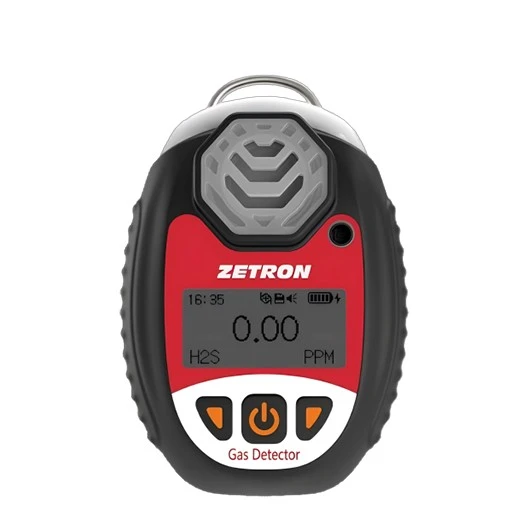
The MS400 platform reads CO2 at 0–500 ppm in its published portable table for low-level work, and personal monitoring is anchored by the MS104K-S1: a diffusion CO2 monitor worn on the person with one-to-two-year working time, event records and a man-down alarm — the pattern for cellar and cold-store fleets where the gas pools at ankle height and the worker kneels into it.
Fixed points at low level in pits and cellars complete the pattern; CO2's weight means sensor placement is a floor-level decision, the opposite of methane practice.
Process scale: percent and NDIR
At percent levels, NDIR analysis takes over: the MIC300-F08 publishes CO2 ranges of 0–20%, 0–50% and 0–100% for biogas, fermentation and process streams, where CO2 percentage is a product and process variable — half the biogas recipe, the fermentation's progress curve.
Between the scales sits ambient monitoring: the MS800A-10 includes CO2 in its station panel for greenhouse, building and environmental work.
Two gases in one: safety CO2 and process CO2
Carbon dioxide leads a double life. As a safety hazard it is the quiet asphyxiant and toxicant of cellars, fermentation halls, dry-ice stores and CO2-injected processes, dangerous at percent levels a person cannot sense. As a process variable it is the measure of fermentation progress, combustion quality, biogas composition and greenhouse climate. The safety instruments read ppm into the low percents with fast alarms; the process instruments read percent volume precisely and continuously. Confusing the two specifications is easy and expensive: a safety point asked to control a fermenter, or a process analyser asked to guard a cellar, each fails at the other's job while appearing to work.
Where CO2 accumulates and how schemes answer
Heavier than air and happy to stay so, CO2 fills from the floor up: pits, cellars, sumps, the bottom of tanks and the low corners of cold stores. Detector placement bows to the physics — points low, near the sources and at the entrances where a descending worker can be warned before descending into the layer. Ventilation interlocks extract from low level, because high-level extraction skims clean air off the top of the layer and leaves the hazard standing. Breweries, wineries and biogas plants write this into their bones; any facility storing or generating CO2 in bulk should copy them deliberately rather than learn independently.
NDIR: the natural CO2 sensor
CO2 absorbs infrared strongly and specifically, so non-dispersive infrared sensing is its native technology: no consumable chemistry, spans from ppm to pure gas, and stability that suits both safety points and process analysers. The disciplines are optical and thermal — keep the bench clean, manage condensation, respect warm-up — and the reward is a measurement that stays honest for years between services. Where a specification calls for CO2 alongside other gases, the NDIR channel usually anchors the platform's accuracy story.
CO2 specification checklist
Begin with the world the instrument lives in. Safety world: ranges from ambient upward through the danger percents, alarms staged below the exposure limits, placement low and at thresholds, actuation aimed at extraction and warning. Process world: the stream's actual band — fermentation and biogas at tens of percents, flue gas in single digits to tens, greenhouse enrichment near a thousand ppm — with accuracy and stability specified at the control point, not at full scale. Research and incubation worlds add their own precision accents. Then the shared disciplines: NDIR as the default principle; condensation management wherever warm wet gas meets cooler hardware; pressure compensation where altitude or process pressure moves the partial-pressure truth behind the percentage; and calibration with certified span gas at the concentration the decisions use. A CO2 inquiry that states its world in the first line gets a serious quotation; one that asks for 'a CO2 detector, 0–100%' gets a brochure.
Carbon dioxide terms
Dry ice sublimation — the solid's direct return to gas, the store-room and transport hazard that fills low spaces silently. Fermentation gas — the CO2 of brewing and biogas, generated in bulk by the process itself. Cellar atmosphere — the accumulated low-layer air of fermentation and storage spaces, tested before entry as a confined space. NDIR — the infrared absorption principle that is CO2's native measurement. Partial pressure — the share of total pressure one gas contributes, the physiologically active quantity behind the percentage. Hypercapnia — the body's CO2 poisoning state, whose early symptoms mimic tiredness and drink.
Displacement — the mechanism by which generated CO2 evicts breathable air from low enclosures. Extraction at low level — the ventilation geometry that removes a heavy gas from where it actually lies. Greenhouse enrichment — the deliberate maintenance of CO2 near a thousand ppm for crop growth, a process duty with people inside it. Carbonation — the beverage industry's dissolution of the gas, whose plants and cellars share the brewer's geography. Soil gas — ground-generated CO2 that migrates into basements in some geologies, the domestic face of the industrial hazard. Span gas — the certified CO2 mixture by which process and safety instruments alike are kept honest.
The cellar drill
Every industry with CO2 cellars converges on the same drill, worth stating as the guide's practical core. The space is tested from outside, low, before entry — every time, however familiar. The entrant wears the monitor; the attendant keeps the second reading and the retrieval kit; the ventilation runs from before the test until after the exit, extracting from the low level where the gas lives. Any rising reading ends the entry without discussion, because CO2's impairment curve gives the discussion no time to happen in. Facilities should write the drill for their own cellars with their own numbers, rehearse it with the people who will perform it, and audit it by watching it — the three activities that distinguish a drill from a paragraph.
The same drill pattern, mutatis mutandis, governs dry-ice transport holds, CO2-injected greenhouses after dark, and the pits of biogas plants — the gas is one, and its manners do not change with the industry's name.
CO2 and the crowded room
One more CO2 theatre deserves its paragraph because it is where most people will ever meet the measurement: the occupied room. Classrooms, offices and meeting spaces use CO2 as ventilation's proxy — the exhaled tracer that reports how much of the air is other people's — with action thresholds in the high hundreds of ppm that are about cognition and comfort rather than danger. The instruments are the same NDIR family at a different scale, and the discipline transfers surprisingly well: placement away from direct breath and windows, honest averaging, trends over spot readings. A generation meeting CO2 first as a number on a classroom wall will staff industry with an intuition this guide could not have bought them — that air is measurable, and that what is measured can be managed.
Calibration humility for a gas that is everywhere
CO2 calibration carries a peculiar trap: the gas is in every room at hundreds of ppm, so a 'zero' taken in occupied air is a fiction with a number attached, and a span taken near a breathing technician drifts as they breathe. The routines answer plainly — certified zero gas or a genuinely unoccupied, ventilated space for baselines; span gas at the decision concentration; the technician standing downwind of their own work. It is a small parable of the whole detection art: the atmosphere being measured includes the measurer, and honesty begins with accounting for one's own exhalations.
| Instrument | CO2 measurement | Role |
|---|---|---|
| MS104K-S1 | Personal diffusion monitor | Worker protection in cellars and cold stores |
| MS400 platform | 0–500 ppm portable span | Area checks |
| MIC300-F08 | 0–20 / 50 / 100% NDIR ranges | Process and biogas analysis |
Send a target gas list, get a configuration
Quotations are built from the published parameters on this site. Tell us the gases, the ranges and the quantity — or the point schedule for a fixed project — and the reply comes back within 24 hours.
Request a quotation