Carbon dioxide build-ups are a quiet hazard in breweries, wineries, dry-ice handling, greenhouses, cold storage and cellar work, where the gas pools at floor level and displaces oxygen without smell or colour. A personal monitor travels with the worker into exactly those low spots.
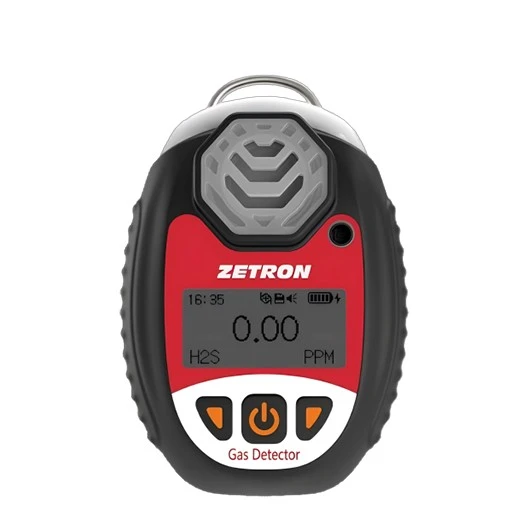
Operation
Measurement is by diffusion through the sensor face. The 1.7-inch LCD shows the live reading, and three buttons cover power, paging and acknowledgement. An infrared communication port, with an optional PC dock, offloads the 1,000 stored event records for exposure documentation.
Automatic zero calibration keeps the baseline honest over the long service interval, reducing the workshop time that usually dominates the cost of personal gas detection.
Alarms and safety functions
Alarms combine sound, light and vibration at 95–105 dB, with low alarm, high alarm, STEL and TWA thresholds so both sudden releases and slow accumulation across a shift are caught.
A man-down alarm is built in: if the wearer stops moving, the unit raises the alert itself. For lone workers in cellars, silos and cold rooms, that function is often the deciding feature.
Ordering notes
The MS104K platform is a single-gas personal family; this page covers the carbon dioxide configuration. When you inquire, state the gas, the alarm thresholds your site procedure uses and the quantity, so the units can be configured before dispatch.
The single-gas discipline
A single-gas fleet lives or dies on routine, not features. The MS104K-S1 asks almost nothing of its wearer — clip it on, and the replaceable-sensor architecture means the morning check is a bump test and a glance at the remaining sensor life rather than a bench session. Oxygen versions guard entries and nitrogen-blanketed areas; hydrogen sulfide versions ride sewer, sludge and sour-service crews; carbon monoxide versions cover boiler houses and steel. Matching the gas to the actual exposure profile of each crew is the whole specification.
Replaceable sensors change the cost shape of ownership. Instead of retiring an instrument when its cell fades, the cell swaps and the housing, electronics and alarm systems continue. Over a fleet of dozens, that is the difference between a capital line and a consumables line — and consumables get bought on time, while capital requests wait for budget rounds. Instruments that stay in service stay calibrated; instruments waiting for replacement paperwork protect nobody.
Alarm behaviour for lone workers
The 85 dB buzzer and flashing indication are sized for the environments these instruments actually work in — plant rooms, galleries, treatment halls — but the real lone-worker feature is simplicity: no modes to be in the wrong one of, no menu between the wearer and the alarm state. A single-gas instrument that alarms is unambiguous, and unambiguous alarms get obeyed. Crew briefings can be one sentence long: if it sounds, leave and report. That clarity is a design achievement, not a missing feature list.
Choosing which gas each crew carries
Single-gas fleets fail by generosity: issuing the same gas to everyone because uniformity is tidy. The tidy fleet leaves the boiler crew wearing oxygen units they never needed while the sewer crew's hydrogen sulfide instruments are shared three ways. The correct map is exposure by task: sewer and sludge work, hydrogen sulfide; boiler houses, furnace floors and steel, carbon monoxide; entries, blanketed areas and nitrogen service, oxygen; refrigeration, ammonia. Audit the map yearly against the incident and near-miss record, and let the map — not habit — order the spares. A single-gas programme is a set of small, exact decisions; its elegance is that each one is cheap to get right.
Expiry management completes the picture. Cells announce their remaining life through calibration behaviour long before they refuse; a fleet board that tracks sensor fitting dates against expected life turns replacement into a planned consumable line. The instruments are inexpensive; the programme around them is the product, and it is priced in attention rather than money.
The case for wearing it on the chest
Personal monitors protect the air their wearer breathes, so placement is doctrine: chest or collar, inside the breathing zone, sensor unobstructed by clothing, straps or the radio clipped beside it. Belt and pocket carriage read the air of a different microclimate and lag the breath that matters. Brief the placement with the same seriousness as the alarm response, and check it in the field the way supervisors check harnesses — visually, routinely, without apology. The smallest instrument in the catalogue carries the largest behavioural component, and managing that component is the supervisor's craft.
Glossary for single-gas personal monitoring
Personal monitor — an instrument whose workplace is the wearer's breathing zone and whose only question is the air entering one pair of lungs. Breathing zone — the hemisphere around nose and mouth that placement doctrine aims the sensor into. Time-weighted average — exposure accumulated against the clock, the quantity occupational limits ration. Short-term exposure limit — the fifteen-minute ceiling that guards against peaks an average would forgive. Ceiling limit — the concentration that may not be crossed for any duration at all. Sensor life — the working span of an electrochemical cell, consumed by exposure, time and climate, and forecast from calibration behaviour before it is exhausted.
Bump test — the brief gas challenge that proves sensor, alarms and annunciation alive before the shift. Latching alarm — an alarm that holds until acknowledged, so a peak nobody saw is not silently forgiven. Non-latching alarm — one that clears when the air does, suited to conditions that must be watched continuously rather than remembered. Issue desk — the point where instruments are charged, tested, recorded and handed over, and where a fleet's culture is physically located. Quarantine tag — the visible mark that removes a failed instrument from circulation until a bench clears it. Fleet board — the display of calibration currency and sensor ages that turns replacement from surprise into schedule.
The single-gas programme as a safety culture instrument
Because single-gas units are issued in numbers and worn all shift, they become the most visible safety artefact a site owns — and therefore a cultural instrument whether management intends it or not. A fleet that is charged, bumped, tagged and trusted teaches the workforce that the safety system works; a fleet of dead units in a drawer teaches the opposite lesson more eloquently than any poster. Supervisors should treat the personal-monitor programme as a communications channel: every dock interaction is a message about whether the organisation means it. The instruments are the cheapest culture a plant can buy, in both directions.
The programme's data completes the culture loop. Dose and alarm downloads, reviewed without blame, show crews their own exposure geography — the valve that always sighs, the route that always peaks — and crews who see their data change their routes and report their valves. The single-gas monitor thus graduates from alarm bell to survey instrument in the hands of an organisation that reads what it collects.
- Configuration on this page
- Carbon dioxide (CO2), single gas
- Sampling
- Diffusion
- Working time
- 1–2 years
- Display
- 1.7-inch LCD
- Buttons
- 3
- Records
- 1,000 event records
- Comms
- Infrared port; optional PC dock
- Output
- Sound, light, vibration; 95–105 dB
- Modes
- Low, high, STEL, TWA
- Extra safety
- Man-down alarm; automatic zero calibration
Measurement
Interface and data
Alarms
- Personal CO2 monitoring with 1–2 year working time
- Diffusion sampling — no pump to maintain
- 1,000 event records with infrared offload and optional PC dock
- Man-down alarm for lone workers
- Automatic zero calibration
Send a target gas list, get a configuration
Quotations are built from the published parameters on this site. Tell us the gases, the ranges and the quantity — or the point schedule for a fixed project — and the reply comes back within 24 hours.
Request a quotation