The instrument pattern is settled: a pumped multi-gas detector for the pre-entry test from outside, personal multi-gas monitors on every entrant, and an attendant at the opening holding the picture together.
The pre-entry test
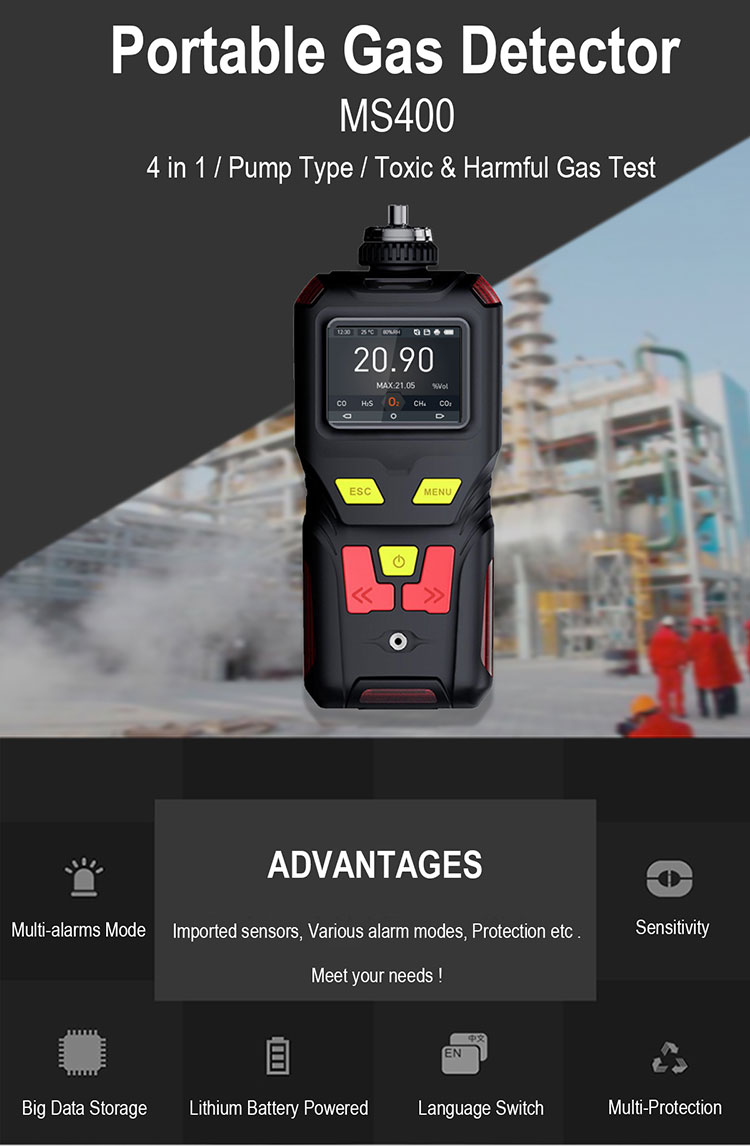
The pumped instrument draws the space's air through a probe before anyone enters — top, middle and bottom, because gases stratify: methane high, hydrogen sulfide and carbon dioxide low, solvents wherever their vapour settles. The MS400S switches between pump and diffusion for exactly this dual life, and the MS104K-M's standard external pump serves the same test in a smaller body.
The core four gases — oxygen, combustibles, carbon monoxide, hydrogen sulfide — are the minimum set; the risk assessment adds process-specific gases from the platform library. Oxygen is read first and believed most: it certifies the space can support both life and honest sensor readings.
During entry and the rescue problem
Continuous personal monitoring replaces the one-off test because spaces change: sludge disturbs, residues off-gas, adjacent lines leak. Fall and man-down alarms — fitted across the portable range here — exist for the entrant who cannot call out, and ventilation plus retrieval systems complete a pattern whose rule is absolute: no unprotected rescue entries. Most confined-space fatalities are would-be rescuers; detection's job is to make the atmosphere known early enough that rescue is a procedure, not an improvisation.
The oxygen and calibration guides develop the supporting disciplines.
The entry programme around the instruments
Regimes differ in their paperwork but agree in their skeleton: identify and classify the spaces, write the entry procedure, train entrants, attendants and supervisors in their separate duties, equip the testing and monitoring roles, and rehearse rescue that does not depend on entry by the attendant. Instruments serve two of those bones — testing and monitoring — and their selection should be traced to the classification: spaces with toxic inventories need the toxics measured, not merely the standard four recited; spaces with engulfment or mechanical hazards remind everyone that gas is one hazard family among several and never the permit's only signature.
Programme audits close the loop: permits reviewed against downloads, bump compliance sampled, calibration currency checked. The audit's findings are usually mundane — a dock without gas, a probe too short for the deep vessels, a crew testing after entry because the queue for the pumped unit was long — and mundane findings are the programme working as intended, catching drift before it is measured in harm.
Ventilation and detection as partners
Ventilation changes the atmosphere detection judges; detection verifies the atmosphere ventilation claims. Blowers purge spaces before entry and dilute during it, but air movers have dead zones — the far side of baffles, the bottom of sumps, the inside of connected pipework — and only measurement at those points proves the purge reached them. The testing routine should therefore map the space's dead zones once, deliberately, and write them into the entry procedure as mandatory sample points. Thereafter the partnership is routine: ventilate, test at the dead zones, enter, monitor, and let any rising reading trigger the withdrawal that the ventilation's failure has announced.
Rescue readiness and the attendant's instruments
The attendant's console is a small system: the entrant's readings where telemetry provides them, the retrieval winch and tripod, the communication check, and the absolute rule that rescue never means a second body in the space without breathing apparatus. Instruments support the rule by keeping the attendant informed without entry — remote sampling before the incident, telemetry during it. Facilities should test the whole chain in drills that include the instruments: a simulated alarm, a timed retrieval, a download reviewed afterwards. What the drill reveals about radios, alarms and human sequence is the programme's true state, more honest than any procedure manual.
Specifying the confined-space programme's instruments
The instrument chapter of an entry programme, written properly, is a roster-matching exercise: pumped testing instruments counted against concurrent entries and owned by the attendant role; continuous-monitoring instruments counted against entrants and owned by the wearing role; the gas sets derived from the space inventory rather than from the standard four recited by habit — with the toxics of the site's actual processes (ammonia at the refrigeration plant, chlorine at the water works, solvent vapours at the coating shop) displacing ceremony. Calibration and bump infrastructure sized to the morning peak, when the whole fleet presents itself at once; records flowing from downloads into the permit archive by a route somebody owns. Suppliers quoting against that chapter are quoting a programme, and the comparison between them should be made on programme terms — dock throughput, gas logistics, training support, spares depth — because the instruments themselves, at this level of the market, are the most interchangeable part of the system that keeps entrants alive.
Confined-space terms
Permit-required space — a confined space whose hazards have earned it a written entry regime. Entrant — the worker who crosses the plane of the opening, on whom the monitoring rides. Attendant — the outside guardian who owns testing, communication and retrieval, and who never enters. Entry supervisor — the role that authorises, oversees and terminates entries against the permit. Engulfment — the burial or drowning hazard of stored materials and liquids, gas's sibling in the permit's hazard list. Atmospheric hazard — the permit's gas chapter: deficiency, enrichment, flammability, toxicity.
Pre-entry test — the remote measurement, oxygen first, that opens the entry sequence. Continuous monitoring — the vigil kept on the entrant's air while work proceeds. Ventilation purge — the air changes that precede a provable atmosphere, proven by measurement rather than arithmetic. Retrieval — the non-entry rescue by winch and harness that the attendant executes. Calibration and bump — the two routines whose currency the permit implicitly demands of every instrument it names. Acceptable entry conditions — the readings, recorded, under which the supervisor's signature is given.
The programme's evidence pack
When an entry programme is examined — by an auditor, an insurer, or in the worst case an investigator — it is examined as paper: the space inventory with its classifications, the procedures, the training records per role, the permits with their readings, the downloads that corroborate them, the calibration and bump trails of the instruments named. Programmes should assemble that pack continuously rather than retrospectively, ideally by architecture: downloads filed against permit numbers as a matter of routine, dock records joined to the same index. The pack's existence changes daily behaviour more than any exhortation, because people perform differently inside a system that remembers — and confined-space work is precisely where performance should be at its most deliberate.
The entry that goes right, narrated
It is worth narrating a good entry once, plainly, because programmes are taught by stories better than by clauses. The space was tested from outside at three levels, oxygen first, and the readings were written on the permit by the attendant who took them. The entrant's instrument was bumped at the dock in the attendant's sight. Ventilation ran before the test and through the work. When the sludge layer was disturbed and the hydrogen sulfide channel stirred — not to alarm, but visibly — the entrant withdrew on the attendant's call, the space was re-proved, and the job resumed with the disturbance planned rather than discovered. Nothing in the story is heroic; that is the story's point. Confined-space excellence is a sequence of small correct actions by people whose instruments told them the truth in time.
The attendant's log as literature
Programmes should read their attendants' logs the way editors read manuscripts: for the entry that took three tests to clear and the one whose readings moved mid-task, written up in the monthly review with the instruments' downloads beside them. The log is the programme's primary source — everything else is commentary — and treating it with editorial respect teaches attendants that their observations are the record, not a formality on the way to it. Sites that publish the month's most instructive entry, anonymised and praised, find their logs improving in the direction of truth, which is the only direction that has ever saved anyone.
Send a target gas list, get a configuration
Quotations are built from the published parameters on this site. Tell us the gases, the ranges and the quantity — or the point schedule for a fixed project — and the reply comes back within 24 hours.
Request a quotation