Sensors are digital and plug-and-play, in electrochemical, infrared, catalytic combustion, thermal conductivity and PID versions, so the same housing can be configured for the gas set a site actually faces. The detector platform supports more than 500 gas types across its sensor library.
Sampling, display and alarms
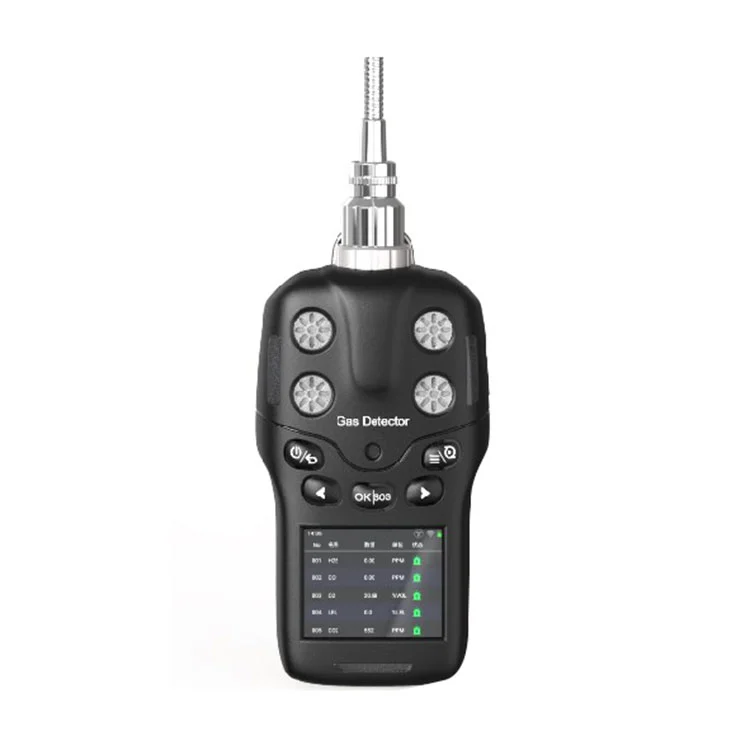
A built-in pump draws the sample for pumped measurement, and switching the pump off converts the unit to diffusion sampling for personal monitoring. A pump-blockage alarm warns when the sample path is obstructed, so a flat reading is never mistaken for a safe atmosphere. Readings show on a 2.31-inch HD colour screen, with four-button operation and one-button calibration for fast field checks.
Alarms combine sound and light with vibration and voice prompts. Alarm types cover concentration, underpressure, fault, pump blockage and fall (man-down) events, with low, high, interval and TWA/STEL modes, so both instant peaks and shift-average exposure are watched at the same time.
Data, power and options
The MS400S stores more than 200,000 records, with an optional memory card above 16 GB for long campaigns. A USB Type-C port handles fast charging and data transfer. Optional wireless modules — Bluetooth, WiFi, LoRa, 4G and NB-IoT — add cloud upload, a mobile app, remote alarm notification by phone, SMS or WeChat, and a one-click SOS call for lone workers.
The housing is rated IP68 against dust and water, and the intrinsically safe circuit design with anti-static construction suits hazardous-area carry. An LED lighting option supports inspections in dark pipe racks and vessel entries.
Where it is used
Typical work includes confined-space entry checks, hot-work permits, tank and pipeline inspection, wastewater plant rounds, chemical plant patrols and emergency response screening. Buyers usually pair the MS400S with bump test kits and spare sensors; send your target gas list with the inquiry and the configuration can be quoted sensor by sensor.
Working the entry sequence with the MS400S
A confined-space entry runs on a rhythm the instrument has to fit: bump test at the dock, remote sample drawn from outside the space, continuous monitoring on the entrant's chest, readings logged against the permit. The MS400S is built for that rhythm. The pump version pulls the pre-entry sample through a probe so the atmosphere is proven before anyone climbs in; the diffusion version rides lighter for continuous wear. Because the same housing serves both, a fleet can standardise on one charger, one calibration routine and one set of spares while still covering both jobs.
The 10-second data-recording interval turns the entry into a record. When an alarm sounds mid-task, the log shows whether the rise was a spike — a disturbed sludge layer, a hose swept across the sensor — or a genuine climb that means the ventilation has failed. Supervisors reviewing the downloaded file after the shift can separate nuisance events from near misses, and that distinction is what improves the next permit rather than just filing this one.
Reading the alarm architecture
Each gas carries two adjustable alarm points, and the instrument layers vibration, sound and light on top of the numeric thresholds, plus a dedicated low-battery warning. In a noisy pump hall the vibration alarm is the one that gets felt through a glove; on a quiet night round the flashing beacon is what a colleague sees. Setting the two points deliberately — a low alarm that means investigate, a high alarm that means leave — is worth more than any single sensor specification, and the MS400S exposes both points per gas rather than burying them in a service menu.
The automatic zero set at startup deserves respect rather than blind trust: it assumes the start-up air is clean. Crews working beside running plant should power up in known fresh air, away from exhausts and process vents, so the zero the instrument trusts for the next twelve hours is honest. Paired with the fresh-air and target-gas calibration options, that one habit is the difference between a detector that reassures and one that merely displays numbers.
Fleet economics of a standard portable
Standardising entries on one four-gas platform compounds quietly. Bump gas is one mixture — the published four-in-one standard gas at 25% LEL methane, 50 ppm carbon monoxide, 15% oxygen and 25 ppm hydrogen sulfide, or the six-in-one mixture where fitted. Training is one course. The record format is one file type, downloadable over the data cable into the same software. When a sensor reaches end of life, the replacement decision is visible months ahead because every unit in the fleet ages on the same curve, and spares ordering stops being guesswork.
Ingress, impact and the realities of the kit bag
IP68 is a laboratory sentence; its field translation is that the instrument survives the dropped bucket, the rain-swept deck, the hose-down at shift end and the flooded sump's edge without its seals becoming the story. Paired with the fall alarm, the protection rating makes the MS400S the unit a fleet manager issues to the roughest rota without a special conversation. None of that removes the ordinary courtesies — rinse salt water off, dry the sensor cap before storage, keep the pump's inlet filter cleaner than your conscience — but it moves them from survival conditions to good practice, which is where such habits belong in a fleet expected to last.
Storage is part of the instrument's working life more often than buyers admit: units spend most hours in the dock. The 200,000-record memory means the dock is not a bottleneck — nobody must download before the next issue — and the battery's behaviour in storage sets the issue routine: a top-up charge rhythm, a bump at issue, and a fleet state that any supervisor can read at a glance. Fleets that design the dock as carefully as the entry get the dock's dividend: instruments that are simply ready, every shift, without heroics.
Specifying the MS400S against a real roster
The specification conversation for a standard portable should start from the roster, not the datasheet: how many entrants per shift, how many attendants, how many spaces, how far apart. Pumped units are usually counted against attendants and testers; diffusion units against entrants. Add the spares margin for calibration rotation and the honest attrition of industrial life, and the fleet number writes itself. The quotation that follows should name the bump gas, the calibration kit and the download arrangement in the same breath as the instruments, because a fleet is those things together or it is a pile of instruments with accessories to be argued about later.
| Gas | Range | Min. reading | T90 |
|---|---|---|---|
| Combustible (EX) | 0–100 %LEL | 0.1 %LEL | ≤10 s |
| Methane (CH4) | 0–100 %LEL | 0.1 %LEL | ≤10 s |
| Oxygen (O2) | 0–30 %Vol | 0.01 %Vol | ≤10 s |
| Carbon monoxide (CO) | 0–100 ppm | 0.1 ppm | ≤25 s |
| Carbon dioxide (CO2) | 0–500 ppm | 1 ppm | ≤20 s |
| Ozone (O3) | 0–1 ppm | 0.001 ppm | ≤20 s |
| Hydrogen sulfide (H2S) | 0–10 ppm | 0.001 ppm | ≤30 s |
| Sulfur dioxide (SO2) | 0–10 ppm | 0.001 ppm | ≤30 s |
| Nitric oxide (NO) | 0–10 ppm | 0.001 ppm | ≤30 s |
| TVOC | 0–10 ppm | 0.001 ppm | ≤30 s |
| PID volatiles | 0–10 ppm | 0.001 ppm | ≤30 s |
- Up to 4 gases simultaneously from a library of more than 500 gas types
- Plug-and-play digital sensors: electrochemical, infrared, catalytic, thermal conductivity, PID
- Built-in pump, switchable to diffusion; pump-blockage alarm
- 2.31-inch HD colour display, 4 buttons, one-button calibration
- More than 200,000 stored records; optional memory card above 16 GB
- USB Type-C fast charge and data; optional Bluetooth, WiFi, LoRa, 4G, NB-IoT
- Sound, light, vibration and voice alarms; low / high / interval / TWA / STEL modes
- Fall alarm and one-click SOS on wireless builds; IP68 housing
Send a target gas list, get a configuration
Quotations are built from the published parameters on this site. Tell us the gases, the ranges and the quantity — or the point schedule for a fixed project — and the reply comes back within 24 hours.
Request a quotation