Sensor principles span electrochemical, infrared, catalytic combustion, thermal conductivity and PID, so toxic, combustible and volatile-organic targets can share one platform. The published configuration examples include ethyl mercaptan (C2H5SH) builds for odorant monitoring.
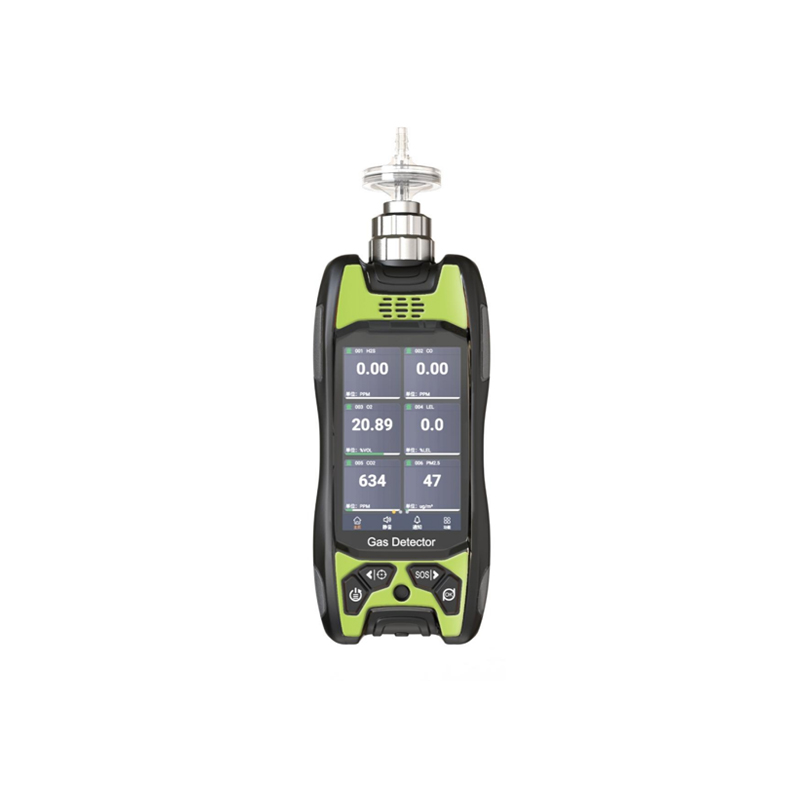
Interface and handling
A 3.5-inch HD colour IPS capacitive touchscreen works alongside four physical buttons, so the unit can be driven with gloves through the buttons or directly on screen for configuration. The built-in pump provides pumped sampling with a pump-blockage alarm, and LED lighting is fitted for dark work areas.
Audible output exceeds 95 dB at 30 cm, backed by visual and vibration alarms and voice prompts. Alarm modes include low, high and zone settings plus TWA/STEL exposure tracking. A fall alarm and an SOS emergency call protect lone workers on large sites.
Records and connectivity
Storage exceeds 1,000,000 records as standard, with an optional card taking capacity beyond 10,000,000 records for continuous logging campaigns. The Type-C port covers charging and data offload.
Wireless options include Bluetooth, WiFi, LoRa and LoRaWAN, MESH networking and 4G/NB-IoT with HTTP, MQTT, TCP and UDP protocols. Optional BeiDou positioning ties readings to a location, and cloud upload with app access and remote alarm notification by phone, SMS or WeChat closes the loop between the worker in the field and the control room.
Choosing between MS600S and MS600
The MS600S and the MS600 are separate models, not trim levels of one unit: the MS600S is the touchscreen, high-storage build described here, while the MS600 is a 2.5-inch display build with an 800 ml/min pump and 100,000 records. Quote requests should name the exact model so the configuration, sensor set and price match the instrument you intend to deploy.
Survey work with the MS600S
Leak survey is a walking measurement: the surveyor covers ground at pace, watching a reading that must respond before the source is passed. The touchscreen interface of the MS600S is built for gloved, one-handed work — large targets, a trend visible at a glance, alarm states that do not need a manual to decode. With more than a million records of storage behind it, a full day of route data lands in one file, and the file is the deliverable: clients and auditors increasingly want the trace, not a summary sentence saying no leaks were found.
The six-gas standard configuration with an optional seventh channel suits survey-plus-entry days: the same instrument that walks the fence line in the morning clears the pit entry after lunch, with the hydrogen channel covering battery rooms the standard four cannot see. Configuration discipline matters here — an instrument that can carry seven gases tempts over-specification, and every unnecessary sensor is weight, cost and calibration time. Specify the six or seven the site actually produces.
Data handling and the infrared option
Infrared combustible sensing changes the survey in two places: poisoned atmospheres where catalytic beads would fade — silicone vapours, sulfur compounds, leaded environments — and oxygen-depleted pockets where a catalytic sensor reads low because it cannot burn. The optional infrared channel keeps the combustible reading honest in both. Its trade-off is blindness to hydrogen, which is why the platform keeps the electrochemical hydrogen channel in the set: the combination, not either sensor alone, is the complete answer for mixed industrial sites.
Download discipline closes the loop. Records move over USB or the optional data cable into the same review workflow as the rest of the fleet; alarm events, calibration history and bump results sit in one timeline. For contractors, that timeline is increasingly the product — the evidence pack handed over with the invoice.
Where the touchscreen earns its keep
Menus on small portables are where good instruments go to be hated: deep trees, long-press codes, settings nobody dares touch in the field. A touchscreen with a phone-like layout shortens training to minutes and, more importantly, makes the right settings reachable at the point of work — alarm review, peak recall, calibration start. Crews that can operate an instrument confidently maintain it better, and maintained instruments are the entire point of a monitoring programme.
Gloves, rain and the touchscreen question
Touchscreens in gas detection attract a fair scepticism: plant is worked in gloves, in rain, with dirty hands, on ladders. The MS600S's interface answers by scale — targets sized for gloved fingers, the critical states (alarm, gas, reading) legible without touching anything, and the touchscreen serving the deliberate interactions: configuration review, calibration, data inspection. The sceptic's test is easy to run and worth running at evaluation: glove up, wet the screen, and perform the three field operations — silence nothing you shouldn't, find the peak readings, start a calibration. An interface that passes is a training asset; one that fails is a daily tax.
Screen-first instruments also change what a supervisor can audit: calibration history, bump results and alarm events are readable on the device itself, at the gate, without a laptop. Spot checks become thirty-second conversations instead of IT requests, and fleets behave differently when their records are that easy to read — the same reason tachographs changed driving.
Seven channels and the discipline of enough
The optional seventh channel invites a useful argument. Candidates for it — hydrogen for battery and reformer areas, chlorine for water treatment duty, ammonia for refrigeration sites — each carry a constituency with a real hazard. The argument is settled by the site's assessments, but the existence of the slot changes procurement politics: instead of a separate special instrument for the minority hazard (different charger, different routine, forgotten in a drawer), the MS600S absorbs it into the standard platform. Minority hazards are where accidents breed, precisely because their kit is exceptional; a platform that makes them ordinary is a safety feature disguised as convenience.
Field glossary for multi-gas survey work
Survey pace — the walking speed at which a pumped instrument's response can still resolve a leak's location; faster than the sensor's transport delay allows and the plume is behind you before the alarm speaks. Plume — the three-dimensional body of escaped gas downwind of a source, shaped by wind, buoyancy and obstacles, and read by its rising and falling edges. Background — the reading the atmosphere gives before the target gas is added, established upwind and revisited whenever the wind or the neighbourhood changes. Dwell — the deliberate pause at each test point that lets the reading settle into evidence. Peak hold — the instrument's memory of the highest reading seen, used to mark a source's centre after passing through it.
Span gas — the certified mixture used to set an instrument's response; for multi-gas survey units it is the multi-component mixture matched to the fitted channels. Cross-sensitivity — one sensor's partial answer to another's gas, tabulated by the manufacturer and carried in the surveyor's head for the site's known pairs. Intrinsic safety — the protection concept that limits electrical energy so the instrument cannot ignite the atmosphere it measures, evidenced by the model's own certification documents. Data docking — the routine by which records leave the instrument for the archive, with the survey's evidentiary value decided by whether the routine actually runs. Alarm fatigue — the human failure mode in which frequent low-value alarms teach crews to discount the real one, managed by honest thresholds and by investigating repeat alarms as findings.
- Gas capacity
- 6-in-1 or 7-in-1
- Sensors
- Front-end plug-and-play digital sensors, calibration-free replacement
- Principles
- Electrochemical, infrared, catalytic combustion, thermal conductivity, PID
- Sampling
- Built-in pump; pump-blockage alarm
- Display
- 3.5-inch HD colour IPS capacitive touchscreen
- Keys
- 4 physical buttons plus touchscreen
- Storage
- More than 1,000,000 records; optional card beyond 10,000,000
- Port
- USB Type-C
- Alarm volume
- More than 95 dB at 30 cm
- Alarm modes
- Low, high, zone, TWA/STEL; fall alarm; SOS call
- Wireless (optional)
- Bluetooth, WiFi, LoRa/LoRaWAN, MESH, 4G/NB-IoT (HTTP/MQTT/TCP/UDP)
- Positioning (optional)
- BeiDou, cloud upload, mobile app, remote alarm by phone/SMS/WeChat
Configuration
Interface and data
Alarms and options
- 6-in-1 or 7-in-1 gas configurations on one platform
- Front-end plug-and-play sensors, replaceable without disassembly
- 3.5-inch touchscreen plus 4 physical buttons
- More than 1,000,000 data records as standard
- Alarm output above 95 dB at 30 cm with voice prompts
- Optional MESH, LoRaWAN and 4G telemetry with BeiDou positioning
Send a target gas list, get a configuration
Quotations are built from the published parameters on this site. Tell us the gases, the ranges and the quantity — or the point schedule for a fixed project — and the reply comes back within 24 hours.
Request a quotation