The pump draws 800 ml/min, so remote sampling through a probe reaches into pits, ducts and vessel nozzles before entry or during leak hunts.
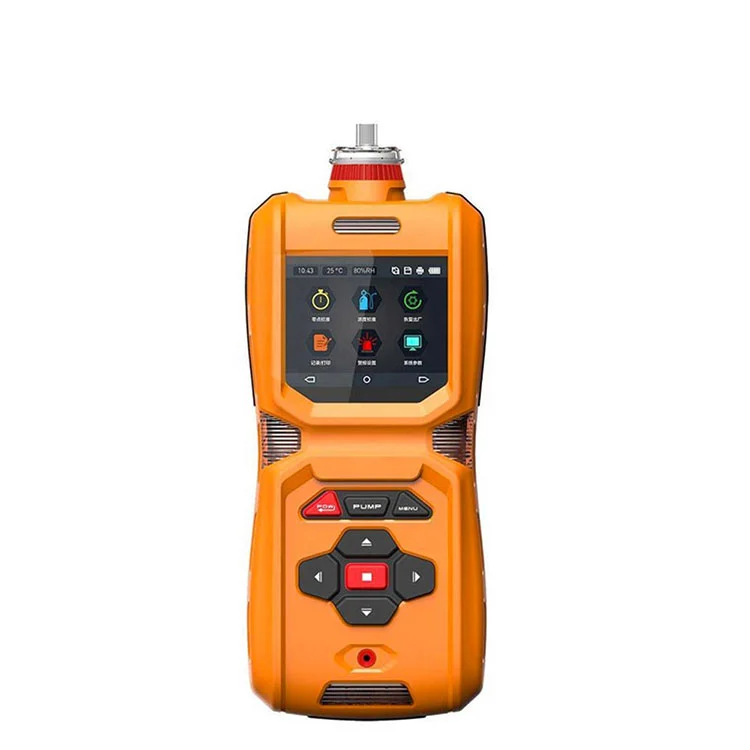
Field performance
The operating window runs from -40 °C to 70 °C with 0–95% humidity, covering cold-store, outdoor winter and hot process environments. Drop resistance is rated at 8 m or more, reflecting a housing designed for toolbox life rather than bench life.
Alarms combine sound, light and vibration at 95 dB measured at 30 cm, with low, high, TWA and STEL modes. A man-down alarm adds a safety layer for solo inspection rounds.
Data and power
The monitor logs 100,000 data records, downloaded over USB, which also handles charging. The rechargeable battery pack is detachable, so a flat pack can be swapped instead of benching the instrument.
Optional WiFi, 4G and LoRa modules move readings to PC software for fleet reporting. Buyers comparing this model with the MS600S should note the two are distinct instruments: the MS600S adds a 3.5-inch touchscreen and million-record storage, while the MS600 is the lighter 2.5-inch build described here.
Analysis-grade portable work
Some measurements cannot wait for a laboratory and cannot be delegated to a safety-grade sensor. Percent-level methane in a biogas engine hall, oxygen purity at a generator outlet, trace hydrogen sulfide ahead of a catalyst bed — these are process numbers, and the MS600 exists to take a portable instrument to them. The platform's span from parts-per-billion traces to 100 %Vol bulk gas means one carrying case covers the diagnostic route: sample conditioning in the bag, the reading on the screen, the record in the file.
Accuracy at this level is a sampling discipline before it is a sensor specification. Lines must be purged, dead volumes flushed, condensation managed, and the reading allowed to settle through the published response time rather than screenshotted at first movement. The instrument's data storage rewards the discipline: a settled, timestamped record is defensible in a way a notebook figure never is.
The pumped sampling chain
Built-in pumping with selectable flow turns the MS600 into a small sampling system. Flow selection matters: too fast across a diffusion-style cell and the reading starves; too slow and transport lag smears the profile of a changing stream. Filters protect the sensors from the particulates that ride process gas; water traps protect them from the condensate that forms when hot wet gas meets a cool line. Specifying the chain — probe, filter, trap, line length, flow — is part of specifying the instrument, and quotations for analysis work should name it.
Battery and shift design
A portable analyser that dies at hour six of an eight-hour diagnostic has failed at its only job. The detachable rechargeable pack lets a second pack ride in the case and swap in seconds, and the published six-to-eight-hour typical endurance sets the honest planning figure for a shift. For multi-day campaigns, the pack rotation — one in the instrument, one on charge, one spare — is the logistics detail that keeps the route moving.
Sample conditioning: the analyser's other half
Every portable analyser's accuracy is decided upstream of its sensors, in the probe, the filter and the water management. Hot streams need cooling or dilution before they meet electrochemical cells; wet streams condense in cool lines and take soluble gases — hydrogen sulfide, ammonia, sulfur dioxide — with them into the trap, flattering the reading; dusty streams blind filters progressively, starving flow in a way that mimics falling concentration. The MS600's pumped architecture assumes a conditioned sample, and professional users document their sampling train per application: probe material and length, filter grade, trap position, target flow. That document, kept with the instrument, is what makes next quarter's readings comparable with this quarter's.
Response time belongs to the same accounting: the published sensor T90 begins when gas reaches the cell, and the line's transport delay precedes it. Long lines on changing streams smear peaks and delay alarms; the remedy is flow, short runs, and readings allowed to settle. Diagnostic work forgives the delay; alarm work must price it in.
Percent and ppm on one platform: range discipline
An instrument spanning parts-per-billion to pure gas tempts a category error: treating one configuration as if it were equally native everywhere. Ranges are chosen per channel at configuration, sensors are fitted per range, and the accuracy story differs between a trace channel working at its floor and a bulk channel mid-span. The quotation should therefore name each channel's working range against the streams it will actually meet — a channel ranged 0–100% that spends its life at 0.3% is a wasted channel, and a trace channel asked to read process upsets will saturate exactly when the information matters. Range discipline is cheap at order time and expensive afterwards.
Glossary for analysis-grade portable work
Sample conditioning — the treatment of a gas stream between the process and the sensor: cooling, drying, filtering, pressure regulation, each step chosen so the measurement represents the stream rather than the sampling system's accidents. Transport delay — the time a sample spends in the line, added to sensor response time before any reading may be judged. Dead volume — the unswept space in fittings and traps where old sample lingers and smears a changing stream's profile. Span drift — the slow migration of an instrument's response between calibrations, trended from calibration records. Detection floor — the concentration below which a channel's output is indistinguishable from its own noise, and below which numbers should be reported as 'less than', not as digits.
Percent volume — the bulk scale of process gas, one percent being ten thousand ppm. Trace — the ppm and ppb country where exposure and leakage questions live. Dilution fitting — a calibrated leak or venturi stage that brings an over-range stream into a sensor's span, at the price of a factor that must ride with every reading. Multipoint sampling — one analyser serving several sample points in sequence through a manifold, with purge times per point written into the sequence. Baseline survey — the first disciplined measurement of a stream or area, against which every later change is judged, and whose documentation quality decides its worth.
Ownership notes from the field
Owners of analysis-grade portables develop habits worth copying. They keep the instrument's configuration printed in its case, because the person troubleshooting a stream at midnight should not have to interrogate a menu to learn what the box is fitted with. They log every sampling train change — a longer line, a different filter — in the same notebook as the readings, because the train is part of the measurement. They retire sensors by the calibration record rather than by failure, and they keep one channel's worth of spares for the streams that cannot wait. None of this is in the manual, and all of it is the difference between an analyser and an ornament in a fitted case.
They also schedule the instrument's own proving: a known stream, a reference gas, a co-located reading against a fixed analyser, on a rhythm that suits the duty. Portable analysis drifts unobserved more easily than fixed analysis, because nobody watches its zero between campaigns; the proving rhythm is the owner's answer, and its records are what make a portable's numbers admissible in arguments with process engineers.
- Gas capacity
- Up to 6 gases simultaneously
- Targets
- Toxic gases, flammable gases and vapours, oxygen
- Pump
- Internal pump, 800 ml/min
- Display
- 2.5-inch colour display
- Operating range
- -40 to 70 °C, 0–95% humidity
- Drop resistance
- 8 m or more
- Battery
- Rechargeable, detachable pack
- Storage
- 100,000 data records
- Alarms
- Sound, light, vibration; 95 dB at 30 cm; low / high / TWA / STEL
- Extra safety
- Man-down alarm
- Interface
- USB for data and charging; optional WiFi / 4G / LoRa; PC software
Measurement
Build and environment
Data and alarms
- Up to 6 gases at once, including oxygen and flammables
- 800 ml/min internal pump for remote sampling
- Works from -40 °C to 70 °C; drop resistance 8 m or more
- 100,000 records, USB download, detachable battery pack
- Man-down alarm for lone-worker rounds
Send a target gas list, get a configuration
Quotations are built from the published parameters on this site. Tell us the gases, the ranges and the quantity — or the point schedule for a fixed project — and the reply comes back within 24 hours.
Request a quotation