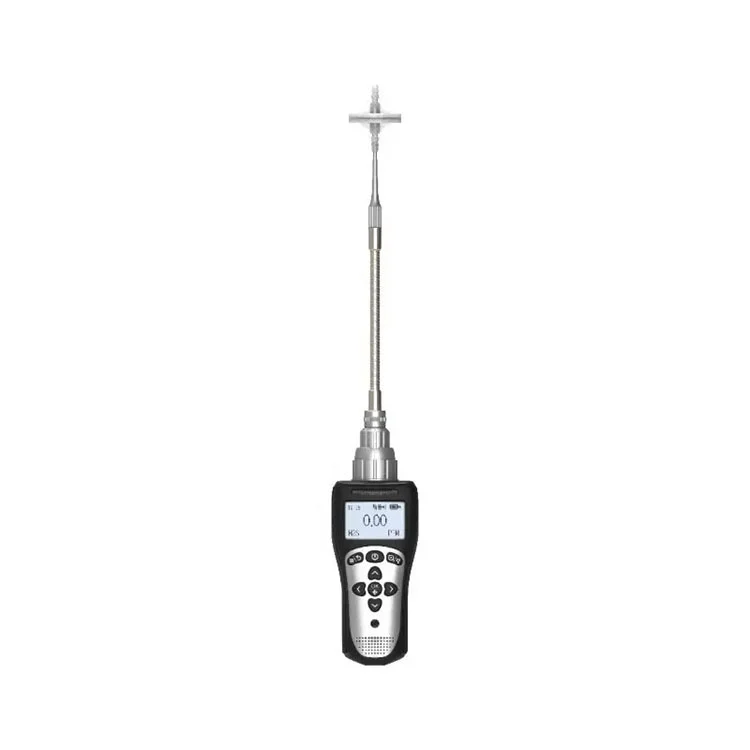
The MS400 platform reads oxygen at 0–30 %Vol with 0.01 %Vol resolution and a T90 inside 10 seconds — fast and fine enough to watch a space being purged or a worker descending.
Why oxygen goes first
Oxygen displacement is mechanism, not gas: nitrogen, argon, carbon dioxide, methane — anything that is not air pushes the percentage down without smell or warning, and the entrant's own body is a poor sensor that fails at roughly the moment consciousness does. Hence the rule structure of entry work: test before entry, test continuously during entry, and test oxygen first because it validates the space for every other measurement.
Enrichment is the forgotten twin: leaking oxygen lines in welding shops, hospitals and water treatment raise fire risk dramatically, and the same 0–30 %Vol span watches both directions.
Sensors and settings
Galvanic electrochemical cells are the standard oxygen sensor — self-powered, linear across the span, and consumed by the very gas they measure, which sets their service rhythm. Pressure matters: readings are partial-pressure sensitive, so altitude and purging change interpretation, and calibration in fresh air (20.9%) is the field ritual that anchors the scale.
Oxygen channels appear across this site's range — in the portable platforms, in the MIC100 fixed points for inerted areas, in analyzer panels and the MS800A-10 station — because there is no gas programme that does not begin with the air itself.
Deficiency: the mechanics of the silent space
Oxygen deficiency is manufactured by ordinary processes: nitrogen blanketing and purging that leak into work areas, carbon dioxide generation displacing air in cellars, rust consuming oxygen inside sealed tanks, microbial action in stored grain and biomass, welding gases pooling in hulls and vessels. None of these announces itself; the atmosphere simply stops supporting its occupants, and the first symptom is impaired judgement — the victim is the last to know. Fixed points at the entrances of blanketed and purged areas, personal monitors on everyone who enters suspect spaces, and pre-entry testing as an unbreakable rule are the three walls against a hazard with no warning properties of its own.
Enrichment: the fire that has not happened yet
Oxygen enrichment inverts the familiar risk: materials burn faster, hotter and at lower ignition energies; clothing and hair become fuels; greases and oils approach auto-ignition. Oxygen production, storage and transfer areas, hospital and hyperbaric facilities, and any place where oxygen lines can leak into enclosures carry the enrichment risk, and it is chronically under-monitored because deficiency has the better publicity. Dual-direction alarming — the defining feature of oxygen instruments — exists precisely for this symmetry, and schemes should name both thresholds with the same seriousness.
Choosing the oxygen sensor
Galvanic cells are the portable standard: self-powered, honest, and finite — consumed by the very gas they measure, faster at high concentrations and pressures. Paramagnetic and zirconia analysers serve fixed percent measurement where precision and longevity justify the sampling system. At altitude and in pressure-swing processes, partial pressure is the quantity that matters physiologically and chemically, and instruments that report it — or compensate for pressure — prevent the subtle error of a percentage reading taken where the total pressure is not the sea-level assumption baked into a naive display.
Oxygen specification checklist
Oxygen's checklist is short because its physics is singular, but every line earns its place: both alarm directions named with thresholds (deficiency at the conventional 19.5%, enrichment at 23.5% in common practice, adjusted where the site's assessment argues otherwise); the sensor technology matched to duty (galvanic cells for personal and portable work, paramagnetic or zirconia for fixed precision, any of them pressure-compensated where altitude or process pressure matters); response fast enough for the entry and area duties it guards; and the sampling pattern — diffusion at the breathing zone for people, pumped draws for pre-entry levels, fixed points at doors and low places for areas. The final line is procedural and absolute: the instrument never substitutes for the entry discipline around it, and the specification should name the discipline it joins — permit, attendant, ventilation, rescue — so the quotation can be judged as part of a system rather than as a talisman.
Oxygen terms
Oxygen deficiency — air below the conventional 19.5% threshold, whatever the displacing agent. Oxygen enrichment — air above roughly 23.5%, in which materials become fuels and fuels become eager. Inerting — the deliberate displacement of oxygen by nitrogen or another inert gas to prevent combustion, whose leaks manufacture deficiency next door. Blanketing — the maintenance of an inert atmosphere over a stored product, a permanent inerting with permanent neighbours. Galvanic cell — the self-powered electrochemical oxygen sensor, consumed by the gas it measures. Paramagnetic susceptibility — oxygen's distinctive magnetic behaviour, the precision fixed principle.
Partial pressure — the quantity altitude and process pressure change behind a constant percentage, and the quantity physiology actually reads. Asphyxiant — any gas whose harm is the oxygen it displaces, simple or chemical in kind. Rusting consumption — the slow oxidation inside sealed steel vessels that can render their air unbreathable without any added gas. Purging — the displacement of one atmosphere by another, whose endpoints are proven by measurement, not by elapsed time. Confined-space pre-test — the remote oxygen reading that opens every entry sequence, on which the other channels' meanings depend. Enrichment fire behaviour — the lowered ignition energies and accelerated burning that make oxygen leaks a fire officer's subject as much as a hygienist's.
Oxygen in the contract of entry
Because oxygen's reading frames all others, entry regimes make it the permit's first signature and its most rehearsed number. That status deserves one more emphasis: an oxygen reading is a claim about the whole atmosphere, and it can be wrong in instructive ways — a galvanic cell at the end of its life reading low and flattering no one, a sample drawn from the wrong stratum, a pressure difference between the calibration room and the vessel. The defences are the standing ones: bump before, calibrate on rhythm, sample at levels, and treat a surprising oxygen number as the beginning of an investigation, never as a clerical error to be rounded toward comfort. The gas that measures everything else must itself be measured with suspicion.
Oxygen's two alarms in one shift
A single shift can meet both of oxygen's faces: the morning's tank entry, where a rusting interior has eaten the air toward deficiency and the pre-test's low reading rewrites the job into a ventilated, monitored entry; the afternoon's oxygen-line repair in the plant room, where a leaking flange has enriched a corner past the threshold and the fixed point's high alarm empties the room of hot work until the leak is found. Crews who have lived that day stop thinking of oxygen as the simple channel. The instrument that guards both directions with equal seriousness — and the training that gives the enrichment alarm the same obedience as the deficiency alarm — is the difference between a site that knows oxygen and a site that merely measures it.
The oxygen channel's calibration peculiarity
Oxygen sensors calibrate against the air itself — the one gas whose span concentration surrounds the calibrator at a known value — and that convenience hides a discipline: the air must actually be air, uncontaminated by the process next door, at a pressure the instrument accounts for. Fleets that span their oxygen channels beside an exhaust or inside a nitrogen-blanketed workshop have calibrated their fleet to a fiction and will read the world wrong by exactly that fiction's size. The remedy is a sentence in the procedure — fresh air means outside air, away from vents — which this guide hereby supplies to any procedure that lacks it.
| Instrument | O2 measurement | Role |
|---|---|---|
| MS400 platform | 0–30 %Vol, 0.01 %Vol resolution, T90 ≤10 s | Entry testing and personal monitoring |
| MIC100 | O2 among four fixed channels | Inerted-area watch |
| MS800A-10 | O2 in ambient panel | Station monitoring |
Send a target gas list, get a configuration
Quotations are built from the published parameters on this site. Tell us the gases, the ranges and the quantity — or the point schedule for a fixed project — and the reply comes back within 24 hours.
Request a quotation