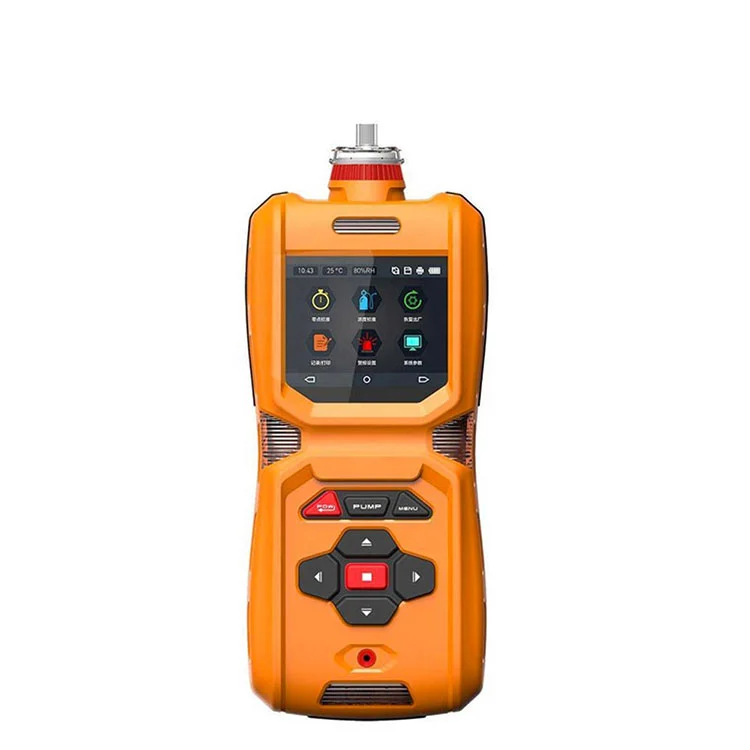
The 4-in-1 side is the MS400S and the MS104K-M. The 6-in-1 side is the MS600 (six gases) and the MS600S (six or seven gases). All four are pumped instruments with datalogging; they differ in display, storage, telemetry and intended crew.
What the extra channels buy
Channels five and six typically carry the gases a risk assessment adds to the core four: carbon dioxide in beverage, fermentation and cold-storage work; volatile organics by PID in chemical and remediation work; ammonia, chlorine or sulfur dioxide where the process names them. If your permits never name a fifth gas, the 4-in-1 class covers the work at lower purchase and calibration cost.
Calibration is the hidden multiplier: every channel is a sensor to bump, calibrate and eventually replace. A six-channel fleet carries roughly half again the sensor budget of a four-channel fleet, which is why mixed fleets — 4-in-1 for general crews, 6-in-1 for process crews — are the common pattern.
Sampling and data differences
Sampling separates the pairs further. The MS400S switches between its built-in pump and diffusion; the MS104K-M carries a standard external pump in a smaller body; the MS600's internal pump draws 800 ml/min for remote points; the MS600S pairs its pump with a touchscreen and storage beyond a million records for logging-heavy programmes.
Telemetry follows the same gradient: the 4-in-1 models offer wireless options on the MS400S, while the MS600S adds MESH and LoRaWAN networking with positioning for site-wide systems. Choose the data path your safety system will actually consume.
The short answer
Standardise on 4-in-1 where the core four gases define the hazard and crews are large. Step up to 6-in-1 where named extra gases, heavier logging or telemetry justify the sensor budget. Both classes share the same alarm philosophy — low, high, TWA and STEL — and the same calibration discipline.
Reading the comparison as a safety case
Strip the marketing from both options and the safety case is short. The four-gas instrument protects against the four atmospheres that produce the overwhelming majority of confined-space and general industrial casualties. The six-gas instrument adds protection where a documented fifth or sixth hazard exists — and subtracts a little everywhere else, in weight, in calibration burden, in the chance that an unnecessary sensor's fault sidelines the unit. Safety cases are not improved by surplus; they are improved by fit. The documented-hazard test is therefore not a purchasing preference but the correct method: hazards identified by the site's own assessments get channels; hazards imagined by a catalogue do not.
Total cost over the fleet's life
Price the five-year picture before choosing: purchase, then the consumables curve — sensor replacements per channel, calibration gas per routine, pump filters and tubing for the pumped variants — then the downtime cost of a larger fleet's longer service sessions, then the residual value of standardisation. Six-gas fleets cost more per unit-year in every line, which is money well spent where the gases are real and money burned where they are not. Conversely, a four-gas fleet that must be supplemented by single-gas instruments for chlorine or hydrogen duty loses its simplicity advantage; the honest comparison is between complete systems for the actual hazard set, not between two bare instruments.
A decision rule that survives audits
Write the rule down: channels follow documented hazards; the standard fleet instrument is the smallest configuration covering the site's universal hazards; extended configurations are issued against named areas or tasks whose assessments name the extra gases. That rule survives audits, budget reviews and the arrival of enthusiastic sales literature, because it ties every channel on every instrument to a piece of the site's own evidence. It also ages well — when a new process adds a gas, the rule admits the new channel by the same evidence that excluded the old temptations.
Weight, and what it does to compliance
An instrument's protection is proportional to its presence on the body, and presence is a function of weight, bulk and annoyance. The six-gas unit's extra cells, larger battery and (often) pump make it the heavier companion across a twelve-hour shift, and heavier companions get set down — on the bench, in the cab, beside the hatch — precisely when the work gets physical. Compliance audits that weigh instruments are not being cute: they are measuring the probability that the protection is present at the unplanned moment. Where the six gases are needed, that cost is paid knowingly and managed; where they are decoration, it is paid for nothing, daily, in the currency that matters most.
Calibration logistics as the deciding spreadsheet
Run the two fleets through one maintenance year on paper. The four-gas fleet bumps on one mixture in under a minute a unit and calibrates in a short bench session; the six-gas fleet adds mixtures or a second application, longer sessions, more cells drifting on more clocks, and a spares shelf half again as deep. Multiply by fleet size and by the loaded cost of the technician's hour, then set the difference against the incidents the extra channels could plausibly have changed. That spreadsheet — not the catalogue prices — is the comparison's honest bottom line, and safety managers who build it usually find the answer is fleet-shaped: four for the many, six for the named few.
Terms the comparison depends on
Standard gas set — the four channels (oxygen, combustibles, carbon monoxide, hydrogen sulfide) that cover the common confined-space hazard profile. Extended set — any configuration beyond the standard four, justified channel by channel from documented hazards. Documented hazard — a gas named by the site's own risk assessments for a place or task, the only legitimate author of an extra channel. Dock throughput — the number of instruments a bump-and-charge station can ready in the morning window, a fleet-size constraint disguised as furniture. Sensor annuity — the yearly consumable cost a channel imposes in cells, gas and bench time, payable for the instrument's whole life.
Issue discipline — the desk routine that decides whether instruments leave tested or merely charged. Weight budget — the total carried load a worker's belt and chest can bear before equipment starts being set down. Configuration freeze — the fleet decision that every unit of a class shares thresholds and behaviour, so any instrument feels familiar in the dark. Task-issued instrument — a unit assigned per job from a pool, the pattern that suits extended configurations. Personally-issued instrument — a unit assigned per worker, the pattern that suits the standard set and builds ownership of its care.
The tie-breaker questions
When the spreadsheet and the safety case leave the choice close, three questions break the tie. Which configuration will the crews actually wear for twelve hours in August? Which one's calibration routine survives the site's real staffing in the turnaround month? And which failure — a missed fifth-gas event, or a standard instrument left in the van — does the site's own history say is likelier? Answering from history rather than from imagination is the whole method of this comparison in miniature, and it generalises: detection choices made from a site's own evidence compound in value, while choices made from other sites' fears merely compound.
| Point | MS400S (4-in-1) | MS104K-M (4-in-1) | MS600 (6-in-1) | MS600S (6/7-in-1) |
|---|---|---|---|---|
| Gases at once | 4 | 4 (any four) | 6 | 6 or 7 |
| Sampling | Built-in pump, switchable to diffusion | External pump standard; pumped/diffusion | Internal pump 800 ml/min | Built-in pump |
| Display | 2.31-inch HD colour | 2-inch LCD | 2.5-inch colour | 3.5-inch touchscreen |
| Storage | More than 200,000 records | 200,000 records | 100,000 records | More than 1,000,000 records |
| Ingress / build | IP68 | IP68 | Drop resistance 8 m+, -40 to 70 °C | Touchscreen field build |
| Alarms | Sound/light/vibration/voice; fall; SOS option | 95–105 dB; pump-blocked; man-down | 95 dB at 30 cm; man-down | Above 95 dB at 30 cm; fall; SOS |
| Telemetry | Optional Bluetooth/WiFi/LoRa/4G/NB-IoT | PC software export | Optional WiFi/4G/LoRa | Bluetooth/WiFi/LoRaWAN/MESH/4G, BeiDou option |
- Core-four permits and large crews: 4-in-1 class
- Named fifth/sixth gases or heavy logging: 6-in-1 class
- Mixed fleets are the common professional pattern
- Every channel is a calibration duty — count sensors, not just instruments
Send a target gas list, get a configuration
Quotations are built from the published parameters on this site. Tell us the gases, the ranges and the quantity — or the point schedule for a fixed project — and the reply comes back within 24 hours.
Request a quotation