Pumped sampling matters when the measurement point is not where the worker is standing — the bottom of a pit, the far side of a bund, the headspace of a tank. The pump draws the atmosphere to the sensors while the operator stays at a safe distance.
Measurement and alarms
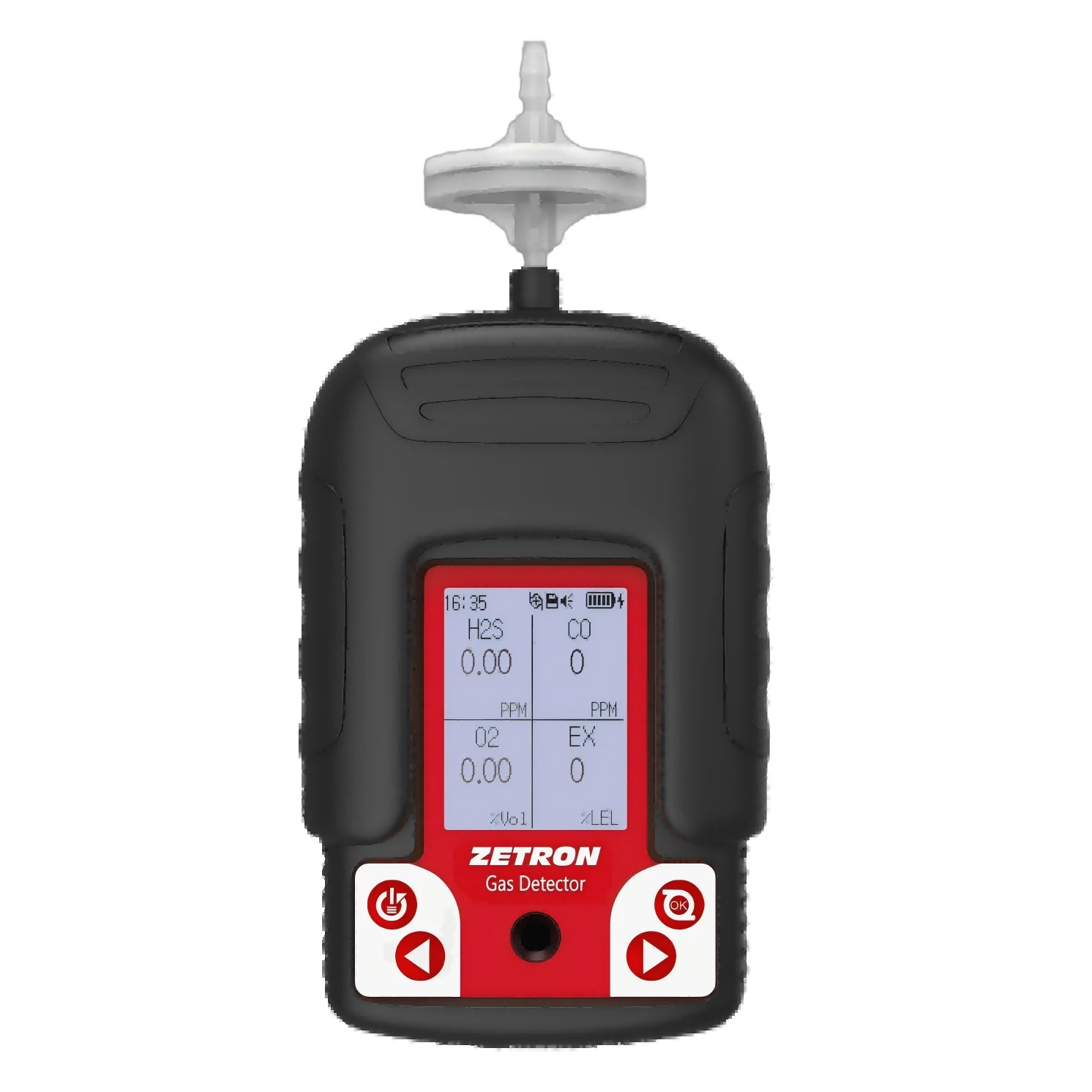
Readings show on a 2-inch LCD with four-button control. Alarms run at 95–105 dB with sound, light and vibration channels and three alarm levels, covering low and high concentration thresholds plus STEL and TWA exposure limits.
A pump-blocked alarm flags a kinked or flooded sample line instead of silently reporting clean air, and a man-down alarm covers the wearer. The housing is rated IP68, so washdown and rain are not concerns.
Power and data
The rechargeable battery is a 7.4 V, 1400 mAh pack. Storage holds 200,000 records, and PC software exports and analyses the logged data for exposure records and incident review.
Against the MS400S, the MS104K-M is the smaller, lighter four-gas option with a standard external pump; the MS400S adds a larger colour display, Type-C fast charging and wireless options. Sites standardising on one platform usually choose by the sampling style their procedures assume.
Why pumped sampling changes the entry
Diffusion instruments measure the air that reaches them; pumped instruments go and fetch the air that matters. The MS104K-M's built-in pump, drawing up to 30 metres, lets the tester stand at the hatch and interrogate the bottom of the vessel, the far end of the trench, the low corner where vapours pool — before a boot crosses the threshold. The sample delay over a long line is a known quantity: allow the transport time, watch the reading settle, and only then judge the space. Entries judged on fetched samples are the entries that stay routine.
Pumped sampling also protects the instrument's judgement during the entry itself. A diffusion unit on a chest strap samples the entrant's immediate surroundings; a pumped unit can keep drawing from a fixed probe at the work level while the entrant moves. Both patterns are legitimate — the specification question is which atmosphere the permit is actually about.
Three sensor families, one routine
Catalytic, infrared and PID options behind one housing mean the fleet's routine stays constant while the sensing matches the gas. Catalytic beads for general combustible duty; infrared where poisons or low oxygen would corrupt a bead, accepting its hydrogen blindness and pairing accordingly; PID where the hazard is solvent vapour at toxic rather than flammable concentrations. Training, charging and bump routines do not change when the sensor does, and that constancy is what keeps a mixed fleet honest.
Line management on pumped work
Thirty metres of sample line is a tool and a responsibility: it kinks at hatch edges, pools condensate in its low bends, adsorbs sticky gases onto long runs of the wrong material, and adds a transport delay the tester must respect. The professional kit treats the line as an instrument — coiled without sharp bends, inspected for damage, kept to the length the job needs rather than the length the reel holds, and purged with clean air between spaces so yesterday's vessel does not testify about today's. Reactive gases deserve short lines and scepticism; inert targets forgive more. The pumped instrument's display is only ever reporting the end of that line, and the tester who forgets it has measured a hose.
Calibration and bump practice for pumped units includes the pump itself: flow-fail alarms proven by blocking the inlet, filters on the replacement rhythm the dust load dictates. A pump drawing at half rate through a clogged filter still samples — badly, slowly, plausibly — which is the failure shape this entire catalogue warns about in every technology it touches.
Diffusion days and pumped days
Fleets often discover the MS104K-M pattern backwards: a diffusion fleet finds its entries queuing for the one pumped unit, or a pumped fleet finds its wearers resenting the line on continuous duty. The resolution is role separation — pumped instruments owned by the testing role, diffusion by the wearing role — and the MS104K family makes that separation cheap because both roles share one platform's routines, alarms and spares philosophy. The mixed fleet's specification reads like a roster, again: testers times concurrent entries, wearers times crew size, and a margin for the calibration rotation that keeps both honest.
Glossary for pumped single-gas testing
Sample draw — the act of pulling a remote atmosphere to the sensor through a line, converting a diffusion instrument's patience into reach. Probe — the rigid or flexible tube that enters the space first, in sizes from a hatch crack to a vessel's full depth. Transport lag — the line's delay, computed from its length and the pump's flow, and owed to every reading before judgement. Flow-fail alarm — the pump's confession that it is no longer drawing, without which a blocked line would report clean air. Water trap — the condensate guardian between a wet space and a dry sensor. Filter sock — the sacrificial element that takes the dust so the sensor does not.
Pre-entry test — the remote examination of a space's atmosphere before a body follows, performed at levels because still air stratifies. Stratification — the layering of gases by density in undisturbed air, the reason top, middle and bottom are three different spaces. Continuous monitoring — the wearing role that succeeds the test, watching the entrant's air for the changes work itself produces. Attendant — the person outside the space who owns the test record, the communication and the retrieval plan. Retrieval system — the tripod, winch and harness that extract an entrant without a second entry. Permit space — a confined space whose hazards have earned it a written entry regime.
Training testers on the pumped pattern
Competent pumped testing is a taught skill with specific failure drills: the blocked line that must announce itself through the flow alarm; the reading taken too early, recognised by its still-climbing trace; the stratified vessel, sampled at one level by a lazy routine and at three by a trained one; the hose with yesterday's atmosphere still in it. Trainers should manufacture each failure in a safe rig and let trainees catch themselves making it, because the hatch is a poor classroom and the drills are cheap. Certification of testers — observed, signed, refreshed — is the programme's way of keeping the skill after the trainer leaves.
The tester's other instrument is language: readings reported with their gas, scale and level ('oxygen twenty point eight at the top, nineteen point nine at the sump') build the shared picture the permit signs against. Programmes that drill the reporting phraseology get entries that a supervisor can actually supervise from outside the space.
- Gas capacity
- Any 4 gases configurable
- Sampling
- Pumped and diffusion; external pump standard
- Ingress rating
- IP68
- Display
- 2-inch LCD
- Buttons
- 4
- Storage
- 200,000 records
- Software
- PC export and analysis
- Battery
- 7.4 V, 1400 mAh rechargeable
- Alarms
- Sound, light, vibration; 95–105 dB; three levels; low / high / STEL / TWA
- Extra safety
- Pump-blocked alarm; man-down alarm
Measurement
Interface and data
Power and alarms
- Any four gases configurable in one compact unit
- External pump fitted as standard; pumped or diffusion sampling
- 200,000 data records with PC software export
- IP68 housing, 2-inch LCD, four-button control
- Pump-blocked and man-down alarms
Send a target gas list, get a configuration
Quotations are built from the published parameters on this site. Tell us the gases, the ranges and the quantity — or the point schedule for a fixed project — and the reply comes back within 24 hours.
Request a quotation