Data integrity is the second design centre: multi-level user permissions, a full audit trail, and electronic records and signatures in the FDA 21 CFR Part 11 pattern, so the counter's data can stand inside a regulated quality system.
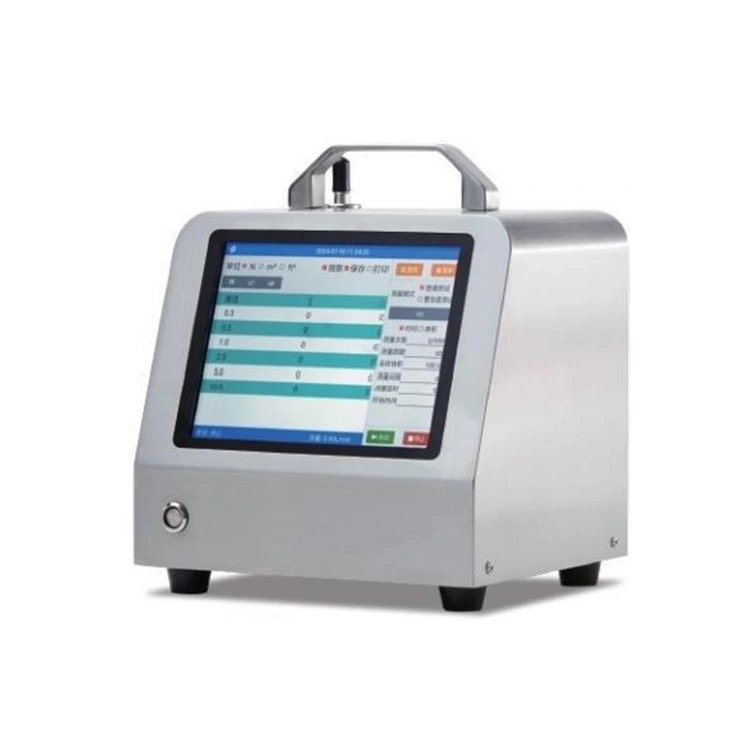
Records and reporting
Sampling records exceed 1,000,000, and results leave the instrument by USB as PDF reports plus raw data. A practical touch for qualification work: the counter calculates the required number of monitoring points from the cleanroom area automatically, following the ISO 14644 approach, and room names can be kept in Chinese or English.
The 8-inch touchscreen is sized for gloved operation and for reviewing a round's results standing at the instrument rather than back at a desk.
Family position
The base B110 is a separate model, published with a 28.3 L flow class and its own storage figure, and the B1030 is the 0.1 µm six-channel portable. The B110-Pro is the regulated-environment build of the family: stainless shell, audit trail and million-record storage. Name the model your specification is written against, and the quotation will be built on that model.
Records that survive an audit
In a regulated cleanroom the count is only half the deliverable; the other half is the record's integrity — who measured, where, under what recipe, with what instrument state, and proof the file was not edited afterwards. The B110-Pro's electronic-record design in the FDA 21 CFR Part 11 pattern addresses exactly that: user management that ties results to people, audit trails that log changes, recipe and sampling-point management that makes the plan part of the record. Quality teams should map their own documentation procedures onto these features at qualification time, because a record system only protects the facility if the procedures use it as designed.
Storage depth — more than a million records — changes behaviour at the bench: nobody deletes history to make room, nobody transcribes by hand at shift end. Combined with multi-format export, the counter's archive becomes the room's memory, queryable when a deviation investigation asks what the air was doing three Tuesdays ago.
Programmes for classification and for routine monitoring
Classification and routine monitoring ask different things of the same counter. A classification round samples to the standard's grid — the B110-Pro calculates the required number of monitoring points from the cleanroom area automatically — while routine monitoring returns to a few meaningful points frequently, under stored recipes and sampling-point plans. Both programmes run on the same record discipline: more than a million sampling records on board, an audit trail that logs every change, and exports that carry the result with its context, so a count gathered on a routine round and a count gathered for classification can be told apart years later.
Qualification: IQ, OQ and the counter's paper life
A regulated counter accumulates a paper life parallel to its working one: installation qualification proving it is the instrument ordered, installed where intended; operational qualification proving its flow, sizing and counting against reference standards; performance qualification proving it inside the facility's own procedures. The B110-Pro's features — recipes, sampling-point management, user roles, audit trail — are the substance those qualifications examine, and they should be configured as part of qualification, not discovered afterwards. Sites that qualify the configuration, not just the hardware, avoid the audit finding that writes itself: a compliant instrument running an unqualified process.
Change control continues the paper life: recipe changes, user additions, clock synchronisation, export-path changes — each a controlled event in the audit trail, reviewed on the quality system's rhythm. The counter's million-record memory is an asset here precisely because nothing needs deleting; the archive and the audit trail age together, and an investigator can walk a result from the screen back to the shift, the operator and the room state without meeting a gap.
Sterile core versus supporting grades
Facilities commonly tier their fleets: the high-flow, fully-featured counter for the sterile core where sample volumes are the statistical argument, standard counters for the supporting grades where frequency matters more than volume per sample. The tiering works when the data regime is one — same export discipline, same review meeting, same deviation pathway — because excursions do not respect the fleet's internal borders. Specify the regime once, centrally, and let the instruments differ underneath it; the reverse arrangement, identical instruments under fragmented regimes, produces beautiful hardware and indefensible data.
Glossary for regulated cleanroom counting
Audit trail — the chronological, tamper-evident record of who did what in the instrument's data, the spine of electronic-record compliance. Electronic signature — the credential-bound act that ties a person to a record's approval. User role — the permission set that decides who may run, review, configure or merely witness. Recipe — the governed sampling plan: points, volumes, limits, stored under change control. Sampling point management — the registry that binds physical locations to their recipes and histories. Data integrity — the property that records are complete, consistent and unaltered, summarised in the ALCOA principles the auditors recite.
Qualification — the documented proof, in installation, operational and performance stages, that an instrument and its configuration do what the facility's procedures claim. Change control — the regime under which recipes, users and settings may be altered, each change reasoned and recorded. Deviation — the documented departure from an expected result or procedure, investigated to its cause. Trend report — the periodic reading of a point's history against its baseline, the regulated room's early-warning instrument. Retention — the period for which records are kept, set by the product's regulatory life rather than by storage convenience. Export validation — the proof that data leaving the instrument arrives in the quality system unchanged, checked like any other transfer of custody.
The investigation the counter must one day serve
Every regulated counter should be bought against a imagined future day: a deviation meeting, eighteen months hence, asking what the air was doing around a particular batch on a particular night. The questions arrive in order — which points, what counts, whose operation, what instrument state, can we trust the file — and the B110-Pro's architecture is a set of pre-written answers: the point registry, the recipe that ran, the user who ran it, the audit trail that proves the file's biography, the archive deep enough that nothing was overwritten. Buyers should rehearse that day during evaluation, with the vendor's demo data, because the meeting will not accept a demonstration; it will accept records.
The counter's place in the quality system
In the quality system's anatomy, the B110-Pro is a sensory organ with a notary attached: it perceives the room's air and certifies its own perceptions. That dual nature is why its purchase belongs jointly to production (which needs the perception) and quality (which needs the notarisation) — and why specifying it from either office alone produces the classic half-instrument: a superb counter whose records the auditors cannot use, or a superb record system attached to sampling nobody trusts. The joint specification meeting, with the deviation scenario on the table, is an hour that decides a decade of investigations, and this page's advice is simply to hold it before the order rather than after the first audit finding.
Counting people in, counting on them
The regulated counter's user management is usually read as a control, and it is kinder read as a courtesy: it remembers who is trained, relieves operators of proving it nightly, and lets a new technician inherit a running programme without inheriting its doubts. Facilities should populate the roles as carefully as the recipes — reviewers who actually review, administrators whose changes are themselves reviewed — because an audit trail reviewed by nobody is a diary, and a diary is not a control. The instrument supplies the machinery; the facility supplies the attention that makes it governance.
- Shell
- 316L stainless steel, disinfectant-resistant
- Display
- 8-inch touchscreen
- Access
- Multi-level user permissions
- Trail
- Full audit trail
- Records
- Electronic records and signatures in the FDA 21 CFR Part 11 pattern
- Storage
- 1,000,000 or more sampling records
- Export
- USB: PDF reports plus data
- Point calculation
- Automatic calculation of required monitoring points from cleanroom area (ISO 14644 approach)
- Room names
- Chinese or English
Build
Data integrity
Qualification aids
- 316L stainless shell that tolerates cleanroom disinfectants
- Audit trail and multi-level permissions for regulated data
- More than 1,000,000 sampling records, USB PDF export
- Automatic ISO 14644-style point calculation
Send a target gas list, get a configuration
Quotations are built from the published parameters on this site. Tell us the gases, the ranges and the quantity — or the point schedule for a fixed project — and the reply comes back within 24 hours.
Request a quotation