The instruments divide by principle and by posture: catalytic and infrared point sensors, in portables that hunt and fixed points that stand guard.
Principles: catalytic and infrared
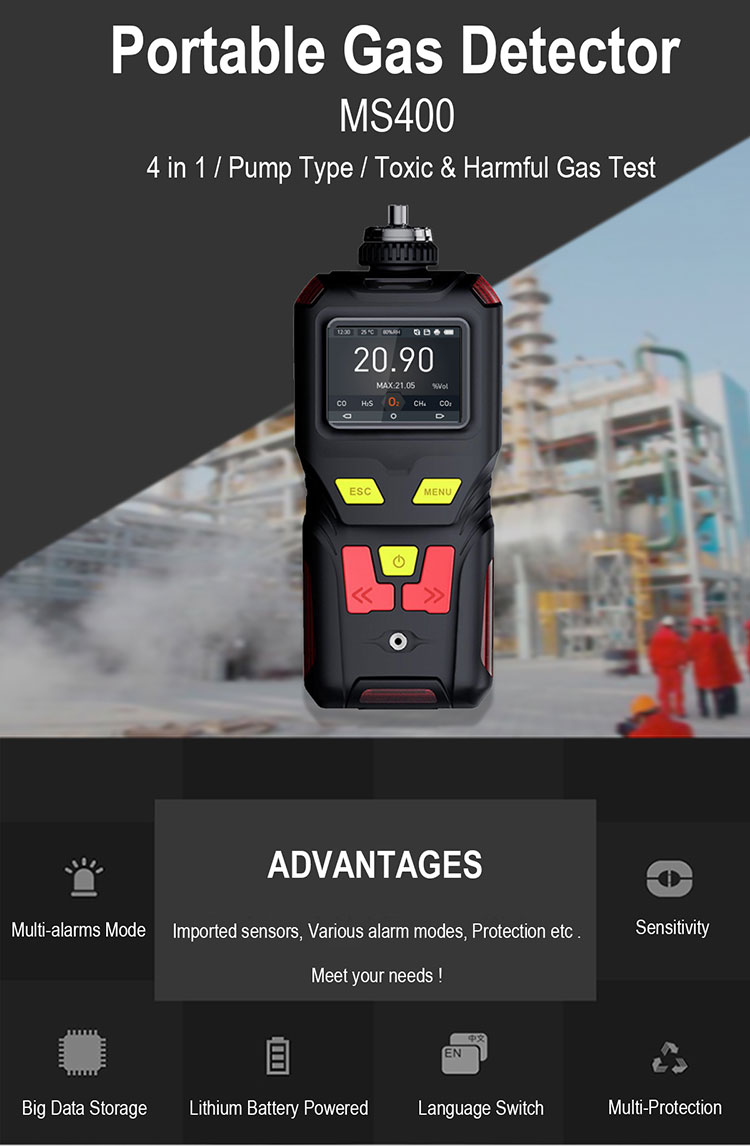
Catalytic bead sensors oxidise the gas on a heated element and read the heat: simple, responsive to nearly all combustibles, but needing oxygen and vulnerable to poisons like silicones. Infrared sensors read absorption at the gas's wavelength: no oxygen needed, poison-immune, but blind to hydrogen. The MS400 platform table reads combustible gas (EX) and methane both at 0–100 %LEL with T90 inside 10 seconds.
Response factors matter: a catalytic sensor calibrated on methane reads other gases approximately, and professional practice corrects or calibrates for the target gas. The calibration guide covers the routine.
Placement and posture
Fixed combustible points sit where gas collects: high for methane and hydrogen, low for heavy vapours, and always between the likely source and the likely ignition. Portable combustible checks precede and accompany hot work, entries and leak response.
The methane guide develops the fuel-gas special case; the fixed detectors category covers point selection; and the confined-space page sets the entry pattern where combustible readings gate the permit.
The flammability picture in full
A combustible gas burns only inside its range: below the lower explosive limit the mixture is too lean, above the upper limit too rich — though the path to the upper limit passes through the explosive range, and rich atmospheres dilute into danger at their edges, which is why 'too rich to burn' is a trap phrase. Inerting, ventilation and detection all manage position within that picture: inerting pushes the mixture's oxygen below the combustion threshold, ventilation dilutes fuel below the LEL, and detection watches the approach. Instruments reporting percent LEL measure the fuel side of the picture; oxygen measurement watches the other — and engineered schemes for enclosed processes monitor both, because flammability is a property of the mixture, not of the gas alone.
Sensor selection by atmosphere, again
The catalytic-versus-infrared decision is this guide's version of the universal question. Catalytic beads answer nearly every combustible, cheaply and simply, where oxygen is present and poisons are not. Infrared answers hydrocarbons where oxygen is scarce or poisons patrol, and shrugs off the exposure history that ages beads. Hydrogen stands outside infrared's sight entirely and must be given its own channel wherever it belongs to the hazard set — battery rooms, reformers, hydrogenation units. A specification that names the atmosphere's poisons and its oxygen behaviour has already chosen its sensor; one that names only the target gas has not yet begun.
Alarm margins and response times
Alarms at 10% and 20–25% LEL buy time against two clocks: the leak's growth and the sensor's response. Response time specifications (T90 in seconds) assume gas arriving at the sensor; real response includes the gas's journey — across a room, up a sample line, through a flame arrestor — which is why placement and, for pumped systems, line length belong in the alarm philosophy. The fastest sensor in the wrong place loses to a modest sensor at the release's throat, and every second of margin is spent by someone: the operator deciding, the fan spinning up, the crew walking out.
Combustible specification checklist
The combustible checklist runs: the gas and vapour inventory with each one's LEL, because thresholds and correction factors hang off it; the atmosphere's oxygen behaviour — always present, sometimes displaced, occasionally enriched — because catalytic sensing is an oxygen-dependent measurement; the poison census (silicones from sealants and lubricants, sulfur from sour streams, lead and halogens from their processes) because it chooses between catalytic and infrared before price is discussed; hydrogen's presence or absence, stated explicitly, because it is infrared's blind spot and the classic specification ambush; the alarm stages and their actuations; and the calibration regime with its gas and factors. Instruments quoted against that page can be compared as engineering. Instruments quoted against 'LEL detector required' can only be compared as prices, and the difference between those two comparisons is the history of most combustible-gas disappointments.
Combustible gas terms
Flammable range — the span between lower and upper explosive limits within which a mixture can burn. Flash point — the liquid temperature at which vapour above the surface can ignite, the storage world's companion number. Auto-ignition temperature — the heat at which a mixture ignites without a spark, matched against equipment temperature classes. Catalyst poisoning — the chemical assassination of a catalytic bead by silicones, sulfur, lead or halogens, permanent or recoverable by kind. Inhibition — the temporary version, hours of blindness after a heavy exposure. Oxygen dependence — the catalytic principle's need for oxygen to burn its sample, failing in inerted atmospheres.
Infrared absorption band — the hydrocarbon fingerprint region by which optical combustible sensing works. Correction factor — the multiplier between a bead's response to its calibration gas and to the site's actual vapours. Alarm margin — the distance between the trip threshold and the explosive boundary, buying time for response and error. Response time T90 — the seconds to ninety percent of the final reading, gas's journey excluded and therefore to be added by the designer. Diffusion head — the passive sensor face that waits for gas to arrive, against the pumped head that fetches it. Hot-work permit — the document whose gas test is this guide's daily embodiment.
The hot-work test as a civic ritual
Consider the hot-work gas test as a piece of social engineering: it places a measurement between an intention and a flame, performed by a named person, recorded on a permit that others sign. Its power comes as much from the pause it imposes — the tester walks the area, thinks about where gas could be, watches the readings settle — as from the numbers themselves. Sites should protect the ritual's integrity accordingly: testers with time to test, instruments bumped and honest, permits that cannot be signed before the readings exist. When production pressure compresses the ritual into a signature, the measurement may still occur, but the thinking — which was most of the safeguard — has been edited out.
The LEL reading and the insurance survey
Insurers and their surveyors have become fluent readers of combustible-gas arrangements, and their questions map this guide's contents with suspicious completeness: which principle, against which poisons, at what heights, alarming to what actions, calibrated how often with what evidence. Sites preparing for such a survey should rehearse it internally with the guide open — the exercise doubles as the scheme's annual review and reliably surfaces the orphaned point, the threshold nobody can justify, the calibration gap in the wet season. Combustible detection is, in the surveyor's phrase, a paper system with sensors attached; the paper is the proof that the sensors are a system.
Percent LEL and the meaning of enough
There is a philosophy question hiding in the alarm threshold: how much margin is enough? Set the trip at ten percent and the plant lives with investigations that mostly find weather; set it at forty and the margin for stratification, error and a rising leak grows thin. The honest answer is that the margin buys time, and the amount of time needed is a property of the response — the fan's spin-up, the valve's travel, the crew's distance to the door — which differs by room and must be argued room by room. Thresholds inherited unexamined from another building are a debt; thresholds argued from the response's physics are a design. This guide's last word is that the argument, documented, is itself part of the safeguard.
| Instrument | Combustible measurement | Role |
|---|---|---|
| MS400 platform | EX and CH4, 0–100 %LEL, T90 ≤10 s | Portable checks and entry work |
| MIC300 / MIC100 | %LEL spans at fixed points | Continuous area guard |
| Laser family | Remote methane screening | Network and yard surveys |
Send a target gas list, get a configuration
Quotations are built from the published parameters on this site. Tell us the gases, the ranges and the quantity — or the point schedule for a fixed project — and the reply comes back within 24 hours.
Request a quotation