The 4-in-1 gas detector is the confined-space industry's standard instrument for a reason: it reads the four gases that define most entry risk — oxygen, combustible gas, carbon monoxide and hydrogen sulfide — in one unit that a worker can wear and an attendant can trust. But '4-in-1' is a category, not a specification. Two detectors with the same label can differ in sampling, alarms, records and toughness in ways that decide whether they serve an entry programme or merely decorate it. This article walks through the choices in the order an entry supervisor actually meets them.
First: the sampling question
Confined space work uses the same instrument twice — once from outside, once on the entrant. The outside test needs a pump: the probe goes in, the atmosphere is drawn to the sensors, and the space is read at several heights before anyone's head crosses the plane. The entrant's monitoring can be diffusion, since the instrument sits in the breathing zone and the air arrives on its own.
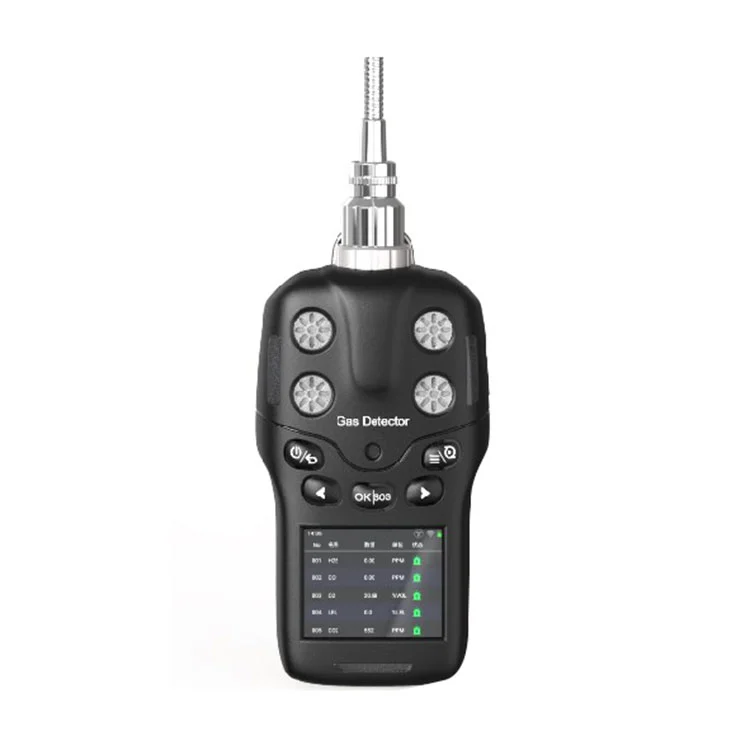
Instruments that do both — a built-in pump that switches off for diffusion duty, as on the MS400S, or a standard external pump, as on the MS104K-M — let one fleet cover both acts. A diffusion-only fleet forces a second pumped instrument for the pre-entry test, which is how programmes quietly end up testing with whatever happens to be charged.
Second: alarms you can act on
Alarm design is human design. The entrant deep in a vessel, wearing gloves and hearing protection, needs alarms that arrive through several senses at once — sound, flashing light, vibration — and an alarm message that distinguishes a concentration event from an instrument fault from a man-down event. Look for low and high concentration alarms for immediate danger, plus TWA and STEL modes for the shift-dose gases, CO and H2S, whose harm accumulates.
The attendant outside needs the mirror image: an instrument state that can be read at a glance, and increasingly a telemetry path — Bluetooth, WiFi or cellular options on modern platforms — that puts the entrant's readings on the attendant's screen rather than at the bottom of a shaft.
Third: records, because incidents are audited
After an incident — or a near miss, which is the cheaper teacher — the first question is what the atmosphere actually was. Datalogging turns opinion into evidence: timestamped readings across the entry, downloadable for the investigation and the permit file. Storage depth (the MS400S logs more than 200,000 records) matters less than the habit of downloading and reviewing; choose the unit whose data path your team will genuinely use, whether that is USB to a PC or wireless to a dashboard.
Fourth: surviving the work
Entry instruments get dropped into sumps, dragged across grating and hosed down at shift end. An IP68 housing is not a luxury in this duty; it is the difference between an instrument that survives its first year and a fleet of warranty claims. Battery behaviour matters the same way: fast charging (USB Type-C on the MS400S class) and honest shift-length runtime beat a spectacular runtime figure measured at laboratory conditions.
Sensor life and calibration burden complete the ownership picture. Plug-and-play digital sensors shorten workshop time; one-button calibration shortens the daily ritual, and rituals that are short are rituals that happen.
A buying checklist that fits on one line each
Pumped and diffusion in one unit, or a pumped partner for every crew. Four channels matching your permit's gas list — and a platform that can add a fifth when the process changes. Multi-sense alarms with TWA/STEL. Datalogging your team will download. IP-rated toughness, fast charging, cheap sensors, one-button calibration. A 4-in-1 that ticks those boxes will serve a confined-space programme for years; one that ticks only the channel count will serve until the first audit.
Start from the permit, not the catalogue
Every confined-space entry is governed by a permit, and the permit names the atmosphere that must be proven safe: oxygen within its band, combustibles below their fraction of the lower explosive limit, toxics below their exposure limits. The detector's job is to evidence each line of that permit, before entry and continuously during it. Writing the instrument specification from the permit — gases, thresholds, sampling method, record format — produces a short list of genuinely suitable instruments. Writing it from a catalogue produces a long list of almost-suitable ones, and 'almost' is where entries go wrong.
The permit also decides the sampling pattern. Pre-entry testing from outside the space demands a pumped instrument or a diffusion instrument on a probe; continuous monitoring during the work demands a unit worn in the breathing zone that logs. Many entries need both, sequentially, which is why the pumped-versus-diffusion question is really a question about which phases of the entry the same instrument must serve.
Pumped or diffusion: the honest trade-offs
A built-in pump adds weight, a power draw and a failure mode — blocked lines and tired pumps read as clean air if the flow alarm is ignored. What it buys is reach: the bottom of the vessel, the far end of the duct, the sump below the floor plates, sampled before a person commits. Diffusion instruments are lighter, simpler and longer-running, and they measure exactly where they are worn — which, on an entrant's chest, is precisely the air the permit cares about during the work itself.
Fleets that do both kinds of entry often standardise cleverly: pumped instruments for the testing role, issued to the attendant or the entry supervisor; diffusion instruments for the wearing role, issued per entrant. Each role gets the tool shaped for it, and the calibration and bump routines stay common across the fleet because the sensor sets are the same four gases.
Alarm philosophy for entry work
Two alarm points per gas is the standard architecture, and the philosophy behind the settings matters more than the numbers themselves. The low alarm is an instruction to investigate and prepare to withdraw; the high alarm is an instruction to leave now, without finishing the task, collecting tools or debating the reading. Crews obey high alarms they have rehearsed. Instruments should therefore be configured identically across the fleet — a worker handed any unit should meet the same thresholds, the same tones and the same vibration pattern, so that recognition is instant under stress, in noise, wearing gloves and a mask.
Oxygen alarms deserve their own sentence in every briefing: oxygen is the only one of the four that alarms in both directions, because enrichment is a fire hazard as real as deficiency is an asphyxiation hazard. A rising oxygen reading in a space being purged with anything but air is a stop-work signal, not a curiosity.
Records: the second product of every entry
A logging detector produces two things: protection during the entry and evidence after it. The evidence — timestamped readings, alarm events, the identity of the instrument and its calibration state — is what incident investigations, insurers and regulators ask for, usually months later. Fleets should decide in advance where downloads live, how they are named against permit numbers, and how long they are kept. A detector whose memory is never downloaded is a witness nobody interviews.
Logging also disciplines the living programme: reviewing a month of downloads shows which alarms recur, which spaces produce them, and whether they are process truths or instrument artefacts. That review, done quarterly, is where bump-test compliance, sensor ageing and training gaps all surface at once — cheaply, before they surface expensively.
Training the humans around the instrument
The best-specified detector fails inside a weak routine. Entrants need to know what the alarms mean and what each demands; attendants need to know the retrieval plan and the rule that they never enter to attempt rescue; supervisors need to know the calibration state of every unit they sign out. Fifteen minutes of role-specific briefing per entry is not bureaucracy — it is the mechanism that converts an instrument's capabilities into an outcome. Buyers comparing detectors should ask how each candidate supports that routine: how fast the bump test runs, how obvious the alarm state is, how forgiving the controls are in gloves.
A specification checklist
Written out, the confined-space four-in-one specification reads: the four gases matched to the site's permits; pumped sampling for pre-entry testing with a probe, diffusion or pumped wearing for continuous monitoring; two adjustable alarms per gas with audible, visual and vibrating annunciation; ingress protection honestly rated for the wettest space on site; data logging with a download routine the organisation will actually run; a calibration and bump regime using the standard multi-gas mixture; and a sensor set — catalytic or infrared for combustibles — chosen with the site's poison and oxygen environment in mind. Any instrument that meets the whole list is a candidate. Price competition belongs between candidates, not between a candidate and a compromise.
Gas-by-gas: what the four channels are really doing
Oxygen is the channel that frames the entry: it detects the displacement and consumption mechanisms — rust, fermentation, purging, absorption — that make a space unbreathable before any toxic gas is added, and its enrichment alarm guards the opposite sin. The combustible channel stands watch over the fuel inventory: solvents, fuels, methane from connected systems, hydrogen from batteries and corrosion. Carbon monoxide arrives from engines, heaters and processes outside the space as often as from inside it, drawn in by the very ventilation meant to protect the entry. Hydrogen sulfide is the sewer-and-sludge specialist, the one with the olfactory treachery — its channel exists because the human nose files false reports about it. A four-in-one chosen with those four stories in mind is a reasoned instrument; the same four channels recited without the stories are a superstition with a display.
The stories also set the pre-entry test order and its interpretation: oxygen first (because the other readings' meaning depends on the atmosphere being air-like), then combustibles, then toxics — and a low oxygen reading invalidates the comfort drawn from the others, because catalytic combustible sensors need oxygen to work and because a displaced atmosphere may be hiding its displacer. Teaching that order, and the reasoning inside it, is the difference between a tester and a person holding a tester.
Response time, sampling distance and the patience budget
Every pre-entry reading has a patience budget built into it: the sample line's transport time plus the sensors' response times, during which the display shows the atmosphere of a moment ago, or of the hose itself. Rushed testers read early and judge the wrong air; the professional habit is embarrassingly simple — know the delay for your line length, watch for the reading to settle, and record the settled number. Instruments with fast sensors shorten the budget but never abolish the line's share of it, which is why the pumped specification lists probe and hose in the same breath as the detector, and why a thirty-metre capability is a discipline as much as a feature: it multiplies the patience the tester must budget, in exchange for keeping their body out of the space being judged.
The dock: where fleets are actually managed
Visit a fleet's dock and you can read its future: instruments charging in order, bump gas in date, a quarantine corner with tags, a board showing calibration currency, spares in a drawer that opens. The dock is where the specification's promises are kept or lost — ingress ratings matter less than whether the seals are inspected, battery claims less than whether the rotation is followed. Buyers choosing between near-equal instruments should ask to see the dock ecosystem each implies: docking stations, software, gas handling, the shape of the morning issue. Fleets are not bought; they are operated, and the operating surface is the dock.
The morning issue deserves choreographing like a pit stop: bump, visual, battery, accessories, sign-out — under two minutes per instrument when the dock is designed for it, and a queue of excuses when it is not. Entry programmes measure their real safety culture at that queue, because a crew that cannot get tested instruments on time will eventually enter on untested ones, whatever the procedure says.
When four is not enough: recognising the fifth gas
The standard four cover the standard tragedies, and the discipline of confined-space work includes recognising the entry that is not standard. Ammonia at the refrigeration plant's valve pit; chlorine at the water works' dosing room; solvent vapour in the coating tank; carbon dioxide in the fermentation cellar; sulfur dioxide at the chemical plant's sump — each adds its channel or its own instrument to the entry's kit, named by the space's inventory in the risk assessment. The four-in-one remains the spine; the fifth gas is the assessment's signature. Programmes that teach the signature — this space, this extra hazard, this extra measurement — produce testers who ask the right question at unfamiliar hatches, which is the whole of the art.
Weather, water and the outdoor space
Confined spaces live outdoors as often as in: tanks in the rain, pits in the frost, vessels in the summer's heat, and each weather writes on the instruments. Rain finds seals and pump inlets; cold thickens battery chemistry and slows electrochemical response; heat ages cells and tests the wearer's temper before the atmosphere does. Evaluation should include the site's actual weather — an instrument that is admirable in a showroom and miserable in a February yard will be left in the van in February, which is the only failure mode that matters. Ingress ratings, temperature ranges and glove-operable controls are the datasheet's weather chapter, and they deserve reading with the site's worst month in mind rather than its average one.
Condensation deserves its own sentence because it is the outdoor tester's daily tax: a cold instrument brought into a warm humid space fogs its sensor faces and its display alike, and a warm instrument sampled into a cold vessel condenses in its line. The remedies are routine — acclimatise the instrument, keep lines short and drained, distrust the first minute's readings in thermal shock — and they belong in the test procedure the permit carries.
The second instrument: redundancy where it counts
Serious entry programmes think about the instrument that fails mid-entry. The entrant's unit is backed by the attendant's — the same readings visible, the same alarms — and the evacuation decision never waits for a diagnosis of which instrument is right. Disagreement between instruments is itself an alarm state: withdraw, then argue. That doctrine costs a second unit per entry and a calibration regime for both, and it purchases the end of the most dangerous sentence in confined-space work, 'my detector says it's fine', spoken against another detector saying otherwise. Specifications for critical entries should state the redundancy plainly, because it is a property of the programme, not an accessory for the instrument.
After the entry: closing the loop in the office
The entry's paperwork traditionally dies in a folder; the logging instrument gives it a second life in the review. Monthly, somebody should read the fleet's downloads against the permits: which spaces alarmed, which alarms were process truths, which instruments drifted, which crews' bump compliance wobbled. That reader is the programme's immune system, and the meeting they feed — operations, safety, maintenance in one room with the traces on the screen — is where specifications for the next purchase are really written, in the language of what the last fleet did well and badly. The four-in-one you choose next should be chosen there, by the evidence of the four-in-ones you already own.
Procurement language that gets the right instrument
Inquiries fail in predictable phrases. 'Four-gas detector, intrinsically safe, best price' procures a lottery. The language that works names the work: the spaces and their gases beyond the four; the test pattern (pumped pre-entry over what line length, continuous wear for how many entrants); the alarm philosophy the fleet already speaks; the dock ecosystem the site will run (gas, docks, software, spares); the records the permits consume. Suppliers respond to that language with configurations and programme terms rather than with brochures, because the inquiry has told them what would actually be bought. Tender documents should carry the same language into the evaluation matrix — points for the dock's morning throughput, for the calibration story, for the training package — so the decision is made where the value lives.
The review after the first year
A year after a fleet lands, hold the review nobody schedules: the download archive read for alarm geography, the dock's records read for compliance truth, the crews interviewed for the annoyances that predict abandonment, the spares ledger read for what actually failed. The review's findings write the second purchase better than any catalogue — sensors re-chosen where the poison census was wrong, pumped ratios adjusted to the real entry pattern, accessories bought that the first order thought were luxuries. Fleets are hypotheses; the first year is the experiment; the review is the honesty that makes the experiment worth its cost.
The accessories that are not accessories
The purchase order's tail decides the fleet's life: the probe lengths that match the deepest vessel, the spare filters counted against the dustiest duty, the vehicle chargers that make the survey crew's units immortal, the belt clips and chest harnesses that decide whether the instrument rides where the air matters, the download cables and software seats that decide whether the records exist. Experienced buyers price the tail with the instruments and refuse the false economy of a bare fleet, because an accessory missing at the hatch is not a saving but a postponement of the entry — or worse, an entry re-planned around the missing piece. The confined-space four-in-one is a system wearing a product's name, and the system is what should be bought.
The borrower's test
Judge your programme by its worst transaction: the Friday-evening entry, the contractor's crew, the space that was not on Tuesday's list. On that day the programme's true assets are not its best instruments but its margins — the spare pumped unit that exists, the bump station that does not queue, the procedure simple enough for a borrowed crew to perform under supervision. Specifications written for the average day will be honoured on the average day; specifications written for the borrower's day are honoured everywhere. Choose the four-in-one, and the fleet around it, for the Friday evening — the Tuesday mornings will take care of themselves.
One paragraph for the purchase order
If the whole article must fit in the purchase order's notes field, let it be this: four gases matched to the site's permits; pumped testing capacity counted against concurrent entries, continuous instruments counted against entrants; alarms identical across the fleet; ingress and temperature ratings read against the site's worst month; a dock, gas and spares ecosystem priced with the instruments; records that flow to the permit archive by a route somebody owns; and the review, a year from delivery, already in the diary. An order carrying that paragraph will be filled by a fleet that works; an order carrying only a model number and a price will be filled by a lottery ticket with a display.