Take one plant room — a compressor house, say, with natural gas trains, a hydrogen-cooled machine next door, operators who visit twice a shift and a contractor crew that opens a flange every few months. Which detection does it need: fixed points on the walls, portables on the people, or both? The honest answer is a designed both, and this article shows the design logic on this single room, because the logic scales to whole plants.
Start with the gas map, not the catalogue
List the room's gases and their behaviours. Methane from the gas train: buoyant, flammable, released at flanges, valves and compressor seals. Hydrogen next door: buoyant-er, invisible flame, wide flammable range. Carbon monoxide in the exhaust corner. Oxygen: the room's own atmosphere, displaced if a large release fills the space. Each gas gets a row; each row gets a release story — where from, how fast, drifting where, meeting whom.
Risks that are positional — tied to equipment and places, present at 3 a.m. — belong to fixed detection. Risks that are personal and episodic — tied to tasks, present when people do specific work — belong to portable detection. The room's map already contains both kinds, which is why the answer was never going to be one style.
Placing the fixed layer
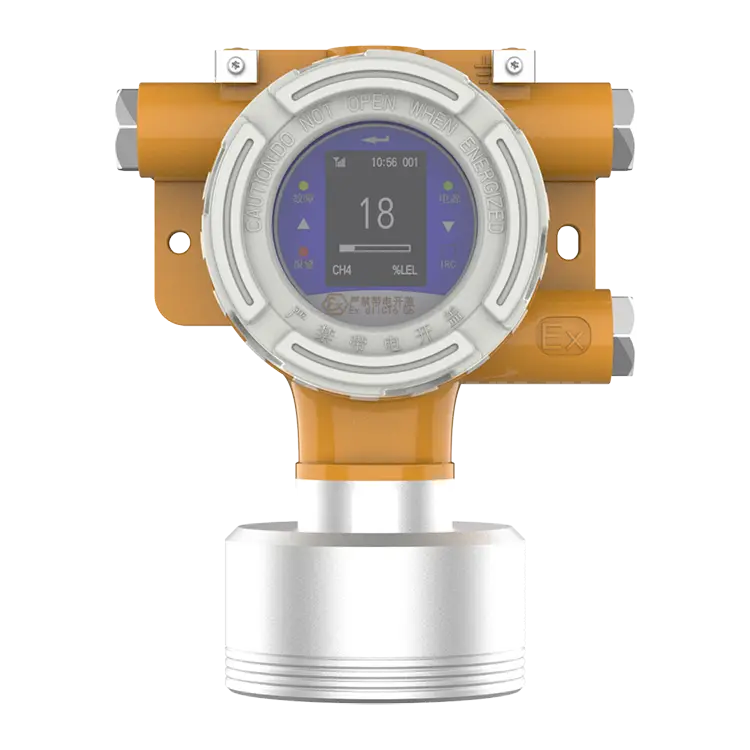
Fixed points go between the credible source and the credible accumulation: high points over the gas train for methane, at the hydrogen boundary, at breathing height near the exhaust corner for CO. The MIC300 series fits single-gas points with its span ladder; the MIC100 fits the mixed corner where four gases share one location. Outputs — 4–20 mA, RS485 — run to an alarm controller that drives the room's responses: beacons, ventilation start, and a signal to the control room.
Count the unglamorous items in the same breath: cabling routes, calibration access (a point no technician can reach with a gas bottle is a point that will drift), and spare capacity on the controller for the point next year's modification adds.
Tasking the portable layer
Portables cover the room's verbs: the operators' rounds (personal four-gas monitors), the flange job (pumped pre-work testing with an MS400S-class unit, continuous monitoring while the line is open), the vessel entry (the confined-space pattern in full). These risks exist only when people do, and a fixed point cannot test the inside of the compressor casing the crew is about to open.
The fleet decision mirrors the fixed one: channel sets from the room's gas map, pumped capability where remote testing is routine, datalogging where permits are audited.
One philosophy, two layers
The layers share thresholds and language: the same %LEL alarm philosophy, the same TWA/STEL thinking, records that meet in the incident review. Plants get in trouble when the two layers are bought by different departments to different standards and meet for the first time during an emergency.
Budget honestly: fixed costs concentrate at installation and spread over years of watch; portable costs concentrate in calibration and sensors over the same years. A plant room planned as one system — as this room was — almost always costs less than two half-systems stretched to cover each other's gaps.
The room's own risk assessment
Begin with the gases, not the hardware. A boiler plant room's credible releases are fuel gas from train fittings and flanges, and carbon monoxide from combustion faults and flue leaks. A refrigeration room's is ammonia from valve glands and vessel connections. A battery room's is hydrogen from charging. Each gas brings its physics: hydrogen and methane rise, ammonia rises when dry and hot but slumps in cold moist air, carbon monoxide mixes evenly. The release inventory and the buoyancy map together decide detector positions — near the credible sources, at the height the gas will occupy, close enough to catch a leak while it is still small. Rooms are protected by that reasoning or not at all; detectors sprinkled by symmetry protect the drawing, not the plant.
What fixed points do during the unstaffed hours
Plant rooms are empty most of their lives, and incidents do not respect staffing. The fixed system's defining act is the 3 a.m. sequence: threshold crossed, fan running, beacon lit, valve shut, signal standing on the panel for the morning — or escalating to the alarm system if the second threshold follows. That autonomy is specified, not assumed: relay logic decided at design, fan proving interlocked where the philosophy demands it, alarm meanings documented where responders can read them in the dark. A detection point that cannot act is a witness; a detection point wired to act is a safeguard, and the difference is a design decision with a price attached — usually a modest one, paid once.
The portable layer, properly understood
Portables earn their place in three plant-room moments. Commissioning and recommissioning, when the fixed scheme's coverage is being proven and sniffing every joint is the work itself. Maintenance, when the task takes a fitter into the room's dead corners, vessels and pits that no fixed point pretends to cover. And alarm investigation, when the fixed system has spoken and a person goes to find out why, carrying the measurement with them. Fleets sized for those moments — a handful of pumped multi-gas units with trained owners — serve a plant room better than a portable issued to every employee and maintained by none.
Interlocks, ventilation and the hierarchy of response
Detection is the trigger; ventilation is usually the remedy. The design question is what each alarm stage does to the air: first stage commonly starts or boosts extraction to dilute the leak toward safety; second stage isolates fuel and raises the evacuation. Designers should state, for each gas, whether the strategy is dilute, isolate or both — ammonia rooms lean on extraction and water absorption, fuel-gas rooms on isolation plus ventilation, battery rooms on continuous extraction sized for the charging load with detection as its supervisor. The gas system and the ventilation system are one system wearing two names, and they should be commissioned together, alarm by alarm, fan by fan.
Maintenance: the scheme's second half
Fixed points drift, foul and age like every other sensor, but they do it unwatched. The maintenance regime is therefore scheduled, recorded and trended: bump or calibration at the manufacturer's interval, sooner after any event that could have flooded or poisoned a sensor; calibration adjustments logged so that a wandering point announces itself; spares held for the points whose failure would blind a room. Portable fleets follow the same discipline at the issue desk. The plant room that tests its scheme quarterly owns a safeguard; the one that installed and forgot owns a decoration with a test certificate from commissioning day.
A closing rule of thumb
For every room, write one sentence: 'When gas appears here at hour X with nobody present, the following happens automatically.' If the sentence can be written concretely — fan, valve, beacon, signal, in order — the fixed layer is doing its job and portables are free to do theirs. If the sentence trails off into 'someone would notice', the room is telling you exactly what to buy next.
Three plant rooms, three correct answers
The comparison sharpens against real rooms. The hospital boiler house, staffed in the day and empty at night, with a fuel train and a flue through occupied floors: fixed CO and gas points interlocked with ventilation carry the night; a portable serves the maintenance visits; the flue gets periodic analysis. The cold-store refrigeration room, ammonia-charged, entered twice a week: fixed ammonia points with staged extraction and door-side annunciation are the safeguard, and personal ammonia instruments ride the engineers who break into the system. The school plant room, visited by a caretaker and contractors: a simple fixed CO point with a beacon outside the door outperforms an elaborate scheme nobody maintains, and the contractor's own portable is written into the permit. Three rooms, three different correct balances — the comparison's answer is a method, and the method is the risk assessment read honestly.
Commissioning the fixed layer so it stays true
Fixed systems are commissioned twice: once electrically, once philosophically. The electrical commissioning proves every point — gas applied, reading at the panel, relays acting, fans running, beacons lit, signals landing in the systems that must see them. The philosophical commissioning writes down what it all means: the alarm stages and their intended human responses, the shelving and bypass rules, the proof-test interval and its owner, the drawing set that future modifications must update. Systems that receive only the first commissioning decay into folklore — points whose purpose nobody remembers, bypasses older than the staff. The second commissioning is a day's paperwork that purchases a decade of intelligibility, and it belongs in the project price from the start.
The night-shift test
Every plant-room scheme should be passed through one scenario before it is believed: 3 a.m., the room empty, the site at skeleton staff, a release at the credible worst point. Walk the timeline in minutes: detection, actuation, annunciation — to whom, where, with what instruction; escalation if the first response fails; the state of the room when the day shift arrives. Fixed systems exist to perform in exactly this film; portables exist for the sequel, when people re-enter the story with instruments in their hands. Schemes that cannot narrate their 3 a.m. film convincingly are not finished, whatever their installation certificates say, and the narration costs nothing but honesty at design time.
Insurance, inspection and the external audience
Plant rooms have external audiences — insurers, fire officers, inspectors — whose questions are converging on the same evidence: is there detection, does it act, is it maintained, can you show me. The fixed layer answers with its records: commissioning certificates, proof-test logs, calibration history, alarm event reviews. The portable layer answers with its dock discipline. Sites that keep both answers filed together, room by room, find inspections shortening year by year; sites that assemble the evidence after the inspector calls find the opposite. The comparison therefore ends where it began: not with two technologies but with one room, one risk assessment, and the evidence that the chosen layers are alive.
Retrofitting detection into old rooms
Most plant rooms were built innocent of detection: no spare panel ways, no cable routes, ceilings full of other services. The retrofit art is economy of intrusion — loop-powered points that ride existing pairs, wireless points where wiring is genuinely prohibitive (with their battery and signal disciplines honestly faced), panels placed where the room's life passes rather than where the drawing is tidy. Phasing helps: protect first the rooms whose 3 a.m. film is worst — the unstaffed fuel room, the ammonia plant, the battery hall — and let each phase's commissioning lessons cheapen the next. Old rooms forgive phased honesty; they punish grand designs that wait for a shutdown that never comes, leaving every room unprotected in the name of protecting all of them eventually.
When the room itself changes
Plant rooms mutate: a new boiler doubles the fuel train, a battery bank moves in beside the switchgear, a store becomes a workshop. Each mutation rewrites the gas map — new sources, new accumulation points, new occupants — while the detection scheme stands still, guarding the room that used to exist. Change management must therefore ask the gas question of every plant-room alteration, however humble, and the detection register must be re-walked against the rooms on a cycle even without alterations, because drift is unrecorded change. The re-walk is a morning's work with the register, a portable and a sceptical eye; it has found more blind spots than any instrument upgrade in the industry's history.
The caretaker's instrument: simplicity as a specification
A word for the smallest sites, where the plant room's congregation is one caretaker and a rota of contractors. There, the winning specification is the one that survives neglect best: a fixed point or two with loud local annunciation and a beacon outside the door, a portable that lives on its charger where the caretaker cannot miss it, a bump routine simple enough to be a habit, and a service contract that brings the calibration to the building. Sophistication is a liability where attention is scarce; robustness is the specification. The comparison this article has run at industrial scale resolves, at the small end, into a single question — what will still be working, and understood, in five years, under the care actually available — and it is the right question at every scale.
Designing for the maintainer
Plant-room schemes are maintained by whoever the organisation actually has — often a generalist electrician with forty other duties — and designs that ignore that fact decay on schedule. Maintainability is a design output: calibration that one person can perform at ground level or with non-intrusive tools, test points accessible without scaffolding, spares that are few and common across the estate, documentation that lives at the panel and names this room in this building's words. Designers should write the maintenance visit as a story — arrival, test, calibration, proof, departure, records — and check the design against the story's every step. The schemes still protecting their rooms in year ten are, without exception, the ones whose stories were easy to perform.
The room's biography in its alarm history
Keep a plant room's alarm history the way one keeps a medical chart, and read it at every modification: the nuisance alarm that was actually a door's habit, the silent years that were actually a blind point, the seasonal pattern that was the heating plant's signature. The biography disciplines both complacency and panic — it shows which alarms deserve engineering and which deserve a procedure, and it gives the next designer the evidence the first one lacked. Rooms are long-lived and staffs are not; the chart is how the room remembers what its people learned.
The handover test
Every plant-room scheme should pass a handover test before it is called finished: a competent stranger — the night electrician, the incoming facilities manager — is given the room, the panel and the documentation, and asked three questions. What does this alarm mean? What happens automatically, and what must a person do? Where is the proof this was tested last quarter? The scheme passes when the stranger answers from the artefacts, not from the designer's memory. Schemes are handed over many times in their lives — to new staff, new contractors, new owners — and the ones designed for the stranger survive their handovers with their protection intact. Design for the stranger; the familiar faces will manage either way.
The comparison's last word: evidence
Strip both architectures to their residue and the residue is the same substance: evidence about air, produced in time to matter. The fixed system produces it continuously and impersonally; the portable produces it personally and episodically; the plant room needs both kinds because its dangers come in both tenses — the leak that develops unwatched and the task that walks into danger deliberately. Every other term of the comparison — cost, maintenance, response, records — is bookkeeping on that single distinction. Keep the distinction in view and the specifications write themselves; lose it, and the plant room gets two expensive answers to a question it never quite asked.
A plant-room proverb book
The trade's proverbs, collected: a detector in a drawer protects the drawer. The fan you cannot prove is a rumour with a motor. Calibrate the point or strike it from the drawing. The night shift is the real client. A beacon outside the door is worth two inside the room. None of these will appear in a standard, and all of them will appear, eventually, in an incident review of a room that ignored them. The comparison this article has prosecuted at length dissolves into the proverbs at the end, which is where engineering wisdom always ends up — compressed, portable, and true at 3 a.m.
The room, revisited in five years
Return to the plant room five years after the scheme was installed and read what time has graded. The fixed points that were proof-tested on rhythm still answer their gas like students who did the reading; the ones adopted by no one's calendar answer like rumours. The portable fleet's dock either hums with its morning ritual or accumulates the archaeology of good intentions. Nothing in the five-year picture was decided by the purchase; all of it was decided by the institutions the purchase either created or failed to create. That is the comparison's final arithmetic, and it is why this article has spent as long on docks, registers and handovers as on sensors: in plant rooms, institutions are the technology.
The plant room's next decade
The plant room is changing under its instruments: electrified heat with its battery stores and refrigerant charges, hydrogen appearing in pilot boilers, buildings managed by remote platforms that will read the fixed layer's data more faithfully than any caretaker. The comparison's terms will survive the change — the unwatched hours still belong to the fixed layer, the walking tasks still belong to the portable — but the balance will keep being redrawn by each room's new contents, which is why this article has insisted on the method over the answer. Methods age slowly; answers age with the plant. The room that is re-argued on its gas map every few years will be protected in every decade; the room protected once, by a scheme nobody re-reads, is protected in the decade it was built and in fewer of the ones that follow.
The room's obituary and its birth certificate
Plant rooms are born in projects and die in demolitions, and both ceremonies deserve the detection file's attention: at birth, the commissioning evidence that becomes the scheme's birth certificate; at death, the readings that clear the strip-out and the lessons harvested for the next room. Between the ceremonies lies the long maintenance of the middle, which this article has anatomised without mercy. Organisations that file the two certificates together — birth and obituary in one folder — find their estates departments learning across generations of buildings, which is the quietest and most durable form of progress the built environment knows.
Colophon: the room at rest
Visit the plant room once more, at rest, in the hour before the shift: the fixed points awake and unalarmed, their tiny lights keeping the room's vigil; the portables asleep in their docks in two neat rows, bumped, charged, biographies current. Nothing is happening, and the nothing is the product — manufactured nightly by every discipline this article has catalogued, from the point register to the dock ritual. Safety, in its finished form, looks exactly like this: a quiet room, honestly watched, in which the extraordinary has been made boring in advance.