A particle counter produces the cleanroom's most quoted and least examined number. Behind 'the room passed' sits a chain of method: which particle sizes were counted, over what volume, at which points, by an instrument in what state — and a record that must survive an auditor years later. This article covers the basics that decide whether cleanroom counts mean anything: channels, sampling logic, and the record-keeping that regulated environments buy instruments for.
Channels: counting by size, not in total
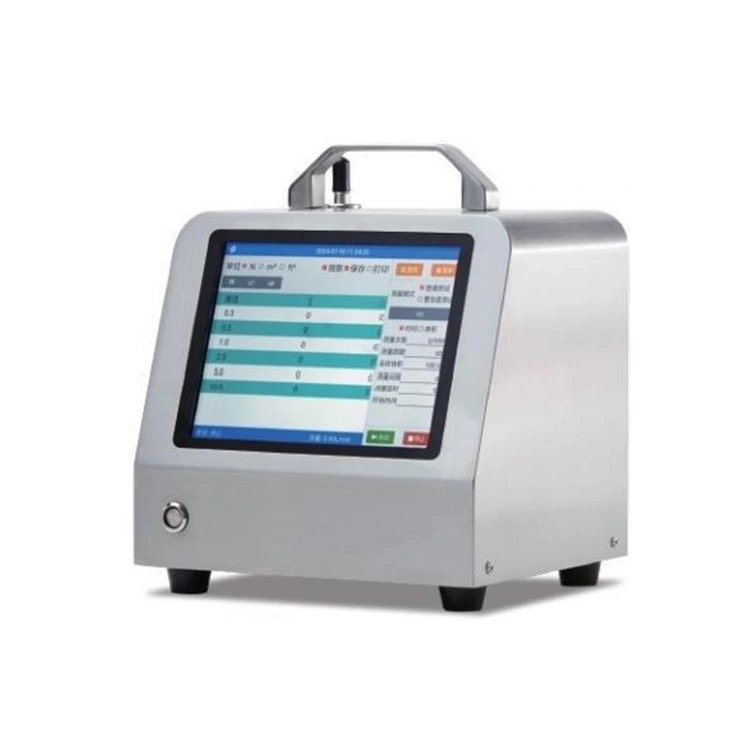
Particles are counted in size channels because size is diagnosis. A counter like the B1030 resolves six channels simultaneously down to 0.1 µm: the distribution across those channels distinguishes a personnel-borne event (coarse particles, near people and doors) from a filtration failure (fine particles, everywhere at once) from a process source (a signature at one tool). A single total count would hide all three stories inside one alarming number.
Classification logic builds on channel counts per volume: the room's class is a statement that counts at specified sizes stayed under specified limits at specified points. The B110-Pro's automatic calculation of required monitoring points from room area exists because the point-count rule is exactly the kind of arithmetic that should be done by the instrument, identically, every time.
Portable and online: the division of labour
Online counters watch fixed points continuously and catch the excursion when it happens; portable counters qualify rooms, investigate excursions and measure where no fixed point exists. Programmes that buy only online coverage cannot investigate; programmes that buy only portables cannot see between visits. The portables' job description explains their feature race — touchscreens sized for gloved use at the point, storage deep enough for a full qualification round (the B110-Pro holds more than a million records), and export that produces the report rather than a data dump.
Records: the pharmaceutical difference
In pharmaceutical cleanrooms the count is a quality record, and quality records live under data-integrity rules: attributable users, no silent edits, a complete audit trail. That is why the regulated-environment counter build — 316L stainless shell that survives disinfectant wipe-downs, multi-level permissions, audit trail, electronic records and signatures in the 21 CFR Part 11 pattern — is a different product from a general-purpose counter with the same optics.
The purchasing lesson generalises: in regulated monitoring, you are buying the record's defensibility as much as the measurement. Specify the audit trail with the same care as the channel sizes, and the cleanroom's numbers will still be standing when the auditor arrives.
What the counter actually counts
A laser particle counter draws air through an illuminated sensing volume and counts the flashes as particles cross the beam, sizing each flash against calibration spheres to sort counts into channels — 0.3, 0.5, 1.0, 5.0 micrometres and their neighbours. Everything else in cleanroom practice is arithmetic built on that simple act: counts per sampled volume become concentrations; concentrations at specified sizes become classes; classes become the room's licence to operate. Understanding the act explains the discipline around it — flow rate is sacred because volume is the denominator; the probe and tubing matter because particles are lost in bends and settling; coincidence limits matter because two particles crossing together count as one large one, flattering the small channels and alarming nobody.
Classification: the formal exercise
Cleanroom classes under the ISO 14644 framework set maximum concentrations per particle size — class 5, for instance, permits 3,520 particles per cubic metre at 0.5 micrometres and none counted larger in its defining table — and classification sampling follows the standard's rules: a grid of locations based on room area, minimum sample volumes calculated so that the statistics can actually see the limit, sampling at rest or in operation as the qualification demands. The arithmetic punishes shortcuts: at low permitted counts, small samples carry enormous Poisson uncertainty, which is why the standard's volume formula exists. A classification performed with inadequate volumes has not failed the room or passed it; it has merely not measured it.
Routine monitoring: the living programme
Between classifications, monitoring keeps the room honest: a smaller set of meaningful locations — beside the critical process, at the return air, at the personnel lock — sampled frequently, trended, and alarmed against action levels set inside the class limits. The trend is the instrument: a point drifting upward over weeks announces a filter loading, a door seal failing, a gowning drift, long before any single count breaches a limit. Monitoring programmes should be designed backwards from the deviations they must catch, and every alarm should have a written first response that is not 'resample until it passes' — resampling has a legitimate statistical role, and using it as an eraser is how programmes rot.
The human contamination source
People are the dominant particle source in most cleanrooms: a gowned operator in motion sheds orders of magnitude more particles than the room's surfaces, and technique — slow movements, working downstream of critical items, disciplined glove sanitisation — shows up directly in the counts. Monitoring data that is reviewed with the operations team, rather than filed by quality alone, teaches this faster than any training deck: teams that see their own shift's trace learn which behaviours the counter can see. Place routine points where people work, not where the air is prettiest, and the programme becomes a coaching instrument as well as a compliance one.
Sample handling: tubing, isokinetics and other quiet errors
Large particles are poor travellers: they settle in horizontal runs, impact at bends, and under-sample through long tubing, so a counter at the end of three metres of lazy hose reports a cleaner room than exists. Keep tubing short, vertical where possible, and bends gentle, and treat the probe's placement as part of the method — at work height, in the airflow that actually passes the product. In unidirectional flow, isokinetic sampling matches probe inlet velocity to the room's air velocity so the sample is representative; in turbulent rooms, position and consistency matter more. These are cheap disciplines with expensive consequences, the classic shape of metrology errors.
Records, recipes and the audit trail
Particle data lives a long time: classifications anchor qualifications, monitoring trends support batch release and deviation investigations, and auditors will ask who sampled, where, with which instrument in what calibration state, under which version of the plan. Counters that manage locations, recipes and users — and export clean records in the formats quality systems eat — remove the transcription layer where most data-integrity findings are born. In regulated environments, electronic records with audit trails in the pattern of FDA 21 CFR Part 11 turn the counter from a measuring tool into a measuring system. Choose the record architecture with the same care as the optics; you will live with it longer.
Viable and non-viable: the two microbiological worlds
Particle counting measures the non-viable world — the dust, fibres and skin that carry microbes as passengers — while microbiological monitoring samples the viable world directly with plates and samplers. The two are cousins, not substitutes: particle counts respond in seconds and steer behaviour today; viable results arrive in days and judge the system historically. Programmes that understand the kinship use particles as the leading indicator and viables as the verdict, and they resist the two classic confusions — treating a clean particle trace as a sterility claim, or dismissing a particle excursion because the plates came back clean. The counter's basics, which this article exists to teach, are the grammar of the leading indicator; the verdict's grammar belongs to the microbiology laboratory, and a facility fluent in both reads its rooms whole.
Where counters go wrong: a field guide
The failure gallery is instructive because every entry is mundane. Flow drift uncorrected since the last calibration, quietly falsifying every volume. A probe left pointing at a wall's boundary layer, sampling the room's least representative air with great precision. Tubing long enough to filter out the large particles that matter most, reporting a cleanliness the product never experienced. A counter sampling a room at rest being quoted as the in-operation state. Coincidence overload beside a shedding process, undercounting exactly when the air is dirtiest. Each failure is prevented by a line in a decent procedure — flow checks, probe placement rules, tubing limits, state definitions, dilution or placement for hot spots — and the procedure is only ever as good as its last audit against the gallery. New programmes should write the gallery into their training; experienced ones should re-read it after every surprising result.
Choosing a counter: the specification conversation
Counter selection runs on the programme's arithmetic: the sizes the classes are judged at (which fixes the channels), the volumes the statistics demand (which fixes the flow rate), the places and states to be sampled (which fixes portability, probes and battery life), and the record the quality system eats (which fixes data handling, user management and export). Price enters after those four, because a counter that cannot execute the programme's arithmetic is not cheaper at any price. Evaluation should include a live exercise — classify a real room corner, run a gowning feedback session, export the file into the actual quality workflow — because counters, like the rooms they serve, reveal themselves in operation rather than in brochures.
The room's memory: baselines and the value of boring data
A cleanroom's particle archive is its memory, and memory compounds: the baseline that proves a refurbishment worked, the seasonal pattern that explains a summer drift, the point whose slow rise predicted a fan-coil failure a month early. Boring data — thousands of unremarkable counts — is what makes the remarkable ones legible, which is why programmes protect the archive's continuity through instrument changes, software migrations and staff turnover. The basics end here, where they began: a counter is a simple instrument that counts flashes in a beam of light, and everything built on it — classes, programmes, memories, licences to operate — is arithmetic plus discipline. The discipline is the article's real subject, and it is available to any facility willing to practise it.
The counter and the cleaner: a necessary friendship
Cleanroom data quietly governs people who never see a counter: the cleaning team, whose methods and hours are validated by the counts that follow them; the maintenance crew, whose interventions are scheduled against monitoring windows; the production planners, who learn which products and processes the room tolerates gracefully. Programmes that share their data — posted trends, excursion stories told without blame, the gowning feedback sessions — turn those constituencies into allies of the room's discipline. Programmes that hoard the data as a quality-department secret find the room defended by one department against the entropy of all the others, a battle with a predictable ending. The particle counter is a measuring instrument; the monitoring programme is a social one, and it succeeds socially or not at all.
Counts across the product's life
Follow a product through its environments and the counter's role multiplies: the component stores, the preparation rooms, the filling line, the inspection and packing areas — each with its class, its monitoring points, its excursion consequences. The mature programme treats these as one chain with a memory, because a particle story that begins in the stores ends, sometimes, in a deviation investigation at the filler, and the investigation's first need is the chain's continuous record. Specifying counters facility-wide — one data discipline, compatible records, calibration under one regime — is what allows the chain to be read as a chain when it matters.
A last word on humility
Particle counting's deepest lesson is statistical humility: the room is never exactly its last sample, the count is never exactly the concentration, and the class is a statement about a distribution observed under rules, not a property the room possesses like a colour. Practitioners who hold that humility design better programmes — adequate volumes, honest states, levels set from evidence — and write better reports, in which numbers arrive with their conditions attached. The instrument will go on counting flashes in the dark, indifferent and exact; everything else in this article is the human discipline of deserving its exactness.
Counts and classes across the world's regimes
The classification grammar is international but not uniform: pharmaceutical practice speaks in the EU's grades alongside ISO classes, electronics in its own class traditions, hospitals and food plants in adaptations of both. The counter's arithmetic is the same everywhere — counts, volumes, sizes — while the limits, states and sampling rules are dialect. Practitioners moving between regimes should carry the arithmetic confidently and the dialect humbly, checking the local table rather than trusting the familiar one, because a class number quoted without its regime is this article's version of a gas reading without its scale. Instruments serve all dialects impartially; programmes are responsible for speaking the right one in the right room.
The basics, restated as a bench card
Distil the article to the card that belongs at the bench. Know your flow and prove it. Sample the volume the statistics demand. Place the probe where the product's air is, in the state the decision concerns. Keep the tubing short and honest. Record the state, the place, the operator and the volume beside every count. Set levels from the room's own baseline, inside the class limit. Read trends before you read verdicts. Treat a surprising zero as a question, not a gift. That card, plus a calibrated counter, is most of cleanroom particle practice; the remainder is experience, which the card's habits are designed to accumulate safely.
The counter's calibration day
Once a year the counter itself must answer for its arithmetic: flow verified against a reference, sizing checked against standard particles, zero proven against filtered air, the certificate filed beside the room classifications it underwrites. The day deserves the programme's respect because every number since the last one inherits its validity — a drift discovered in October retrospectively interrogates a year of Tuesdays. Mature programmes therefore verify flow far more often than annually, at the bench, as a habit, and treat the annual certificate as the formal seal on a year of small honesties rather than as the year's only one. Instruments, like the rooms they serve, are believed in proportion to their evidence.
The counter and the classroom
End the basics where competence is manufactured: in training, with the instrument in the trainees' hands and a real room misbehaving politely nearby. Let them find the shedding glove, chase the count that follows a door's cycling, sample the same point at two volumes and argue about which number deserves belief. The argument is the education; the instructor's role is to make sure the statistics win it. A facility that trains so produces operators whose counts can be trusted, which is the only foundation classification has ever had — the rest, as the article has maintained throughout, is arithmetic plus this.
Small counts, long careers
A counter's career is measured in decades of small numbers, and the basics in this article are deliberately unglamorous because careers are: prove the flow, honour the volume, place the probe, write the state, read the trend. Practitioners who keep those habits become the people whose data other people build on — in deviation meetings, in design reviews, in the quiet confidence that lets a facility release its product on the strength of a trace. That is a large destination for so small an instrument, and it is reached, as the room itself is kept clean, one unremarkable discipline at a time.
Basics for the buyer of a second counter
The second counter is bought differently from the first: the programme exists, its arithmetic is known, and the purchase is really about capacity, redundancy and the places the first counter cannot be at once. The discipline at the second purchase is compatibility — the same channels, the same data grammar, records that merge into one archive without translation — because a fleet of two dialects doubles the programme's friction while adding less than twice its eyes. Facilities should also resist the upgrade temptation that strands the first counter's archive in an abandoned format; the archive's continuity outranks any single instrument's elegance, a sentence that by now, in this article's final section, should read as the refrain it has become.
The basics, examined
Examine the basics one last time, as a viva. Why does flow come first? Because volume is the denominator of every claim the room will ever make. Why the volume the statistics demand? Because a count without the power to distinguish is an anecdote with a decimal point. Why the probe at the product? Because the room exists for the product's air, not for the surveyor's convenience. Why the state on the record? Because a number without its conditions is a rumour in uniform. Why levels from the baseline? Because the room's own behaviour is the only honest prophet of its failures. Five questions; a practitioner who can answer them in the room's own terms has the basics, and a facility whose practitioners can is most of the way to deserving its classification.
The basics, carved over the door
If a facility may carve only five lines over the cleanroom door, let them be these. The flow is the denominator: prove it. The volume is the argument: sample enough of it. The probe is the witness: place it where the product breathes. The state is the context: write it down. The trend is the truth: read it before the verdict. Five lines will not classify a room by themselves, but every classification that has ever survived an audit was built by people who behaved as if they were true — and every failed one, read closely, is the story of one of them being skipped on a busy day. Carve them where busy days can see them.
Colophon: dust, counted honestly
A cleanroom is a promise a building makes to a product: that the air will be counted, and the counting will be honest. The counter keeps the building's side of the bargain one sample at a time — flow proven, volume sufficient, probe placed where the promise is tested, state written beside the number. Rooms kept so become unremarkable to work in, which is the promise fulfilled. The basics end there, where the counts begin: in the dark of the sensing volume, a flash at a time, added up by people who understand what the sum is worth.
Postscript: the operator's signature
Every count in the archive carries an invisible signature — the operator's habits, patience and honesty — which is why programmes train people and not merely procedures. The signature shows in the sampled volumes that were sufficient when nobody was watching, in the states recorded when 'at rest' would have flattered the room, in the excursion reported upward before it was understood. Hiring and coaching for that signature is the programme's deepest quality control, deeper than any calibration, because instruments can be verified in an afternoon and character only across a career of unobserved Tuesdays. Staff the signature well, and the counts will deserve the rooms they describe.
Envoi: the counted room
Rooms forget; records remember. The counted room — sampled at honest volumes, in declared states, by operators whose signatures mean something — leaves behind it a trail of small, exact, unglamorous numbers that add up, over years, to the only kind of knowledge a facility can bank: knowledge of its own air. Everything in this long article has been an attempt to make that trail trustworthy. Keep the flow proven and the probe honest, and the trail will keep the facility — in audits, in investigations, and in the quiet confidence of releasing good product into air that was, demonstrably, as clean as its promise.
A note on metrology
Underneath the practice sits metrology's quiet covenant: traceability. The counter's sizing traces to standard spheres, its flow to a reference meter, its certificate to a laboratory whose own instruments trace onward — an unbroken chain of comparisons reaching back to national standards. Accreditation of that chain is what lets a count in one facility be believed in another's audit room, and it is why calibration certificates name their laboratories and their uncertainties. The chain is invisible in daily work, exactly as foundations are; the building stands on it all the same.