Alongside the gas channels, a pressure sensor and a temperature and humidity sensor are built in, so readings carry the ambient context that analysis work needs for correction and comparison.
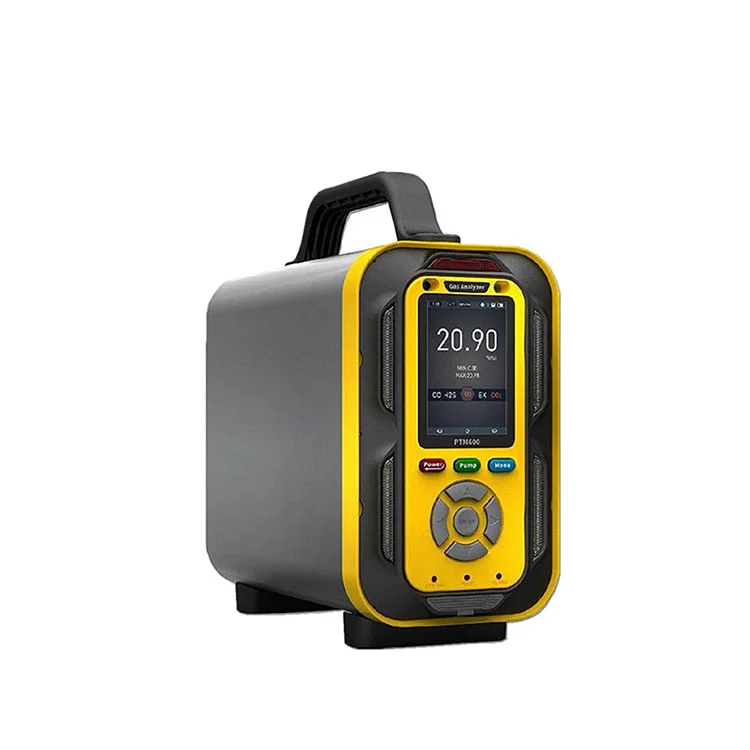
Sampling for analysis work
Interchangeable temperature sampling probes adapt the inlet to the source — ambient air, warm process gas or stack-side sampling — without rebuilding the instrument. The published range table for the platform covers combustible gas and methane across 0–100 %LEL, oxygen to 30 %Vol, carbon monoxide to 100 ppm, and a toxic set read down to 0.001 ppm resolution, with T90 response times between 10 and 30 seconds depending on the gas.
Because the PTM600 shares its sensor platform with the MS400 family, gas configurations can be planned from the same range table; the difference is channel count, sensing context and intended workflow.
Who buys it
Research and monitoring buyers use the PTM600 where a fixed analyser is impractical: pilot plants, field campaigns, temporary measurement points and teaching laboratories. OEM and ODM supply is offered for this model, including configuration for house product lines.
When inquiring, list every target gas and its expected concentration range. With up to 18 channels, the configuration is a design exercise, and a complete target list produces an accurate quotation first time.
Eighteen channels as a diagnostic method
Eighteen simultaneous gases sounds like excess until the first troubleshooting day on a process that misbehaves: a reformer drifting, a fermentation turning, an emission source that only appears when three conditions coincide. Single-gas instruments answer single questions in sequence, by which time the process has moved on. The PTM600 watches the whole panel at once, and the correlations — this rising as that falls — are usually the diagnosis. Its natural home is the route: plant to plant, stream to stream, one calibrated platform building comparable records.
The discipline of a wide-channel instrument is subtraction. Channels not relevant to the stream should be excluded from the configuration: every fitted sensor is a calibration obligation and a potential cross-sensitivity. The quotation conversation for a PTM600 is therefore a process conversation — what streams, what ranges, what else might be in the gas — and the resulting configuration is a document worth keeping with the instrument for its whole life.
Principle diversity inside one case
No single sensing principle spans ppm toxics, percent combustibles, bulk oxygen and organic vapours honestly. The PTM600's catalogue mixes principles because physics demands it: electrochemistry for the toxic traces, infrared or catalytic sensing for combustibles, photoionisation for the vapour family, dedicated cells for the bulk gases. Understanding which principle serves which channel explains both the accuracies and the maintenance rhythm — cells age on different clocks, and the service plan should be written channel by channel, not as a single annual date.
Records as the product
At over a million records, the instrument's memory outlasts campaigns. Timestamped multi-gas files become the baseline library a site builds its process knowledge on: seasonal patterns, feedstock effects, the signature of a healthy run. Engineers inherit these files; the instrument that made them may be replaced, but a well-kept record archive keeps paying. Specify the download routine — who pulls the files, where they live, how they are named — when the instrument is ordered, not after the first campaign.
Cross-sensitivity management across eighteen channels
Eighteen channels multiply the interference question: every cell answers its target and whispers to a few others, and in a complex stream the whispers can add up to a reading. The manufacturer's cross-sensitivity data is therefore a configuration document, not a datasheet ornament — channels are chosen, and their compensation set, with the stream's full composition on the table. Where two fitted channels interfere structurally, the honest answers are a different principle for one of them, a scrubber in the sample path, or a documented correction the data review applies. Instruments of this class reward owners who keep the configuration dossier alive: stream changes, sensor swaps and firmware notes all belong in it.
The same dossier disciplines calibration: which channels share a mixture, which demand single-gas spans, which are zero-only between spans. A wide-channel instrument calibrated casually is eighteen small uncertainties in a rugged case; calibrated by its dossier, it is the most truthful portable on the site.
Campaign logistics for a flagship portable
Flagship portables earn their keep on campaigns — commissioning surveys, troubleshooting weeks, baseline studies — and campaigns are logistics: charged packs and spares staged, gases and regulators confirmed at the destination, the configuration loaded and printed before departure, the download and file-naming convention agreed with whoever inherits the data. Sites that run campaigns well keep a campaign checklist for the instrument the way pilots keep one for the aircraft, because the failure that ruins a campaign is never exotic; it is the missing adapter discovered at the plant gate, three hundred kilometres from the shelf it sits on.
Glossary for wide-channel portable analysis
Channel — one gas's measurement path inside a multi-gas instrument: sensor, range, calibration and record, specified individually. Configuration dossier — the living document that records which channels are fitted, their ranges, principles, cross-sensitivities and calibration groupings, per duty. Stream — the process gas under measurement, characterised by its full composition and not only by the analyte of the moment. Matrix — everything in the stream that is not the analyte, whose interferences the configuration must answer. Scrubber — a chemical stage that removes an interfering component from the sample before the sensor. Dilution stage — the calibrated reduction that brings rich streams into span.
Campaign — a planned period of intensive measurement with its own logistics, configuration and data conventions. Baseline — the disciplined first picture against which campaigns compare. Settling time — the wait for a reading to become the stream's truth rather than the line's history. Multipoint manifold — the valved array that lets one analyser visit several streams in sequence. Calibration matrix — the plan that groups channels by shared gases and orders the bench session. Shelf configuration — the stored setup an instrument returns to between duties, from which each campaign's configuration is derived and to which it is restored.
The wide-channel instrument in commissioning work
Commissioning is the PTM600's natural season: a new unit starting up presents a dozen streams whose behaviours are unknown, interrelated and temporary, and the wide-channel portable walks them in sequence building the baseline library the plant will argue from for years. Commissioning engineers should treat the instrument's configuration as part of the commissioning dossier — which channels, which ranges, which streams, which dates — because the baselines' comparability depends on it, and because the plant's future troubleshooting will reach for those files in moments when nobody remembers the details. The instrument earns its flagship price in those moments, years after the purchase was forgotten.
The same discipline serves emissions investigations and process upsets: the wide picture, taken early, disciplines the argument about causes. Plants that own such an instrument and keep its dossier alive possess a kind of institutional memory that no single-purpose fleet can imitate.
A note on borrowing the flagship
Flagships get borrowed — by sister plants, by contractors, by the troubleshooting team two provinces away — and borrowing is where configurations and dossiers go to die. Owners should lend the instrument the way libraries lend rare books: with its dossier, its calibration matrix and a return checklist that restores the shelf configuration and downloads the campaign's data before the case is closed. The checklist takes ten minutes and is the difference between a platform and a rumour of one. Sites that institutionalise the lending ritual find their flagship more available, not less, because nobody is afraid of losing it in a drawer of somebody else's configurations.
| Gas | Range | Min. reading | T90 |
|---|---|---|---|
| Combustible (EX) | 0–100 %LEL | 0.1 %LEL | ≤10 s |
| Methane (CH4) | 0–100 %LEL | 0.1 %LEL | ≤10 s |
| Oxygen (O2) | 0–30 %Vol | 0.01 %Vol | ≤10 s |
| Carbon monoxide (CO) | 0–100 ppm | 0.1 ppm | ≤25 s |
| Carbon dioxide (CO2) | 0–500 ppm | 1 ppm | ≤20 s |
| Ozone (O3) | 0–1 ppm | 0.001 ppm | ≤20 s |
| Hydrogen sulfide (H2S) | 0–10 ppm | 0.001 ppm | ≤30 s |
| Sulfur dioxide (SO2) | 0–10 ppm | 0.001 ppm | ≤30 s |
| Nitric oxide (NO) | 0–10 ppm | 0.001 ppm | ≤30 s |
| TVOC | 0–10 ppm | 0.001 ppm | ≤30 s |
| PID volatiles | 0–10 ppm | 0.001 ppm | ≤30 s |
- Up to 18 gases measured simultaneously
- Built-in pressure sensor and temperature/humidity sensor
- Interchangeable temperature sampling probes
- Range table shared with the MS400 sensor platform
- Suited to research, university, chemistry and environmental work
- OEM and ODM supply offered
Send a target gas list, get a configuration
Quotations are built from the published parameters on this site. Tell us the gases, the ranges and the quantity — or the point schedule for a fixed project — and the reply comes back within 24 hours.
Request a quotation