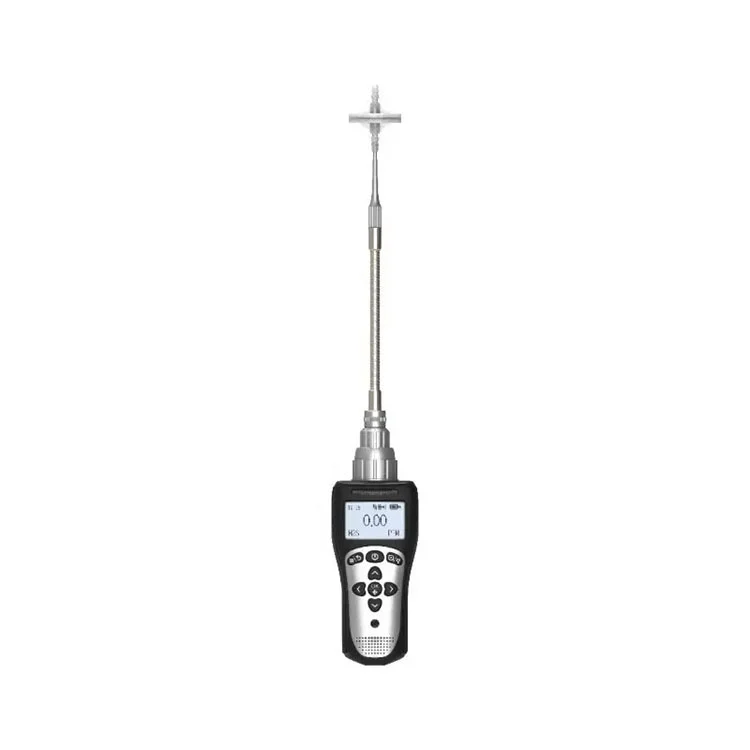
The MS400 platform reads SO2 at 0–10 ppm with 0.001 ppm resolution — the exposure-control span — while analysis and ambient instruments cover the continuous duties.
Emissions and analysis
The MIC300-F08 carries sulfur dioxide in its infrared six-gas set, measuring SO2 alongside CO, CO2, CH4, NH3 and H2S in process and emissions streams — the combination that flue and gas-processing work actually presents. Stack-side, the flue gas category covers campaign measurement of combustion sources.
Continuous emission duty belongs to CEMS-class systems; the emission monitoring guide explains where campaign instruments end and continuous systems begin.
Ambient and personal layers
The MS800A-10 ambient station includes SO2 in its pollutant panel — the fence-line and community layer, where the question is what leaves the site rather than what happens inside it. Personal and area portable monitoring covers the in-plant layer: acid plants, sulfur handling, boiler houses and any space where SO2-bearing gas can accumulate.
Electrochemical sensing serves the portable spans; infrared serves the analyzer spans. Both appear on this site in their proper tiers, and the toxic gas guide places SO2 in its family.
SO2 sources and their monitoring duties
Sulfur dioxide is what sulfur in fuel and ore becomes in fire: power stations, smelters, refineries, sulfuric acid plants and heavy-oil combustion all manufacture it, and their permits ration it. Monitoring splits accordingly — in-stack measurement at percent-to-high-ppm levels for process and compliance, and ambient measurement at ppb levels for the fence line and the town beyond. The instruments for the two scales share principles (ultraviolet fluorescence rules the ambient tier; NDIR and electrochemical cells serve in-stack and area duties) but not designs, and specifications should state the scale first, because everything else follows from it.
Area SO2: protecting people between the stack and the fence
Between the stack and the ambient network lies the plant itself, where SO2 appears at acid plants' converter floors, at sulfur-burning units, at tank and loading areas. Area points at breathing height with ppm alarms protect the workforce from the releases that never reach the stack — the flange weep, the sample point, the maintenance break-in. These points earn their keep during turnarounds, when the plant is opened up and the gas's geography is redrawn daily; personal SO2 instruments ride the crews doing the opening.
Interferences and honest SO2 numbers
SO2 measurement lives in a crowd: nitrogen oxides, hydrogen sulfide and hydrocarbons all press on the same sensors. Electrochemical cells carry cross-sensitivities that mixed plumes expose; UV fluorescence ambient analysers quench under hydrocarbons. The professional remedies are known — scrubbers and filters specified for the actual matrix, correction where the interference is quantified, and scepticism toward any single-instrument reading in a complex plume. As ever in this catalogue's discipline: know the whole atmosphere, not only the analyte on the purchase order.
SO2 specification checklist
Sulfur dioxide specifications open with scale, because the gas lives at three: workplace ppm, where electrochemical personal and area instruments serve; process and in-stack ppm-to-percent, where sampling systems and NDIR or electrochemical benches serve; ambient ppb, where ultraviolet fluorescence serves and where siting and data completeness dominate the design. Each scale then takes its standard questions — companions and interferences in the actual plume, sample conditioning for the hot wet duties, calibration gases at the decision concentrations, and the record's consumer (permit report, area alarm log, community archive). The recurring specification error is scale smuggling: asking a workplace instrument to evidence an emission, or an ambient network to protect a converter floor. The checklist's first line exists to prevent exactly that, and inquiries that write it get instruments matched to the judgement their numbers must carry.
Sulfur dioxide terms
Acid dew point — the temperature below which sulfur oxides and water condense as acid, governing stack sampling and cold-end corrosion alike. Sulfuric acid plant — the conversion of SO2 to acid, the industrial setting where the gas is a feedstock. Converter — the catalytic stage at the acid plant's heart, around which area monitoring arranges itself. UV fluorescence — the ambient-tier principle that rules ppb SO2 measurement. Plume quenching — the suppression of a fluorescence signal by hydrocarbons in the sampled air, an interference with a name and a remedy. Fence line — the plant boundary where stack numbers become community numbers.
In-stack monitoring — the measurement within the flue for process control and permit accounting. Isokinetic stack sampling — drawing the sample at the flue's own velocity so particles and gas represent the stream. Acid rain chemistry — the atmospheric conversion of SO2 to sulfate, the policy backdrop of every permit. Asthma sensitivity — the population trait that makes ambient SO2 a public-health number at concentrations industry once dismissed. Scrubber and FGD — the flue-gas desulfurisation plant whose performance the stack instruments grade. Workplace scale — the ppm country of converter floors and loading points, between the stack and the fence in every sense.
SO2 and the turnaround season
Acid plants and smelters concentrate their SO2 risk into turnarounds, when converters are opened, catalysts changed and a hundred temporary workers meet an atmosphere the regulars respect by reflex. The turnaround detection plan deserves its own page in the shutdown book: personal SO2 instruments issued like radios, area points re-sited for the opened plant's new geography, the testing and rescue arrangements briefed per crew, and the ambient network warned that the fence-line numbers will tell the turnaround's story to the neighbours in real time. Plants that write that page find their turnarounds' gas events shrinking year by year, because the plan's existence changes behaviour before a single instrument is switched on.
Reading SO2 data across the scales
A site that runs all three scales — stack, area, ambient — owns a single story told in three dialects, and should read it as one: the stack's excursion explains the fence line's afternoon; the converter floor's weeps explain the stack's baseline. Data systems that put the three on one timeline, with the wind as the narrator, turn three compliance artefacts into one process understanding. That integration is the mature form of SO2 monitoring, and it is achievable with ordinary instruments — the integration is a decision, not a technology.
SO2 and the shipping lane
Maritime sulfur rules moved SO2 measurement aboard ship and into every port's air: scrubber washwater and exhaust monitoring on vessels, ambient watching in the port cities that host them. The shipboard setting compresses this guide's three scales into one hull — stack numbers for the scrubber's verdict, area numbers for the engine room's crew, fence-line numbers for the port the ship is visiting. Instruments there live hard lives of vibration and salt, and their maintenance is a ship's-engineer discipline rather than a laboratory one. The pattern is the guide's in miniature: name the scale, fit the principle, govern the sampling, and the gas — one of industry 's oldest pollutants — is as manageable afloat as ashore.
The converter floor at 2 a.m.
Return, finally, to the workplace scale where this gas is most personal: the acid plant's converter floor on a night shift, a fitter breaking a flange on a line whose isolation is trusted but verified, the area point above the platform reading its small honest number, the personal instrument on the fitter's chest as the second witness. Everything in this guide — the scales, the principles, the interferences, the calibration gases — exists to make that small scene routine rather than memorable. When it is routine, the monitoring has done the whole of its job, and the fitter's attention is free for the work itself, which is the only thing safety instrumentation is ultimately for.
SO2's paperwork: three audiences, one archive
The stack number is read by the regulator, the area number by the workforce's representatives, the ambient number by the town — and the three audiences increasingly read over each other's shoulders. Sites serve all three by keeping one archive with one clock, so that the story told to each is the same story at different magnifications. Fragmented archives breed the suspicion that the magnifications disagree, and suspicion, once seeded in SO2 country, is a perennial. Integration is therefore not an informatics preference but a public-relations and legal strategy, purchasable for the price of a data architecture decision made once.
| Instrument | SO2 measurement | Role |
|---|---|---|
| MS400 platform | 0–10 ppm, 0.001 ppm resolution | Personal and area safety |
| MIC300-F08 | SO2 in NDIR six-gas set | Process and emissions analysis |
| MS800A-10 | SO2 in ambient panel | Fence-line monitoring |
Send a target gas list, get a configuration
Quotations are built from the published parameters on this site. Tell us the gases, the ranges and the quantity — or the point schedule for a fixed project — and the reply comes back within 24 hours.
Request a quotation