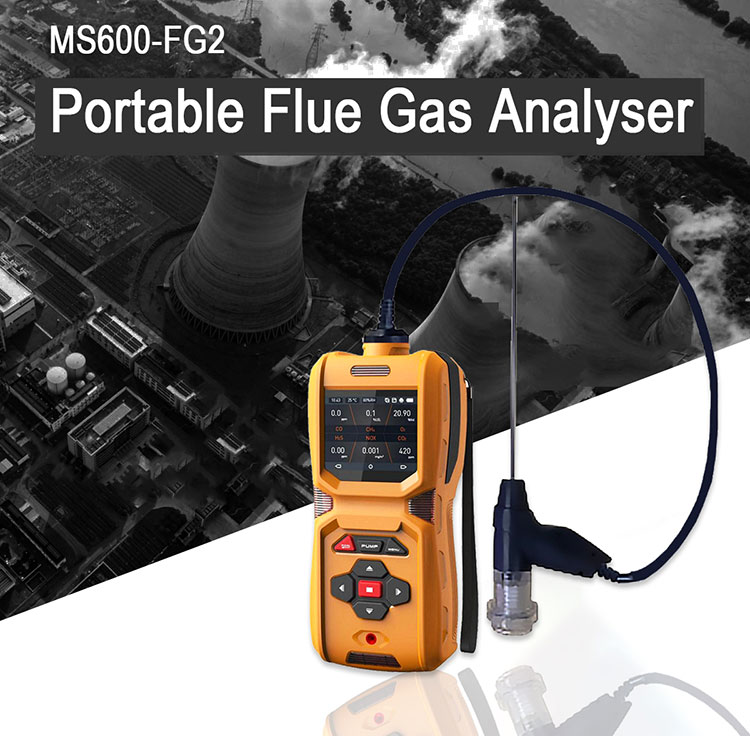
The company's published solution work includes boiler flue gas CO and O2 monitoring driving combustion optimisation; the MS600-FG2 portable is the instrument built for the tuning end of that workflow.
The tuning visit
The visit reads the flue at working load — O2, CO and the supporting channels — then adjusts burner air and fuel and reads again, converging on the efficient band where excess air is low but CO has not begun to climb. The probe and hose discipline decides whether the numbers deserve trust: the FG2's stainless cone-stop probe and kink-resistant hose are the unglamorous core of the method.
Six selectable fuels keep the combustion calculations honest across gas, oil and solid-fuel conversions; the flue gas analyzer category frames the instrument choices around the visit.
From visits to continuous duty
Where the permit demands continuous proof, the duty becomes CEMS: fixed sampling, pretreatment and reporting. Between the poles sit periodic campaigns and plant-room fixed points. The emission monitoring guide draws the regulatory line; the power plant application page shows the full stack of regimes on one site.
Excess air: the master variable
Every point of unnecessary excess air carries heat up the stack; every point of insufficient air leaves fuel unburned and makes carbon monoxide. The flue oxygen reading is the dial between those losses, and its optimum is burner-specific — found by the tuning ritual of trimming toward the CO knee and backing off by a margin, at each firing rate. Continuous oxygen monitoring with a CO override is the industrial version of the same ritual, automated: trim on oxygen, rescue on carbon monoxide. Plants that run it bank the efficiency difference every hour of every year, which is why flue-gas monitoring so often pays for a site's entire detection programme.
CO as the fault alarm
Beyond efficiency, flue CO is the combustion system's confession: rising CO at constant oxygen means something changed — a fouling burner, a damaged swirler, fuel quality drift, air leakage patterns shifting. Trended CO therefore belongs on the maintenance screen, with rises investigated as equipment findings rather than tuned away. The portable analyser's periodic survey and the fixed monitor's trend are the same instrument at two tempos, and boiler houses that use both catch faults at the 'plan the repair' stage instead of the 'failed inspection' stage.
Sampling from a hostile stream
Flue gas fights its measurement: temperature that cooks unprotected probes, acid condensate that eats lines, dust that blinds filters. Heated lines, water traps, filtration and probe materials are chosen for the specific stack, and the maintenance rhythm — trap drained, filter changed, line leak-checked — is what the readings are worth. Emissions reporting adds the metrology layer: reference-method comparisons, drift checks and availability accounting that make the data defensible to the regulator. None of it is glamorous; all of it is the difference between monitoring and theatre.
The boiler house monitoring plan, assembled
One page assembles the boiler house: combustion diagnosis by periodic portable analysis against per-burner baselines, continuous oxygen (with CO where the plant's scale justifies it) for the trim and trend, room protection by fixed CO and fuel-gas points interlocked with ventilation, personal instruments for the maintenance crews, and the emissions layer where the permit requires it. Each element is unremarkable; the plan is the achievement, because boiler houses accumulate instruments by incident and by era until nobody can say what watches what. The periodic exercise of redrawing the plan — instruments, duties, calibration owners, record consumers — costs a day and returns a boiler house whose monitoring can be explained to an inspector, an insurer and a new shift engineer in the same words.
Boiler monitoring terms
Trim control — the automatic adjustment of combustion air against flue oxygen, with CO as its override conscience. Firing rate — the burner's load, across whose range the tuning must be verified point by point. Air leakage — the infiltration into flue and air paths that falsifies oxygen readings and wastes fan power. Cold-end corrosion — the acid attack where flue gas meets cool surfaces, governed by dew point discipline. Sootblowing — the cleaning of heat-exchange surfaces, whose cycle appears in the emissions trend. Opacity — the visible plume measure that older permits still speak, companion to the gas numbers.
Baseline tuning record — the per-burner document of oxygen, CO and NO at each firing rate, against which seasons and services are compared. Portable survey — the periodic analyser visit that audits the continuous instruments and tunes what they cannot. Burner management system — the flame safeguard whose world touches the gas instruments at every start. Purge cycle — the pre-ignition air sweep whose adequacy is a measurement as much as a timer. Fuel variability — the delivery-to-delivery drift that flue trends expose before efficiency reports do. Seasonal recommissioning — the retuning that air density's annual swing quietly demands.
The boiler house's complete picture
Assemble the boiler house's whole story once: the flue instruments narrate combustion's health, the room instruments guard the people who tend it, the fuel instruments price its appetite, and the emissions instruments testify to the neighbourhood. Read together — ideally on adjacent screens, certainly in the same review — the four narrations explain each other: the efficiency dip and the CO creep are one fouling event; the room alarm and the flue's story are one burner fault seen from two sides. Plants reach that integrated reading by intention, usually after an incident has demonstrated the cost of reading in silos. The guide's recommendation is to buy the intention earlier, while it is still cheap: it costs a data architecture and a meeting, and it returns a boiler house that can be understood whole.
The flue's testimony at the planning inquiry
Boiler plant increasingly testifies in public: a school's new boiler house, a hospital's energy centre, a district scheme's expansion — each drawing neighbours' questions that flue data, honestly kept, answers better than assurances. The operator who can produce a burner's tuning baselines, the continuous trend through a winter, the service record that ties them together, speaks a language planning committees find persuasive precisely because it is boring. Flue-gas monitoring thus ends where emission monitoring ends: as public language, whose credibility is manufactured daily at the sampling port by routines nobody applauds. The routines are the reputation; the instruments are merely where the routines live.
The boiler house's season ticket
Give the boiler house a season ticket of measurements: the autumn recommissioning survey that sets the winter's baselines, the mid-winter check that catches fouling while it is still cheap, the spring review that writes the summer maintenance list from evidence. The rhythm converts flue monitoring from a series of visits into a subscription to the plant's own condition, and the subscription's price — three disciplined encounters a year — is repaid the first time a burner fault is met as a scheduled repair rather than as a January failure with tenants or patients attached. Instruments age, burners drift, seasons turn; the ticket is how a boiler house stays ahead of all three.
Flue gas and the neighbour's chimney
One last scale deserves the guide's courtesy: the small combustion plant of the school, the clinic, the housing block, where the flue's audience is a caretaker and its instruments are a portable analyser in a visiting technician's case. The disciplines do not shrink with the plant — the knee is still the knee, the baseline still the baseline, the condensate still eats the unprepared sample line — and the technician who serves small plant carries the whole of this guide in one person's habits. Small plant deserves the same honesty as large, and largely gets it, because the visiting technician's reputation is the monitoring programme, walking from boiler house to boiler house with the analyser as its credentials.
Send a target gas list, get a configuration
Quotations are built from the published parameters on this site. Tell us the gases, the ranges and the quantity — or the point schedule for a fixed project — and the reply comes back within 24 hours.
Request a quotation