Combustion tuning is a balance: too much excess air wastes fuel up the stack, too little makes carbon monoxide. A portable analyzer that reads the flue directly lets the technician adjust, re-read and converge in one visit.
Probe and hose hardware
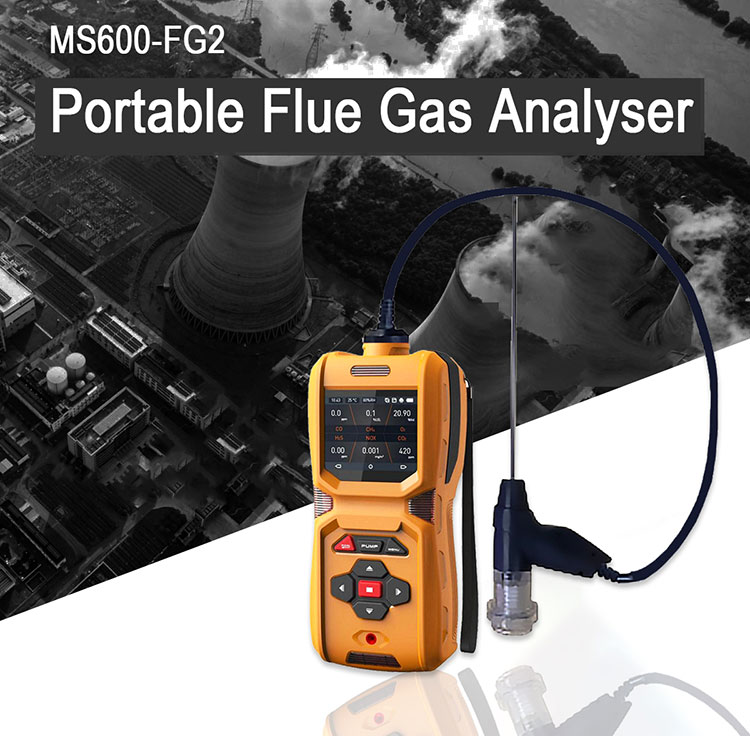
The sampling train is built for hot, awkward access points: a kink-resistant integrated hose that survives being dragged around plant rooms, and a stainless steel probe with a cone-stop that seats repeatably in the flue port. These details decide whether a reading is trusted — a leaking or kinked sample line dilutes the flue gas and fakes a lean mixture.
Six selectable fuels are stored in the instrument, so the combustion calculations follow the fuel actually being burned rather than a generic assumption.
Applications
Residential and commercial furnace, boiler and water-heater tuning is the published home ground, and the same kit serves industrial burner servicing, commissioning checks after burner replacement, and energy audits comparing before-and-after flue readings.
The MS600-FG form appears in the company's own solution writing for boiler flue gas carbon monoxide and oxygen monitoring driving combustion optimisation; the FG2 on this page is the portable analyzer build for that workflow. The shop-listed MS700 FG is a separate high-temperature-probe model and is not merged with the FG2 here.
The tuning session, step by step
A burner tuning session with the FG2 follows the physics of combustion. Start from a stable firing rate; let the flue temperature settle; read oxygen first, because excess air frames everything else. Trim air down in small steps and watch carbon monoxide: the CO curve stays flat, then breaks sharply upward at the point where air runs short — the knee. Set the working point a deliberate margin above the knee, verify at high and low firing rates, and record the pair of readings as the burner's new baseline. Repeat visits compare against that baseline; drift tells the maintenance story before efficiency visibly suffers.
Nitric oxide rides along in the same session because burner adjustments move it: the low-NOx techniques that suppress flame temperature also narrow the stable operating window, and a burner tuned for emissions alone can be a burner that trips. Reading O2, CO and NO together keeps the three-way balance — efficiency, stability, emissions — in one pair of hands.
Flue measurement hygiene
The probe lives in a hostile stream: hot, wet, acidic, soot-laden. Filters and water traps are not accessories but the instrument's lungs, and the session routine — trap drained, filter checked, line leak-tested — decides whether the numbers are the burner's or the sampling system's. A leaking sample line dilutes with room air and flatters oxygen while hiding carbon monoxide; the leak test takes a minute and invalidates nothing. End the session by purging the instrument with clean air so condensate does not spend the night in the cells.
Gas-fired, oil-fired and the tuning differences
Fuel changes the tuning conversation. Gas burners run clean and responsive, their CO knee sharp and their optimum excess air low; oil burners bring soot, sulfur and a wider, softer knee, with filter loading and probe fouling as the session's tax; solid-fuel and biomass appliances add moisture swings and particulate burdens that make sampling hygiene the main event. The FG2's electrochemical set serves all three, but the session plan differs: gas work is trim-and-verify across the firing range, oil work adds soot management and longer settling, biomass work begins with the sample path. Technicians who tune across fuels carry those plans as habit, and the instrument's session records — one per burner, dated — become the appliance's service history in miniature.
Seasonal drift is the quiet argument for the records: burners tuned in winter's dense air behave differently in summer, fuel deliveries vary, fouling accumulates between services. A baseline per burner per season, measured on the same instrument with the same routine, converts arguments about efficiency into readings of a chart — and charts are what energy budgets are defended with.
Safety interlude: the flue is also an atmosphere
Boiler houses concentrate the FG2's gases in the room as well as the flue: carbon monoxide from faulty combustion, fuel gas from train leaks. The technician tuning at the sampling port is standing in the plant room this catalogue's fixed-detection guide describes, and the professional kit for flue work therefore includes the personal multi-gas instrument alongside the analyser. It is a small symmetry worth teaching: the flue instrument diagnoses the burner; the personal instrument guards the diagnostician.
Glossary for flue-gas work
Excess air — the combustion air beyond the stoichiometric requirement, read from the flue oxygen and priced in wasted heat. Stoichiometric — the exact air at which fuel and oxygen would consume each other completely, the reference point of every tuning conversation. CO knee — the firing condition at which carbon monoxide breaks sharply upward as air is trimmed, marking the boundary of safe economy. Lambda — excess air expressed as a ratio to the stoichiometric quantity, the burner's tuning dialect across Europe. Flue gas recirculation — the return of cooled exhaust to the flame to suppress nitrogen oxide formation, at a stability price the tuning must respect. Dew point corrosion — the acid condensation that attacks cold-end surfaces when flue gas falls below its acid dew point.
Soot number — the filter-paper darkness scale by which oil combustion's particulate manners are judged. Draught — the pressure difference that moves flue gas, measured where it explains burner behaviour. Heat losses, dry — the stack loss carried by hot dry gas, the efficiency term excess air inflates. Heat losses, wet — the stack loss carried by water vapour from the fuel's hydrogen and moisture. Net and gross efficiency — the two accounting conventions whose difference is the vapour loss, and whose confusion has ended many a sales argument. Sampling port — the flue access point whose position across the duct decides whether the sample represents the stream or its wall.
The service company's instrument
For the heating and combustion service trade, the flue analyser is the business in a case: it diagnoses, it tunes, it evidences, and its printout or file is what the customer keeps. Service firms should therefore choose and manage it as a revenue instrument — calibration currency as a marketing fact, per-burner baselines as the firm's memory of every appliance it touches, session records filed against the customer's asset register so that any technician can inherit any boiler. The FG2's multi-gas set suits that trade exactly because the modern service visit is an emissions visit as much as an efficiency one, and the firm that arrives able to speak to both, from one instrument's records, is difficult to compete with.
What good flue data does to a maintenance contract
When flue baselines exist, maintenance stops being calendar theatre: the burner whose CO creeps across three visits gets its combustion chamber opened on evidence; the burner that holds its numbers earns a longer leash; the contract's price can be argued from the fleet's actual condition rather than from habit. Energy managers learn to ask for the baselines at tender, and service firms learn to keep them like accounts. The analyser is the small machine at the centre of that change in manners, which is a larger role than its size suggests.
- Gas capacity
- 1–6 gases simultaneously
- Platform library
- More than 500 gas types
- Typical tuning pair
- O2 and CO in flue gas
- Hose
- Kink-resistant integrated hose
- Probe
- Stainless steel probe with cone-stop
- Fuels
- Six selectable fuels
- Work
- Furnace, boiler and water-heater tuning
Measurement
Sampling train
Combustion setup
- One to six gases for flue and combustion work
- Kink-resistant hose and stainless cone-stop probe
- Six selectable fuels for correct combustion maths
- Built for burner tuning and commissioning visits
Send a target gas list, get a configuration
Quotations are built from the published parameters on this site. Tell us the gases, the ranges and the quantity — or the point schedule for a fixed project — and the reply comes back within 24 hours.
Request a quotation