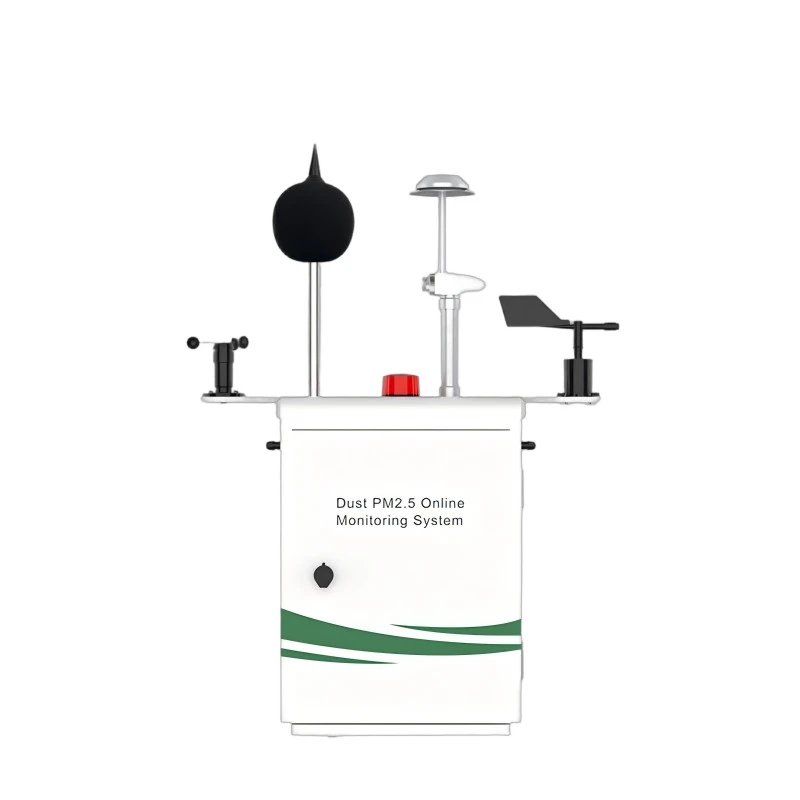
The gaseous panel spans PM2.5, PM10 and TSP particulates; nitrogen dioxide, sulfur dioxide, ozone and carbon monoxide; hydrogen chloride, hydrogen sulfide, oxygen, VOCs and ammonia; carbon dioxide — plus temperature, humidity, wind speed and direction, and atmospheric pressure.
From measurement to warning
Data flows to the cloud continuously, with real-time early warning and exceedance alarms, so the station is an alerting system rather than a logger nobody reads. That behaviour is what industrial parks, plant fence lines and municipal networks actually buy: the moment a parameter crosses its line, the responsible team knows.
A deployment case from the company's own reporting runs an MS800A station in a Philippines industrial park — the classic fence-line role, watching the boundary between industry and its neighbours.
OEM and project supply
OEM and ODM supply is offered for the MS800A-10, and the modular construction suits project integrators who deliver monitoring networks under their own programmes. When you inquire, list the parameters, the number of stations and the data destination (cloud platform, local server or regulator feed) so the module set and transmission build are quoted correctly.
Building a station around ten channels
A monitoring station is a small system pretending to be an instrument: analysers, sampling manifold, calibration gases, data logger, telemetry, shelter climate control. The MS800A-10's ten-channel breadth — criteria gases, combustion gases, hydrocarbons and particulates in one platform — reduces the integration burden by keeping the measurement core in one product family. The buyer's specification should still name the system around it: sample inlet height and location, calibration regime per channel, data path to the regulator's or the network's format, and the uptime expectation that the maintenance contract will be judged against.
Channel discipline applies with force: ten available channels do not oblige ten subscriptions. Every channel is a calibration gas, a consumable stream and a data-quality obligation. Stations that measure the six channels their permit names, well, outperform stations that measure ten channels indifferently — data completeness statistics are part of compliance, and an unreliable channel is worse than an absent one.
From station data to decisions
Ambient data earns its keep in three places: compliance reporting against the permit, episode detection when concentrations climb toward action levels, and trend evidence for planning — whether a new source can be accommodated, whether traffic measures are working. RS485 integration feeds the data systems that serve all three. Buyers should specify the outputs by naming the consumer — the report, the alarm, the archive — because a station configured for its audience delivers from commissioning day, while a generic station gets re-configured for a year.
Calibration regimes for a ten-channel station
A multi-gas station's calendar is a braid: zero checks flowing automatically where the design allows, span calibrations per channel on their own intervals, multipoint audits on the regulatory rhythm, and the consumables — permeation sources, cylinder gases, filters, pump parts — stocked against that calendar rather than against memory. The data system should carry the calendar and complain when it slips, because completeness statistics punish a station whose channels drop out in rotation. Buyers evaluating station proposals should ask for the calendar in writing; a supplier's calibration plan is the truest preview of the station's third year.
Co-location and transfer standards deserve their budget line: a station's numbers inherit their credibility from comparisons — against reference stations at commissioning, against transfer standards on a cycle. Skipping them does not make the station wrong; it makes it undefended, which in regulatory company amounts to the same thing at the worst moment.
Siting: the decision that outlives the hardware
Analysers are replaced; sites are forever. The inlet's height, its distance from roads, stacks, trees and walls, the representativeness of its airshed for the population or the permit it serves — these decide what the station's data means, and no analyser quality can redeem a site that samples a wall's lee or a car park's exhaust. Siting documentation — photographs, obstruction surveys, the rationale against the network's objectives — belongs in the station's founding dossier, defended at procurement with the same vigour as the instrument list, because in ten years the dossier is the only witness to why the numbers mean what they claim.
Glossary for ambient monitoring stations
Criteria pollutants — the regulated set whose concentrations define ambient compliance in most regimes: the particles, ozone, nitrogen dioxide, sulfur dioxide, carbon monoxide family. Reference method — the designated measurement technique against which a station's equivalence is established. Equivalence — the demonstrated comparability of a working method to the reference, evidenced by co-location data. Co-location — running two instruments on the same air to compare them, the station world's cross-examination. Sample inlet — the station's nose, whose height and surroundings decide what population or permit the data represents. Data capture — the fraction of scheduled measurements validly obtained, compliance's quiet second statistic.
Span drift — an analyser channel's slow departure from truth between calibrations, caught by scheduled challenges. Zero air — the scrubbed gas against which baselines are set. Permeation source — the temperature-held device that emits a calibration gas at a known rate for low-level spans. Telemetry — the data path from station to network centre, whose buffering decides whether outages become gaps. Quality flag — the mark that quarantines suspect data without deleting it, preserving the audit trail. Airshed — the volume of air a station's readings can honestly speak for, defined by terrain, sources and the network's design.
The station as a citizen of its network
Few stations work alone: they belong to networks — a regulator's, a city's, an industrial group's — and network membership imposes data manners: common formats, common quality flags, synchronised clocks, calibration traceability that lets one station's numbers be compared with another's without apology. The MS800A-10's integration interfaces are its citizenship papers, and procurement should test them against the network's actual requirements rather than a generic protocol list. A station that cannot speak the network's dialect is an island with excellent instruments, and islands do not produce the spatial picture that is the network's whole reason to exist.
Reading a station's year
A station's annual review is a small ceremony worth institutionalising: availability per channel, drift history, the calibration audit's findings, the episodes captured and the episodes missed, the site's own changes (a new road, a felled tree line, a neighbour's new stack) that alter what the inlet sees. The review's output is next year's maintenance and the network's metadata, updated while the knowledge is fresh. Stations that hold the ceremony age into institutions; stations that skip it age into furniture with data cables.
- Particulates
- PM2.5, PM10, TSP
- Gases
- NO2, SO2, O3, CO, HCl, H2S, O2, VOC, NH3, CO2
- Meteorology
- Temperature, humidity, wind speed, wind direction, atmospheric pressure
- Set
- Particulate module, gaseous module, meteorological module, video module, data acquisition and wireless transmission module
- Selection
- Free parameter selection per station
- Upload
- Cloud upload
- Alerting
- Real-time early warning; exceedance alarm
Parameters
Modules
Data behaviour
- Modular station: particulates, gases, meteorology, video
- Sixteen-plus parameters with free selection
- Cloud upload with real-time exceedance alarms
- OEM and ODM supply for project integrators
Send a target gas list, get a configuration
Quotations are built from the published parameters on this site. Tell us the gases, the ranges and the quantity — or the point schedule for a fixed project — and the reply comes back within 24 hours.
Request a quotation